

Wireless Site Survey Antelope Valley — Ekahau predictive, onsite, and validated
A Antelope Valley site survey from WiFi Hotshots — delivered fixed-fee with Ekahau AI Pro and ECSE-certified engineers — is the same engagement as a Antelope Valley wireless site survey, with the wireless scope made explicit in the SOW. Ekahau ECSE certified engineers deliver every Antelope Valley wireless site survey as a fixed-fee SOW — 60-minute dispatch from our Valencia HQ to Palmdale and Lancaster for aerospace hangars, regional hospitals, K-12 districts, and wind-farm operations.
WiFi Hotshots is a vendor-agnostic enterprise network engineering firm serving enterprise customers, enterprise architects, infrastructure buyers, and network engineering teams across the Antelope Valley, the High Desert, and greater Southern California.
Ekahau ECSE — Certified Survey Engineer on every engagement
Multi-CCIE engineering bench
Fixed-fee SOW — no T&M surprises
25 years of enterprise networking leadership
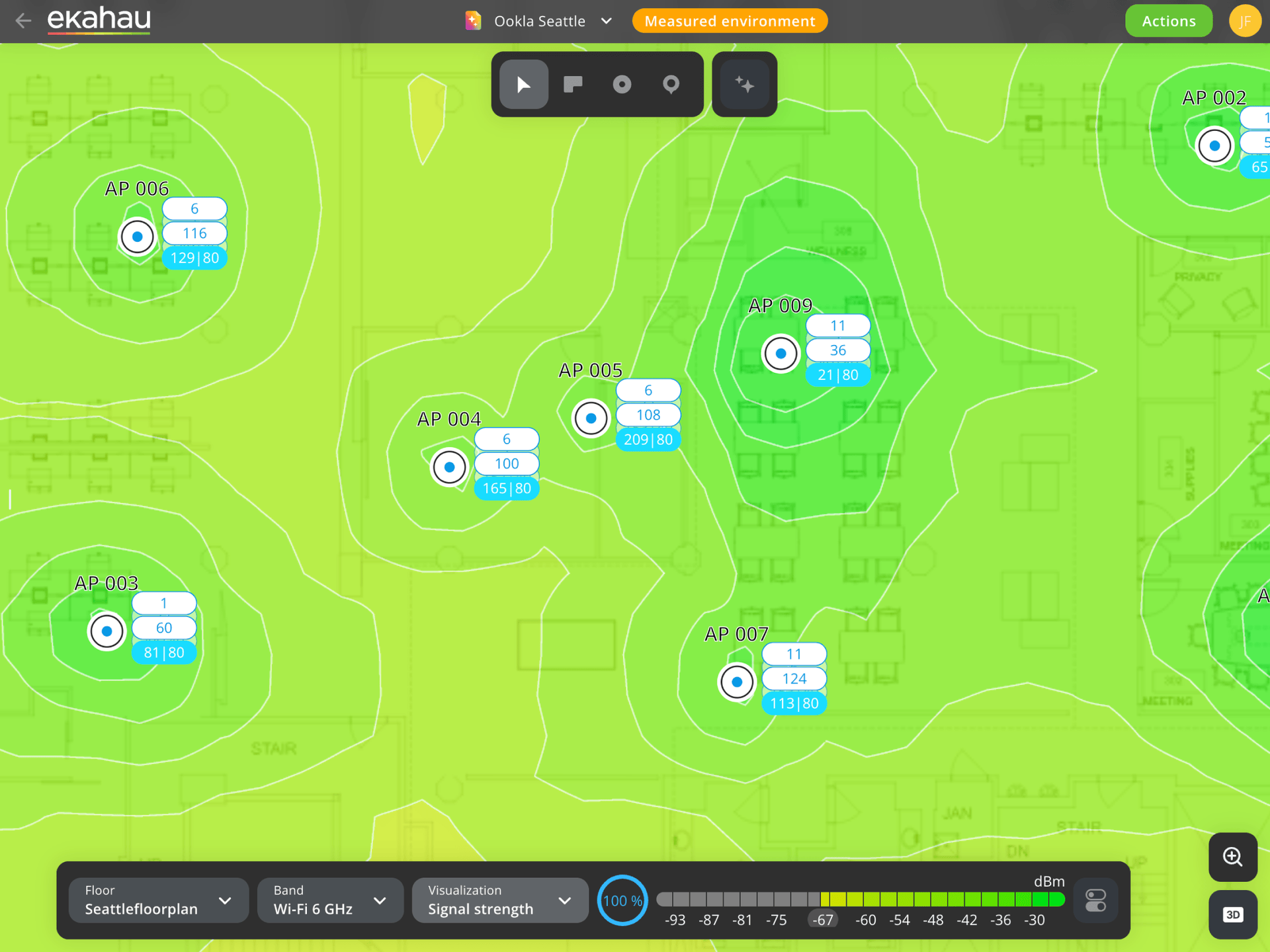
An Antelope Valley wireless site survey from WiFi Hotshots starts with Ekahau predictive modeling and closes with post-install validation heatmaps — every engagement a fixed-fee SOW, not hourly billing.
We cover the full AV footprint from our Valencia HQ on a 60-minute dispatch to Palmdale and Lancaster: sheet-metal hangar shells at USAF Plant 42 (Boeing, Lockheed Martin Skunk Works at Site 10, Northrop Grumman), clinical corridors at Antelope Valley Medical Center and Palmdale Regional Medical Center, CMU-block classroom buildings across Antelope Valley Union High School District, Palmdale School District, and Lancaster School District, pre-engineered metal warehouse shells on the CA-14 corridor, and wind-farm operations across the Tehachapi Pass. See the enterprise wireless services overview, the full enterprise network services portfolio, our engineering credentials and certifications, or send us your floor plans to start a scope call.
Why Antelope Valley Wireless Survey Projects Fail Without an RF Baseline
Antelope Valley building stock is not generic. The aerospace corridor around USAF Plant 42 and along Sierra Highway carries welded steel-frame hangar shells with corrugated sheet-metal roof decking and rolling hangar doors — assemblies that produce 20-plus-dB shadow zones and multipath fading patterns that invalidate predictive models tuned to drywall-and-stud office stock. The CA-14 (Antelope Valley Freeway) warehouse corridor is dominated by pre-engineered metal buildings (PEMBs) with metal pallet racking that creates signal voids invisible to a flat-floor predictive model — in racked zones, density often climbs from the open-floor rule of thumb of 1 AP per 3,000–4,000 sq ft to 1 AP per aisle.
CMU-block K-12 construction across AVUHSD, Palmdale School District, and Lancaster School District attenuates 5 GHz by 15–25 dB per wall, which means hallway-only AP plans fail at 30 Chromebooks per classroom. Desert thermal exposure — Lancaster tied its all-time record of 115°F on July 10, 2024, Palmdale hit 115°F on July 6, 2024 — drives AP enclosure thermal derating that a generic SoCal survey workflow will not catch.
Deploying APs without a measured RF baseline means your channel plan is built on assumptions, not data. When a Zebra scanner drops association mid-aisle in a Palmdale PEMB warehouse or a Vocera B3000n badge holds to a ‑82 dBm AP three rooms away on an AVMC patient floor, the root cause is always the same: the pre-deployment work was skipped or compressed.
An enterprise wireless site survey in the Antelope Valley is not optional for complex environments — it is the engineering step that separates a network that works from one that generates tickets. The design target for a general enterprise data environment is a minimum ‑67 dBm RSSI at cell edge with at least 25 dB SNR. For voice-grade networks — Vocera Smartbadge, Spectralink, Ascom — those targets hold, and you add a 15–20% cell overlap requirement at the ‑67 dBm boundary to support fast BSS transition under 802.11r.
For RTLS-grade asset tracking at AVMC or Palmdale Regional (Centrak, Stanley, AiRISTA tag ecosystems), the effective coverage floor rises to ‑65 dBm primary with at least three APs visible at any tracked location for 10-meter accuracy. None of those thresholds can be confirmed by looking at a floor plan. They require measurement.
Ekahau Predictive Survey Methodology: Floor Plan Ingestion to AP Placement Map
Every WFHS engagement begins in Ekahau AI Pro, the design and analysis module within the Ekahau Connect platform. The workflow starts with floor plan import at measured scale — either CAD-exported PDF or a photographed as-built drawing re-scaled to a known distance. Wall types are assigned material attenuation values: glass, drywall, CMU, poured concrete, concrete with rebar, corrugated sheet-metal, and steel truss each carry different dB-per-meter loss figures.
For sheet-metal hangar shells at Plant 42 and along the Sierra Highway aerospace corridor, the model requires a sheet-metal attenuation assignment rather than a generic metal value, because corrugated steel roof decking creates waveguide effects and standing-wave patterns that a flat dB/m assumption misses. For PEMB warehouse construction on the CA-14 corridor, metal pallet racking is modeled as a separate attenuation layer because rack density drives AP count independently of building shell geometry.
Once the floor plan is calibrated, the predictive engine runs AP placement simulations against the design requirement profile — coverage at ‑67 dBm RSSI, channel plan, and secondary-AP overlap for 802.11k neighbor list population. The output is an AP count per floor with placement coordinates and a draft bill of materials.
For Antelope Valley deployments, predictive design typically covers 1,200–2,000 sq ft per AP on 5 GHz and 6 GHz radios in open-plan office environments and 2,500–4,000 sq ft per AP in open-floor PEMB warehouse space. High-density spaces — classrooms at AVUHSD’s eight traditional high schools with 1:1 Chromebook or iPad density, AVC lecture halls, AVMC med-surg patient floors — require tighter placement intervals driven by client count and MOS score targets rather than coverage radius alone.
Predictive survey is accurate for standard construction. On atypical AV materials — corrugated sheet-metal hangar roofs, welded steel truss hangar frames, metal pallet racking at density, CMU-block classroom walls, lead-lined imaging suites at AVMC and Palmdale Regional — the predictive model flags uncertainty zones that require an AP-on-a-Stick validation pass before hardware procurement. For large-volume hangars at Plant 42 (12,001-ft and 12,002-ft runway-adjacent facilities with 80–120 ft ceiling heights in select bays), 3D-volume calibration is mandatory because signal behavior at mezzanine working height (18 ft AGL) differs materially from signal at ground level (5 ft AGL).
- AP count per floor with X/Y placement coordinates exportable to AutoCAD or PDF overlay
- Channel plan: 2.4 GHz channels 1/6/11 for coverage; 5 GHz 20/40/80 MHz assignments per zone with DFS exposure noted for UNII-2A and UNII-2C channels near Edwards AFB and Palmdale Regional Airport; 6 GHz LPI channel selection for Wi-Fi 6E and Wi-Fi 7 APs (indoor LPI class, no AFC required per FCC Part 15 Subpart E; outdoor standard-power requires AFC)
- Per-band heatmap exports showing RSSI, SNR, secondary coverage (802.11k), and co-channel interference overlay
AP-on-a-Stick Validation for Antelope Valley Venues: Aerospace, Medical, and School Buildings
AP-on-a-Stick (APoS) methodology mounts a production-model AP on a telescopic pole at the intended deployment height — typically 12–18 ft for ceiling-tile environments, 25–40 ft for PEMB high-bay and aerospace hangar conditions, and up to 60–80 ft for the tallest Plant 42 hangar bays where AP mounting must clear overhead crane travel. The Ekahau Sidekick 2 attaches to the survey laptop via USB-C and runs four tri-band radios scanning 2.4, 5, and 6 GHz simultaneously at 50 sweeps per second across the full 2,400–7,125 MHz range.
The surveyor walks the floor while the Sidekick 2’s nine custom 3D antennas record passive RF measurements at every point — RSSI, SNR, noise floor, and co-channel interference — across every visible AP. That measurement data overwrites the predictive model where they differ, producing a hybrid design that combines simulation efficiency with field accuracy.
Antelope Valley venues that mandate APoS rather than predictive-only include any facility where drawings do not reflect reality. Aerospace hangars at Plant 42 and around Palmdale Regional Airport (PMD, joint-use with USAF Plant 42) have 30–120 ft ceilings with moving overhead crane bridges and parked airframes that reconfigure the RF environment daily — a survey of an empty hangar produces a different coverage map than the same hangar with a wide-body test article blocking 40% of the floor.
Clinical floors at Antelope Valley Medical Center (420 licensed beds) and Palmdale Regional Medical Center (184 licensed beds) carry infection-control constraints on above-ceiling access that require cable routing to be confirmed before the first AP is mounted; lead-lined imaging suites boundary as RF-opaque zones on the heat map.
K-12 buildings across AVUHSD (approximately 23,000 students grades 9–12 across 8 traditional plus 3 alternative high schools), Palmdale School District (approximately 17,935 K-8 students across 28 schools), and Lancaster School District, many constructed with CMU-block exterior walls and central corridor layouts, need room-by-room passive validation to confirm that a hallway-only AP plan holds signal at the back of a 30-seat classroom — it rarely does. These institutions are referenced as venue archetypes, not as claimed engagements.
- Aerospace and industrial: aisle-by-aisle attenuation capture through steel racking and sheet-metal shells; directional antenna modeling for above-rack coverage zones; 3D-volume calibration for hangar bays with 30–120 ft ceilings at Plant 42 and Sierra Highway facilities
- Healthcare: infection-control ceiling-plenum constraints confirmed before cable pathways are routed; lead-lined imaging suite boundaries flagged as RF-opaque zones requiring AP relocation; VoWLAN handset roaming exercised on Vocera B3000n, Versity 92, Spectralink, and Ascom form factors at AVMC and Palmdale Regional Medical Center footprints
- Education: 1:1 device density planning per AVUHSD, Palmdale SD, and Lancaster SD classroom; roaming validation across wing transitions in CMU-block buildings where hallway APs alone are insufficient at the back of a 30-seat room; E-rate FY2026–2030 Category 2 documentation formatted for USAC submission
Floor plans and device counts are all we need to scope the work — most Antelope Valley engagements are quoted on a fixed-fee SOW within three business days of a 30–60 minute scoping call.
Passive and Active Validation: Throughput, Roaming, and Voice MOS Testing
A passive survey records every RF signal in the environment without associating to any SSID. The Ekahau Sidekick 2 listens — it measures what the air contains, not what a connected session reports. Passive surveys are used for pre-deployment environment assessment (neighbor AP inventory, noise floor, DFS radar event detection) and for post-install coverage confirmation. DFS event rates in the Antelope Valley are not generic.
Edwards Air Force Base sits immediately north of the Palmdale/Lancaster cities and controls the R-2515 restricted airspace (~1,812 sq mi) nested within the larger R-2508 National Test Range Complex (~19,600 sq mi) — the densest military test-radar environment in the contiguous United States. UNII-2A and UNII-2C channels see measurably higher radar-event rates near Edwards, Plant 42, and Palmdale Regional Airport than in generic SoCal metro locations; DFS channel selection in production requires field-validated radar-event logs, not an out-of-box DFS enablement.
Validate DFS exposure with field measurement before enabling DFS channels in production. The output is a heatmap for every band, every floor, at every survey waypoint — color-coded RSSI, SNR, and secondary coverage for 802.11k neighbor list validation.
Active validation associates to the production SSID and measures what the client actually experiences. iPerf3 bidirectional throughput runs confirm uplink and downlink capacity against the designed channel width. Roaming tests exercise 802.11r fast BSS transition — the protocol is designed to shorten roaming interruptions, and 50 ms or less is the accepted voice-grade handoff target that 802.11r was built to support. Active testing with a roaming test client confirms whether the deployed controller configuration actually achieves it or whether a misconfigured minimum RSSI threshold is stalling the handoff.
For voice-over-Wi-Fi migration engagements — Cisco Webex Calling, CUCM, or Teams Phone — the active test also captures a MOS (Mean Opinion Score) trace across the full walking route. A voice-grade network targeting MOS 4.0+ requires the ‑67 dBm RSSI and 25 dB SNR thresholds to hold at cell edge without exception. Any area that drops below those targets appears as a gap in the post-install validation report, with a remediation recommendation tied to a specific AP or configuration change. The independent post-install validation report is the deliverable your operations team, auditor, or next engineer can pick up without context.
Antelope Valley Market Constraints: Aerospace RF Environments, Desert Thermal, and DFS Radar
Aerospace Sheet-Metal Hangar Shadowing at Plant 42 and Sierra Highway
The Antelope Valley aerospace corridor centers on USAF Plant 42 in Palmdale — a government-owned, contractor-operated (GOCO) facility spanning more than 5,800 acres of Mojave Desert land with approximately 3.2 million sq ft of industrial space served by two 12,001/12,002-ft concrete runways (04/22 and 07/25). Plant 42 houses Boeing, Lockheed Martin Skunk Works (Site 10), and Northrop Grumman Palmdale operations including B-21 Raider production, and any Antelope Valley wireless site survey that touches these tenant campuses has to account for the sheet-metal hangar RF stack those buildings impose.
Hangar shells are welded steel frame with corrugated sheet-metal roof and sidewalls. Sheet-metal creates 20-plus-dB shadow zones; outdoor-to-indoor signal propagation is severely attenuated, which means an outdoor AP reaching in from a pole mount does not cover the hangar floor — dedicated indoor APs at deployment height are required.
Large open-bay hangars with 30–120 ft ceilings and moving overhead crane bridges add another layer: AP mounting has to clear crane travel height or the crane itself blocks the signal when it moves. Outdoor apron and ramp coverage is a separate design with outdoor-rated APs.
Secure-facility portions of Plant 42 tenant campuses, Edwards AFB internal wireless, and Northrop Grumman controlled-environment work are out of scope for commercial site survey integrators — SAP, SCIF, CJIS-adjacent, and DoD-internal wireless infrastructure routes through cleared integrators on base-CIO or 412th Communications Squadron channels, and WFHS declines that scope at intake. This scope boundary is a deliberate E-E-A-T move: we surface the limit rather than pretend it does not exist.
Desert Thermal Stress on Outdoor AP Enclosures and IDF Closets
Lancaster and Palmdale both broke all-time high-temperature records in July 2024 — Lancaster tied 115°F on July 10, 2024, Palmdale recorded 115°F on July 6, 2024 and 114°F on July 10, 2024. A black or dark-colored outdoor AP enclosure in direct Mojave sun at 115°F ambient can reach internal enclosure temperatures 15–25°C above ambient, which puts an AP spec’d to 65°C near or above its derated Tmax.
These conditions are why every Antelope Valley wireless site survey that scopes outdoor APs across Lancaster, Palmdale, or Quartz Hill opens with a thermal-derating pass tied to specific AP model datasheets, not a generic 65°C Tmax assumption. AP model selection drives the outdoor design.
The Cisco IW9167E Heavy Duty is rated -40° to 70°C (-40° to 158°F) operating temperature with IP67 ingress protection ; the Meraki CW9163E is rated -40° to 65°C (149°F) without solar derating (55°C with solar derating) and IP67 with 100 mph sustained / 165 mph gust wind rating ; the HPE Aruba AP-577 is rated -40° to 65°C (149°F) with full solar loading and IP66/67 .
AP-577 is the strongest solar-rated of the three because the spec includes full solar loading at 65°C rather than listing it as a derating. Mitigations for AV outdoor AP placement: mount on the north side of structures, prefer IR-reflective or light-colored enclosures, and plan for 55°C as the real-world summer-afternoon ceiling. IDF room thermal is the second half of the problem — indoor closets hosting switches and APs must meet ASHRAE TC 9.9 Class A2 minimum (10–35°C / 50–95°F allowable; 18–27°C recommended).
In AV warehouses without active IDF cooling, summer interior temperatures routinely exceed 35°C; WFHS IDF thermal assessment is scoped as part of the survey engagement when relevant, and cabling infrastructure review with PoE capacity validation is added to the SOW when the survey identifies below-ceiling pathway or switch-port constraints.
Edwards AFB DFS Radar Event Density and Wind-Farm SCADA Coexistence
The Antelope Valley’s DFS radar environment is unlike any other SoCal market. Edwards Air Force Base spans 301,000 acres (470 sq mi) and supports more than 11,000 military, civilian, and contractor personnel; the 412th Test Wing operates an average of 90 aircraft across upwards of 30 aircraft designs, performing more than 7,400 missions annually including over 1,900 test missions. Plant 42’s ATC and airport surveillance radars at Palmdale Regional Airport (PMD) add further DFS-event density on UNII-2A and UNII-2C.
On survey engagements near Edwards, Plant 42, PMD, or along the AV’s northern tier, we validate DFS channel exposure with a 24–48-hour spectrum capture before recommending DFS channels for production SSIDs; where radar-event rates are high enough to trigger frequent channel-change disruptions, we recommend fixing the channel plan to non-DFS UNII-1 and UNII-3 on 5 GHz, plus 6 GHz LPI for Wi-Fi 6E and Wi-Fi 7 clients.
Separately, the Tehachapi Pass wind-farm corridor — Alta Wind Energy Center (600 turbines, 3,200 acres, 1,550 MW) sits immediately north of the AV on the Kern County side — generates SCADA backhaul and O&M wireless requirements that coexist with LOS microwave PtP and unlicensed 5/6 GHz fixed links. The Mojave Wind that makes Tehachapi Pass a commercial wind resource also produces 40–60 mph gusts in spring and 80-plus mph gusts are not rare; outdoor APs and mast-mounted PtP links on the Tehachapi side need wind-rated hardware (the CW9163E’s 100 mph sustained / 165 mph gust rating and Cambium ePMP 4500-class equipment both spec appropriately).
For wind-farm operations engagements, IEC 61400-25 (wind turbine supervisory control communications) and IEC 62443 (industrial automation cybersecurity) frame the integration work; WFHS scopes the WLAN side and coordinates with the turbine vendor’s SCADA integrator.
LA County fire code and NFPA 1221 ERRCS applicability apply to AV buildings the same as elsewhere in LA County — buildings over three stories, 50,000 sq ft, or with basement floor-area thresholds trigger Emergency Responder Radio Coverage Systems with 99% signal coverage in critical areas and 90% coverage elsewhere. AVMC, Palmdale Regional Medical Center, and the newer AV commercial mid-rises trigger ERRCS; every Antelope Valley wireless site survey on a three-plus-story or 50,000 sq ft structure includes an ERRCS coordination pass with the LA County Fire radio group so our AP cable pathways do not conflict with existing BDA cabling.
We identify existing ERRCS infrastructure in the ceiling plenum and route AP cable pathways to avoid conflict with BDA cabling. WFHS is not an ERRCS integrator — if the survey reveals an ERRCS coverage gap or a BDA installation that does not satisfy NFPA 1221 signal level requirements, the correct next step is a licensed ERRCS contractor, not a Wi-Fi vendor. We flag the gap, document the location, and coordinate referral. Our approach to clinical wireless environments covers both the survey methodology and the post-construction validation sequence.
Scope an Antelope Valley Site Survey.
Send floor plans to sales@wifihotshots.com or call (844) 946-8746 — we return a fixed-fee SOW, not a multi-week proposal cycle.
Survey Deliverables: Heat Maps, BOM, Install Runbook, and Validation Report
At the close of every Antelope Valley wireless site survey engagement, the client receives a complete document set — not a summary slide deck. The Ekahau project file (.esx) is included in every handoff so a future engineer can reopen the exact survey, adjust wall materials, or re-run the coverage model without starting from scratch.
The platform mix — Cisco Catalyst 9800 (IOS-XE 17.15+ for Wi-Fi 7 and 17.12+ for 6 GHz AFC), Cisco Meraki MR and CW9166/CW9163E, HPE Aruba Central (AOS-10) with AP-577 outdoor, Juniper Mist AP45 Wi-Fi 6E, RUCKUS One with R770/R760 Wi-Fi 7, ExtremeCloud IQ with AP5010/AP5020 Wi-Fi 7 — does not change the deliverable set. Every engagement ships with the same documentation regardless of vendor, because the documentation belongs to the client, not the vendor.
Guest and BYOD onboarding — NAC and zero trust policy or cloud-native captive portal, certificate-based authentication, WPA3-Enterprise with 192-bit mode for CJIS-adjacent municipal work — is scoped as a separate design workstream when the survey reveals that the existing SSID architecture does not segment guest traffic.
AP refresh and controller migration planning for Cisco Catalyst 9800, Meraki MR, HPE Aruba Central, Juniper Mist, RUCKUS One, and ExtremeCloud IQ is scoped separately where the survey identifies a controller version or capacity constraint. For AV districts considering centralized vs. distributed control, Catalyst 9800-CL (cloud virtual appliance, tiered at 1,000/3,000/6,000 APs with 10,000/32,000/64,000 clients) and 9800-40 (2,000 APs / 32,000 clients) are both common sizing points.
- Ekahau project file (.esx) plus annotated heatmap exports per band (2.4, 5, 6 GHz) per floor: RSSI, SNR, secondary coverage (802.11k), and co-channel interference overlay
- Vendor-agnostic AP bill of materials with AP model, mount type, antenna selection, PoE class requirement, and cabling length per drop — including thermal derating notes for AV outdoor deployments
- Installation runbook: AP placement drawing, cable pathway map, switch port assignment, and VLAN/SSID configuration notes for the contractor
- Post-install validation report: passive heatmap confirmation, iPerf3 throughput results, 802.11r roaming handoff timing, DFS event log for UNII-2 exposure near Edwards/PMD, and MOS trace data for voice-grade engagements
- Design warranty: WFHS stands behind the AP count and placement — if coverage gaps appear at post-install validation that were not present in the design, we remediate the design at no additional cost
Antelope Valley Wireless Site Survey Coverage and Service Map
WiFi Hotshots dispatches from Valencia (Santa Clarita Valley) to the full Antelope Valley on a 60-minute drive time to Palmdale and Lancaster via the CA-14 Antelope Valley Freeway — the single largest geo-differentiator for AV engagements versus firms based in central LA or the Inland Empire.
Coverage runs the full AV triangular plain: Palmdale (approximately 162,500 population, 106 sq mi incorporated), Lancaster (approximately 167,400 population), and the unincorporated AV communities of Quartz Hill, Acton, Agua Dulce, Leona Valley, Lake Los Angeles, Littlerock, and Pearblossom. The Kern County side of the AV — Rosamond, North Edwards, and the Mojave fringe — sits inside the same dispatch, as do Tehachapi Pass wind-farm operations at Alta Wind Energy Center (600 turbines spanning 3,200 acres, 1,550 MW capacity).
An Antelope Valley wireless site survey from this geo-base routinely spans multiple verticals on a single trip. Federal, healthcare, and higher-education engagements across the AV include USAF Plant 42 tenant facilities (commercial-integrator scope only — Boeing, Lockheed Martin, and Northrop Grumman non-controlled-environment buildings), Antelope Valley Medical Center (420 licensed beds, one of 14 trauma centers in LA County), Palmdale Regional Medical Center (184 licensed beds), and Kaiser Permanente AV medical offices across Palmdale and Lancaster.
Education and aviation engagements include Antelope Valley College (approximately 13,500 enrollment including the California Aerospace Technologies Institute of Excellence partnered with AFRL at Edwards), CSU Bakersfield Antelope Valley satellite campus in Lancaster, AVUHSD’s 8 traditional plus 3 alternative high schools, Palmdale School District’s 28 K-8 schools, Lancaster School District, Acton-Agua Dulce USD, and Palmdale Regional Airport (PMD, joint-use with USAF Plant 42).
Multi-site Antelope Valley engagements are coordinated from a single SOW and a single point of contact. For enterprise clients with facilities across multiple Southern California regions, we dispatch into adjacent service areas without a separate mobilization charge. The geo-family below shows the regional pages where market-specific survey details — LA metro density, San Fernando Valley soundstages and Providence clinical campuses, Santa Clarita industrial corridor, Inland Empire warehouse density, Orange County biotech and hospitality, San Diego coastal and biotech, Palm Desert resort and gaming, Bakersfield oil-and-gas and agriculture — are documented for each sub-market.
Representative Engagement Profiles — Antelope Valley Region
Aerospace production-campus wireless
The AV aerospace archetype maps to a Plant-42-scale production campus with welded steel-frame hangars, corrugated sheet-metal roof decking, 30–120 ft ceiling heights, moving overhead crane bridges, and outdoor apron and ramp areas — the scale familiar to anyone who knows Boeing’s Palmdale operations, Lockheed Martin Skunk Works at Site 10, or Northrop Grumman’s B-21 production facility.
An Antelope Valley wireless site survey on a campus of this profile is scoped end-to-end: predictive design against a sheet-metal attenuation model, 3D-volume calibration across high-bay hangars, AP-on-a-Stick validation under staged crane positions, and post-install validation across both indoor hangar floor and outdoor apron coverage. Typical commercial-integrator scope covers non-controlled-environment buildings only: administrative and engineering-office spaces, non-CUI hangar bays, outdoor AP coverage for apron and ramp areas outside controlled-access perimeters, and enterprise WLAN for employee laptops and tablets.
The design uses hardened indoor APs (Cisco IW9167E Heavy Duty -40° to 70°C IP67, or Catalyst 9166I/9166D1 for controlled-temperature office bays) at deployment height below overhead crane travel, and outdoor IP67 APs (CW9163E, AP-577) on the exterior at IR-reflective mounts for ramp coverage. Controlled-access scope — SAP, SCIF, CUI-processing, or Edwards AFB internal wireless — is declined at intake and referred to cleared integrators working through the base CIO or 412th Communications Squadron.
This scope boundary is a deliberate E-E-A-T move. DFARS 252.204-7012, NIST SP 800-171 Rev 3, CMMC 2.0 Level 2, and ITAR compliance are framed by the client’s own compliance program — WFHS scopes the commercial-WLAN side and does not represent itself as a cleared defense-contractor integrator. Boeing, Lockheed Martin Skunk Works, and Northrop Grumman are referenced here as venue archetypes for the aerospace vertical, not as claimed engagements.
Regional-hospital clinical-wireless network migration
The AV regional-hospital archetype maps to a 180- to 420-licensed-bed acute-care facility with med-surg floors, ED bays, OR suites, and ICU — the scale familiar to anyone who knows Antelope Valley Medical Center in Lancaster (420 licensed beds, one of 14 trauma centers in LA County, founded 1955) or Palmdale Regional Medical Center (184 licensed beds per HCAI, operated by Southwest Healthcare/UHS). An Antelope Valley wireless site survey on a clinical campus of this profile is sequenced around infection-control and ERRCS ceiling-plenum constraints before any AP is mounted.
Typical scope covers a phased wireless migration with ‑65 dBm cell edges at clinical depth for RTLS compatibility, VoWLAN-grade roaming for Vocera B3000n, Versity 92, Spectralink, and Ascom handsets, EHR bedside workflow coverage on roll-around WOWs and clinical tablets, RTLS overlay for patient location and asset tracking on a parallel RF scheme (active-RFID or BLE for Centrak, Stanley, AiRISTA tags), and ERRCS ceiling-plenum conflict identification across buildings meeting the LA County 50,000 sq ft / three-story threshold.
WPA3-Enterprise or WPA2-Enterprise encryption with HIPAA-aligned network segmentation (medical-device VLAN, biomed VLAN, EHR VLAN, guest VLAN with separate PSK/dot1x schemas) is a design input, not a compliance claim. Kaiser Permanente AV’s 6 medical-office / clinic locations across Palmdale and Lancaster represent a parallel branch-clinic archetype where Meraki MR and CW9166I cloud-managed deployments are the common pattern. AVMC, Palmdale Regional, and Kaiser AV are referenced here as venue archetypes, not as claimed engagements.
Large-scale K-12 district deployment across AVUHSD, Palmdale SD, and Lancaster SD
The AV K-12 archetype maps to three overlapping public districts — AVUHSD (approximately 23,000 students grades 9–12 across 8 traditional plus 3 alternative high schools plus SOAR early-college HS at AVC plus Academy Prep Junior High plus online education plus AV Adult Education), Palmdale School District (approximately 17,935 K-8 students across 28 schools), and Lancaster School District covering Lancaster K-8 — plus Acton-Agua Dulce USD serving smaller communities east of the CA-14 corridor.
An Antelope Valley wireless site survey that spans multiple K-12 districts is typically bid as a single SOW with per-site deliverables so E-rate procurement timelines align to a single filing window. Typical scope covers 1 AP per classroom design across CMU-block construction with 15–25 dB per-wall 5 GHz attenuation, 1:1 Chromebook or iPad density at 30–35 student devices per classroom plus teacher laptop plus projector/Apple TV endpoint, voice-quality targets for district-standardized Wi-Fi calling, and E-rate FY2026–2030 Category 2 documentation with a $201.57 per-student budget floor.
The filing window for FY2026 closes April 1, 2026. District-scale capacity math: at 25–30 concurrent steady users per radio doubled to account for 2.4 + 5 GHz with 20% overhead margin, the single-AP-per-classroom floor is defensible for HD video streaming and 1:1 device programs.
AVUHSD’s SOAR early-college partnership at AVC adds a higher-ed overlay: the California Aerospace Technologies Institute of Excellence (CATIE) partnership with AFRL at Edwards sits on AVC’s Lancaster campus and adds aerospace-workforce engineering programs to the education vertical mix. The K-12 campus wireless design methodology covers the full survey and E-rate documentation workflow. AVUHSD, Palmdale SD, Lancaster SD, AAD-USD, and AVC are referenced here as venue archetypes, not as claimed engagements.
Wind-farm operations and industrial wireless on the Tehachapi Pass
The AV industrial/renewable archetype maps to wind-farm operations on the Tehachapi Pass corridor — Alta Wind Energy Center (600 turbines spanning 3,200 acres with 1,550 MW installed capacity, immediately north of the AV on the Kern County side) and adjacent wind-farm O&M facilities — plus solar-farm operations on the AV desert floor and industrial sites along the CA-14 PEMB warehouse corridor. Wind-farm wireless is LOS microwave PtP and unlicensed 5/6 GHz fixed-link work coexisting with turbine SCADA: IEC 61400-25 (wind turbine supervisory control communications) and IEC 62443 (industrial automation cybersecurity) frame the integration scope.
Mast-mounted outdoor APs and PtP radios (Cambium ePMP 4500-class, Cisco URWB Ultra-Reliable Wireless Backhaul, or equivalent) need wind-rated hardware because the Mojave Wind that makes Tehachapi Pass a commercial wind resource also produces 40–60 mph gusts in spring and 80-plus mph gusts are not rare; the CW9163E’s 100 mph sustained / 165 mph gust wind rating is one of the few enterprise outdoor AP specs that tolerates the Tehachapi environment.
The AV side of the CA-14 PEMB corridor (distribution centers, industrial fabricators, aerospace suppliers in buildings sized 100,000–500,000 sq ft) adds a separate workstream: open-floor warehouse wireless at 1 AP per 2,500–4,000 sq ft baseline, rack-density validation at 1 AP per aisle in densely racked zones, and scanner-fleet roaming confirmation on Zebra, Honeywell, and Datalogic handhelds where firmware-fixed RSSI roaming thresholds often override 802.11k/v/r standards. IDF room thermal assessment is mandatory in AV warehouse deployments because summer interior temperatures in uncooled spaces routinely exceed ASHRAE TC 9.9 Class A2 recommended ranges. Alta Wind Energy Center and the CA-14 industrial corridor are referenced here as venue archetypes, not as claimed engagements.
Antelope Valley Wireless Site Survey FAQs
How long does an Antelope Valley enterprise wireless site survey take?
Timeline depends on scope. A single-floor commercial space in Palmdale or Lancaster with complete as-built drawings can be predictively modeled and quoted within three business days of the scoping call. An AP-on-a-Stick field validation for that same floor takes one to two days on-site.
Multi-building campus engagements — an AVMC-scale clinical facility, an AVUHSD-scale multi-school rollout, or a Plant-42-scale aerospace production campus with large-volume hangars — typically run two to four weeks from floor plan receipt to final deliverable.
Aerospace hangars with 30–120 ft ceiling heights add a 3D-volume calibration step that extends on-site time.
Every engagement is scoped and quoted as a fixed-fee SOW before work begins.
Our 60-minute dispatch from Valencia to Palmdale means mobilization is fast, and the timeline, scope, and deliverables are defined in writing. We do not bill hourly against an open-ended estimate.
How do Edwards AFB radar proximity and high-desert thermal cycles affect predictive survey accuracy in the Antelope Valley?
A predictive survey uses Ekahau AI Pro and Ekahau Connect to model RF propagation through a calibrated floor plan. No physical measurement occurs — the software simulates signal paths through assigned wall materials and produces coverage heatmaps and an AP placement plan. It is fast and accurate for standard construction materials.
An AP-on-a-Stick survey mounts a production-model AP on a telescopic pole at the intended deployment height, and the Ekahau Sidekick 2 captures real measurements — actual RSSI, SNR, and noise floor — as the surveyor walks the floor.
For Antelope Valley buildings with atypical attenuation (corrugated sheet-metal hangar shells at Plant 42, welded steel truss hangar frames, metal pallet racking at PEMB warehouse density, CMU-block classroom walls, lead-lined imaging suites at AVMC and Palmdale Regional) or where as-built drawings are unreliable, the AP-on-a-Stick pass is required before procurement.
Most WFHS engagements include both: predictive for initial design and AP count, AP-on-a-Stick for validation before the BOM is finalized.
For aerospace hangars with 30–120 ft ceilings, 3D-volume calibration is added because signal behavior at mezzanine working height differs materially from signal at ground level.
Do you cover all of the Antelope Valley, or just Palmdale and Lancaster?
All of the Antelope Valley — and the 60-minute Valencia-to-Palmdale dispatch via the CA-14 Antelope Valley Freeway is the primary geo-differentiator versus firms based in central LA or the Inland Empire. Coverage runs the full AV triangular plain: Palmdale (approximately 162,500 population), Lancaster (approximately 167,400 population), and the unincorporated AV communities of Quartz Hill, Acton, Agua Dulce, Leona Valley, Lake Los Angeles, Littlerock, and Pearblossom.
Antelope Valley coverage also includes Lake Hughes, Elizabeth Lake, and Llano.
The Kern County side of the AV — Rosamond, North Edwards, and the Mojave fringe — sits inside the same dispatch, as do Tehachapi Pass wind-farm operations at Alta Wind Energy Center.
We also dispatch into adjacent service areas — Santa Clarita, LA metro, San Fernando Valley, Inland Empire, Kern County/Bakersfield — under the same fixed-fee SOW structure.
Palmdale Regional Airport (PMD) and Edwards AFB adjacent engagements are quoted with airport-access credentialing and DFS-radar exposure factored in; Edwards AFB internal wireless and SAP/SCIF/controlled-environment work routes through cleared integrators and is declined at intake.
What does a wireless site survey cost in the Antelope Valley?
Every engagement is priced as a fixed-fee SOW — we do not bill hourly. Scope variables that drive cost in the AV: building square footage, number of floors, number of buildings, construction type (standard drywall vs. CMU block vs. corrugated sheet-metal hangar shell vs. welded steel truss vs. PEMB warehouse with metal pallet racking), required survey type (predictive only, AP-on-a-Stick, or combined predictive-plus-validation),
whether 3D-volume calibration is needed for hangars with 30-plus ft ceilings, whether DFS radar-event logging near Edwards / Plant 42 / PMD is in scope, whether desert-thermal outdoor AP derating analysis is scoped, and whether post-install validation and a formal validation report are in scope.
We return a written SOW quote within three business days of the scoping call of receiving floor plans and a scope description.
Send floor plans to sales@wifihotshots.com or call (844) 946-8746.
No engagement begins without the client signing off on the fixed-fee price first.
What deliverables do we receive after a WFHS Antelope Valley site survey?
Every engagement produces: the Ekahau project file (.esx) for future re-use; annotated heatmap exports per frequency band (2.4, 5, 6 GHz) per floor showing RSSI, SNR, secondary coverage (802.11k), and co-channel interference; a vendor-agnostic AP bill of materials with mount type, antenna, PoE class, and cabling callouts, including thermal derating notes for AV outdoor deployments;
an installation runbook for the contractor; and a post-install validation report with passive heatmap confirmation, iPerf3 throughput results, 802.11r handoff timing, DFS event log for UNII-2 exposure near Edwards / PMD / Plant 42, and MOS trace data for voice-grade engagements.
The deliverable set is the same regardless of the AP vendor — Cisco, Meraki, HPE Aruba, Juniper Mist, RUCKUS, or Extreme.
The documentation belongs to the client and is formatted for a 10-year shelf life.
Can WFHS survey in a live Antelope Valley production environment without downtime?
Yes. Passive survey requires no network access and causes zero disruption to production traffic — the Ekahau Sidekick 2 listens passively and never associates to any SSID. Active throughput testing and roaming validation require a brief association to a production or test SSID, which does not affect other clients on the network.
Full iPerf3 load testing, which generates several hundred Mbps of synthetic traffic to stress the uplink, is scheduled during off-hours or in a maintenance window if the client requests it.
We have conducted passive surveys in live clinical patient floors, operating PEMB warehouses, and aerospace production facilities without interrupting production operations.
Aerospace production schedules and hangar access controls typically drive a pre-survey coordination call with facility security and operations to identify access windows that do not conflict with active test articles, controlled-environment work, or SAP-program timing.
Edwards AFB adjacent work requires additional coordination with the operator to verify that DFS radar-event logging does not overlap with active test-radar schedules.
The pre-survey coordination document we send before mobilization identifies which test phases, if any, require an off-hours or after-hours window.
How does desert thermal and Edwards AFB DFS radar affect AV wireless design?
Both are AV-specific design inputs that a generic SoCal survey workflow misses. Thermal: Lancaster recorded 115°F on July 10, 2024 and Palmdale recorded 115°F on July 6, 2024. A dark-colored outdoor AP enclosure in direct Mojave sun can reach 15–25°C above ambient, which drives AP model selection. We plan outdoor AP placement to the real-world summer-afternoon ceiling (approximately 55°C on a derated 65°C-spec AP), not to the sunny-day datasheet Tmax.
The Cisco IW9167E Heavy Duty (-40° to 70°C, IP67), HPE Aruba AP-577 (-40° to 65°C with full solar loading, IP66/67), and Meraki CW9163E (-40° to 65°C without solar derating, IP67, 100 mph sustained / 165 mph gust wind rating) are the three AV-workhorse outdoor APs; AP-577 is the strongest solar-rated of the three.
DFS: Edwards AFB sits immediately north of Palmdale/Lancaster and controls the R-2515 (~1,812 sq mi) restricted airspace within the R-2508 National Test Range Complex (~19,600 sq mi).
UNII-2A and UNII-2C channels see measurably higher radar-event rates near Edwards, Plant 42, and PMD than in generic SoCal metro locations, and frequent DFS channel-change events disrupt production SSIDs.
We run 24–48-hour DFS spectrum captures before recommending DFS channels for production, and where radar-event rates are high we fix the channel plan to non-DFS UNII-1 and UNII-3 on 5 GHz, plus 6 GHz LPI for Wi-Fi 6E and Wi-Fi 7 clients.
What happens when an Antelope Valley wireless site survey encounters desert-specific RF conditions not in the original scope?
The fixed-fee SOW covers the defined scope. If the survey uncovers something outside that scope at AV sites, we document the finding in the validation report with a clear description of the issue and its location.
Common out-of-scope findings include ERRCS gaps requiring a licensed BDA integrator at AVMC or Palmdale Regional, structured cabling deficiencies blocking AP installation in a PEMB warehouse on the CA-14 corridor, DAS antenna placement conflicts inside aerospace hangar ceiling plenums, IDF thermal conditions exceeding ASHRAE TC 9.9 Class A2 ranges in uncooled warehouse closets, and DFS radar-event rates too high to support DFS-enabled production SSIDs near Edwards or Plant 42.
We then issue a separate change-order estimate for any additional WFHS scope and, where the finding is outside wireless engineering (like ERRCS installation, HVAC/closet cooling, or cleared-integrator scope for controlled-environment facilities), we refer to the appropriate licensed contractor.
The client is never billed above the SOW total without a signed change order first.
That is the operational definition of a fixed-fee engagement.
Can WFHS survey inside Palmdale ITAR-controlled aerospace facilities (Lockheed, Northrop, Boeing)?
Yes, with coordination through the prime contractor’s Facility Security Officer (FSO) before the first site walk. Access is program-specific — WFHS surveyors are not automatically cleared. Our methodology is adapted so no Controlled Unclassified Information is captured in heatmaps, survey hardware runs approved encryption, and any wireless touching ITAR-controlled technical data must use authenticated and encrypted connections per NIST SP 800-171 Rev. 3 control 3.1.16.
CMMC Level 2 is the framework that codifies those 800-171 controls for Defense Industrial Base contractors handling CUI.
See our network security architecture page for the broader compliance posture.
How does Edwards AFB proximity affect DFS channel usability in Rosamond, Mojave, and north Lancaster hangars?
Proximity matters. UNII-2A (5.25–5.35 GHz) and UNII-2C (5.47–5.725 GHz) are mandatory DFS bands, and access points within radar reach of Edwards AFB see higher radar-detection events than typical enterprise sites. An FCC-defined radar hit triggers a 30-minute non-occupancy period on that channel, which can look like mass disassociations to a client.
WFHS validates DFS hit rates during the AP-on-a-Stick phase, then builds a channel plan that avoids pinning critical SSIDs onto UNII-2 where hits are concentrated.
UNII-3 (5.725–5.85 GHz) under Part 15.247 has no DFS obligation and is the fallback for deterministic coverage.
Does WFHS need to file FAA Form 7460-1 for rooftop APs near Palmdale Regional Airport (PMD) or Edwards AFB (EDW)?
Filing is triggered by total structure height, not AP presence alone. Any construction or alteration more than 200 feet above ground level requires FAA notification, as does any structure that penetrates the 100:1 imaginary surface extending 20,000 feet from the nearest runway of an airport with at least one runway longer than 3,200 feet. Typical rooftop APs on 1–2 story AV industrial buildings sit well under the threshold.
Masts, parapet extensions, or monopoles on taller buildings near PMD or EDW may cross it — Form 7460-1 is filed at least 45 days before construction under 14 CFR § 77.7.
For details on how this ties into our overall Antelope Valley wireless design, scoping happens during the site walk.
Can outdoor 6 GHz APs operate on Palmdale and Mojave hangar aprons under FCC AFC rules?
Yes — but only standard-power 6 GHz access points operating under an FCC-approved Automated Frequency Coordination system, restricted to UNII-5 (5.925–6.425 GHz) and UNII-7 (6.525–6.875 GHz). Low-power indoor (LPI) APs cannot be used outdoors: they are restricted to indoor operation, cannot be weather-resistant, cannot run on battery, and must carry an indoor-only label.
Standard-power devices may operate both outdoors and indoors above LPI power limits under AFC control.
As of the last FCC action, seven AFC systems have passed lab testing and public trial and are authorized to manage 6 GHz standard-power operation.
What access point model does WFHS specify for outdoor hangar aprons where Palmdale summer temperatures exceed 110°F?
Heavy-duty industrial-rated APs — not standard outdoor APs. The Cisco Catalyst IW9167E Heavy Duty is rated -40°C to +70°C under solar load, IP67-sealed, and hardened to withstand shock and vibration. The HPE Aruba Networking 570 Series outdoor APs operate from -40°C to +65°C. Both cover AV desert summer thermal loads plus ramp and hangar vibration.
Standard “outdoor” APs often top out at +55°C, which is insufficient for radiant-roof metal hangars at 2 p.m. in July.
WFHS’s thermal survey step measures summer ceiling and mount-point temperatures so the spec matches real conditions rather than catalog copy.
What is the thermal risk to indoor-rated APs inside non-climate-controlled Lancaster warehouses during July and August?
Indoor-only enterprise APs are rated to roughly +50°C ambient. Lancaster metal-roof warehouses without climate control routinely exceed that near the ceiling in summer. The Cisco Catalyst 9120AXI is rated 0°C to 50°C, and when ambient on the 9120AXI exceeds 40°C the AP downshifts from 4×4 to 2×2 on both 2.4 GHz and 5 GHz and drops its uplink from 2.5G to 1G.
That is a measurable capacity loss tied directly to thermal envelope.
WFHS’s wireless site survey step specifically measures summer ceiling temperatures, and when the envelope is exceeded the design swaps to a heavy-duty AP like the IW9167E rated -40°C to +70°C.
How does WFHS design roaming so barcode scanners keep working across 400-foot aisles in AV distribution centers?
802.11r Fast BSS Transition is enabled so the client pre-computes the Pairwise Transient Key with neighboring APs before the roam, collapsing reassociation time. Both FT Over-the-Air (client talks directly to the target AP using IEEE 802.11 authentication with the FT algorithm) and FT Over-the-DS (client talks to the target through the current AP) are supported on current-gen Cisco Catalyst 9800 controllers, with a Reassociation Timeout configurable between 1 and 100 seconds and a default of 20.
WFHS validates cell-edge overlap of roughly 15–20% at the -67 dBm boundary during AP-on-a-Stick walks so scanners hand off cleanly across aisle lengths.
What encryption level does WFHS recommend for AV Hospital (Lancaster) clinical Wi-Fi handling PHI?
WPA3-Enterprise at minimum. The HIPAA Transmission Security standard at 45 CFR § 164.312(e)(1) requires regulated entities to implement technical security measures guarding against unauthorized access to ePHI transmitted over an electronic network. The Encryption implementation specification is “addressable,” which is not the same as optional — where reasonable and appropriate, the covered entity must adopt encryption, and for wireless PHI traversal that is the default posture.
WPA3-Personal uses Simultaneous Authentication of Equals (SAE) for more robust password-based authentication; Enterprise adds 802.1X identity and is the clinical-floor baseline.
Healthcare wireless design sits alongside our wireless engineering practice.
What encryption does WFHS recommend for Palmdale defense-prime environments needing CNSA-aligned wireless?
WPA3-Enterprise 192-bit mode. It uses AES-256-GCMP encryption, HMAC-SHA-384 for key derivation and key confirmation, and ECDH/ECDSA on 384-bit elliptic curves for key establishment and authentication. The mode is aligned with the Commercial National Security Algorithm (CNSA) Suite used in government, defense, and finance verticals. Protected Management Frames are mandatory.
WPA3 192-bit is exclusive for EAP-TLS — certificates are required on both the supplicant and the RADIUS server, which dictates PKI scoping during the design phase.
For defense primes, WFHS validates EAP-TLS certificate chain and supplicant readiness before the cutover.
Does WFHS need FIPS-validated cryptographic modules when surveying defense-prime facilities?
If the federal customer specifies cryptographic protection, FIPS 140-3 validation applies — the Cryptographic Module Validation Program (CMVP) is the joint US–Canada authority that validates modules. FIPS 140-3 became effective September 22, 2019; CMVP began accepting submissions under the new scheme in September 2020.
FIPS 140-2 submissions closed March 31, 2022, and modules validated to 140-2 can continue to be accepted by federal agencies for CUI protection through September 21, 2026.
Upon validation, modules land on the Active list for 5 years (or 2 years for Interim Validations).
WFHS specifies FIPS-mode-capable APs and controllers so the platform can operate in validated mode when the program requires it.
Does WFHS cover the 5.8 GHz ISM band for point-to-point wireless bridges between AV industrial buildings?
Yes. The 5.725–5.85 GHz band (UNII-3) operates under FCC 47 CFR Part 15.247 with no DFS obligation, making it a durable choice for building-to-building links across Palmdale and Lancaster industrial parks.
Devices operate at no more than 1 watt into an antenna with up to 6 dBi of gain; if antenna gain exceeds 6 dBi, transmitter power must be reduced by the same dB amount, with a directional point-to-point exception under Part 15.247.
WFHS sizes the link using real Fresnel zone math against the actual obstruction profile — not a 30-second marketing estimate — and runs a pre-install spectrum capture to confirm the channel is clear before committing to the radio pair.
What does WFHS do differently when surveying AV College multi-building campuses (Lancaster main, Palmdale center)?
High-density design rules apply. Cisco’s high-density reference defines “High Client Density” as any environment with roughly one client per 1.5 square meters or denser — classrooms, lecture halls, auditoriums, sports arenas. That drives smaller cells, directional antennas where the ceiling geometry supports it, and a 24 Mbps mandatory data rate so low-rate broadcast and management traffic does not eat airtime.
Omnidirectional antennas are generally avoided in very high-density scenarios because of the co-channel interference footprint.
WFHS’s campus designs combine predictive modeling against floor plans with AP-on-a-Stick validation in at least the highest-density rooms before the bill of materials is finalized.
How does WFHS design for retail and cardholder-data environments in Lancaster and Palmdale commercial centers?
PCI DSS requires quarterly scanning for unauthorized wireless access points in any environment where cardholder data is processed, stored, or transmitted — whether or not the merchant intentionally operates wireless. Controls must be in place to protect wired networks from attack via rogue or unknown wireless APs regardless of whether wireless technology is intentionally used in the cardholder data environment.
Compliance documentation requires quarterly reports showing periodic wireless scans of all CDE locations with rogue wireless devices eliminated.
WFHS’s survey toolchain doubles as a rogue-AP detection baseline, and the deliverable set includes scan evidence suitable as an input to PCI compliance documentation.
How does WFHS design for Tehachapi and Mojave wind-farm SCADA wireless — can Wi-Fi coexist with SCADA radios?
By separating on spectrum and operating band. UNII-3 (5.725–5.85 GHz) under FCC Part 15.247 and the 6 GHz standard-power AFC bands offer DFS-free outdoor options that generally stay out of SCADA telemetry channel plans. Standard-power 6 GHz APs only operate under FCC-approved AFC, which queries the FCC Universal Licensing System to avoid incumbent microwave links — that same mechanism keeps Wi-Fi clear of licensed SCADA backhaul.
Sites near wind-farm SCADA are surveyed with a spectrum-analyzer-equipped professional platform to confirm non-overlap before AP placement.
WFHS does not install on top of a channel plan it has not measured.
What is the BSS coloring and spatial reuse benefit in dense AV classroom or hospital deployments?
802.11ax BSS Coloring and Spatial Reuse addresses interference from overlapping BSS in enterprise and high-density environments. OBSS-PD Spatial Reuse is the Wi-Fi 6 feature that optimizes spectrum utilization by dynamically adjusting transmission thresholds based on neighboring network activity — co-channel APs can operate simultaneously instead of deferring, which reduces wasted airtime in AV College classrooms and AV Hospital patient floors.
OFDMA layers on top, allowing multiple Wi-Fi 6 clients to simultaneously receive data during the same transmit opportunity by allocating subcarriers into Resource Units.
BSS Coloring and OBSS-PD are configurable per-RF-profile on the Cisco Catalyst 9800 controller, which lets WFHS tune dense floors without degrading open-office zones.
Will WFHS’s predictive survey alone be enough for a Palmdale aerospace hangar, or is AP-on-a-Stick validation mandatory?
AP-on-a-Stick validation is mandatory for hangars. Predictive modeling from floor plans cannot reliably simulate signal behavior around aircraft bodies, overhead cranes, and moving sheet-metal obstructions — the dominant reflectors move, so a predictive-only plan degrades the moment the hangar rearranges. Cisco’s industrial automation wireless guidance separates factory-floor and non-carpeted space design from conventional enterprise design for exactly this reason.
WFHS’s hangar methodology always pairs predictive with on-site measured validation using calibrated survey hardware, and the signoff heatmap is the measured one, not the predicted one.
See our wireless site survey methodology for the full deliverable set.
Does WFHS survey for FAA NAS and Edwards-adjacent radar interference on candidate channels before installation?
Yes. Two mechanisms drive the channel plan. Standard-power 6 GHz devices must query an FCC-approved AFC system and can only operate on frequencies and power levels the AFC clears, based on FCC Universal Licensing System data about incumbent microwave links.
On 5 GHz UNII-2A/2C, the APs themselves perform mandatory DFS radar detection — they continually monitor the radio environment, and if radar is detected they either move to another channel or enter sleep mode if no channels are available.
WFHS’s validation phase captures baseline radar events on each candidate channel and tunes the channel plan accordingly, which is especially important in Rosamond, Mojave, and north Lancaster where Edwards proximity drives event frequency.
What is the difference between WFHS’s outdoor Wi-Fi 6E AP recommendations for Palmdale aerospace aprons and a generic outdoor AP?
WFHS specifies outdoor Wi-Fi 6E APs designed to operate under AFC for 6 GHz standard-power use in UNII-5 and UNII-7. The Cisco Catalyst 9163E is a weatherized outdoor Wi-Fi 6E AP with three 2×2 radios plus a dedicated scan radio and an IoT radio — that platform fits the apron use case.
Under FCC rules, standard-power 6 GHz devices may operate outdoors and indoors above LPI power limits, but only under control of an approved AFC system.
Very Low Power (VLP) devices operate below LPI and can be used anywhere without AFC at reduced range.
Generic “outdoor” APs without 6 GHz standard-power certification and AFC integration simply cannot deliver the same 6 GHz coverage outside.
How does WFHS handle 2.4 GHz design in Palmdale and Lancaster industrial parks where legacy scanners and IoT still live?
2.4 GHz is treated as the IoT band. Only channels 1, 6, and 11 are used (the non-overlapping set in the FCC regulatory domain), transmit power is trimmed to minimize co-channel contention from neighboring tenants,
and modern Wi-Fi 6 features carry the load. 802.11ax OFDMA and BSS Coloring are available on both 2.4 GHz and 5 GHz in enterprise-class APs, which means capacity-per-AP on 2.4 GHz is meaningfully better than on legacy 802.11n/ac even for the same scanner fleet.
Target Wake Time is the 802.11ax feature that extends battery life on IoT endpoints — useful for handheld scanners that sit on a charger overnight.
WFHS’s 2.4 GHz plan is about controlled contention, not raw throughput.
What CMMC-specific wireless controls does WFHS validate before handoff at a Palmdale defense-prime site?
WFHS validates that the wireless configuration meets NIST SP 800-171 Rev. 3 control 3.1.16 (Wireless Access) obligations: usage restrictions, configuration requirements, and connection requirements are documented for each type of wireless access; each type of wireless access is explicitly authorized before connections are established;
wireless networking capability is disabled prior to issuance and deployment on devices that do not need it; and all wireless access to the system is protected using authentication and encryption.
CMMC Level 2 is the framework that codifies these 800-171 Rev. 3 controls for Defense Industrial Base contractors handling CUI.
Rev. 2 was withdrawn May 14, 2024 and superseded by Rev. 3, so current Palmdale handoffs reference Rev. 3 only.
WiFi Hotshots is a minority-owned, engineer-led wireless services firm with 25 years of enterprise networking leadership. Every Antelope Valley wireless site survey we run — from a single-building Quartz Hill retrofit to a multi-site AVUHSD and Palmdale SD rollout — ships as a fixed-fee SOW, vendor-agnostic, and documented to a standard your operations team can reference for the life of the infrastructure.
Our Antelope Valley wireless site survey practice runs on Ekahau Connect with Ekahau ECSE certified survey engineers and a multi-CCIE bench. For aerospace hangar and PEMB warehouse survey work across the AV industrial corridor or clinical wireless environments at AVMC and Palmdale Regional Medical Center, the methodology and deliverable set are identical: measure first, design to data, validate before the invoice closes.
Antelope Valley Site Survey — Further Reading
Adjacent disciplines that intersect with the wireless site survey deliverable in any modern Antelope Valley enterprise build — aerospace + defense ITAR-bound enclaves at Plant 42, NASA Armstrong / 412th Test Wing flightline at Edwards AFB, AV industrial production-floor (cement, concrete, glass, solar PV manufacturing), AV Hospital and Palmdale Regional clinical wireless, AVUHSD / Palmdale SD / Lancaster SD / AV College K-20 networks, and vast outdoor apron / ramp / wind-farm spans. Each link below describes how the destination service line consumes, depends on, or hands off to the AV wireless survey deliverable — the Ekahau project file, the AP-on-a-Stick validated heatmap, the DFS-event log near Edwards / Plant 42 / PMD, the thermal-envelope outdoor AP selection — not the destination service line in the abstract.
- Campus LAN refresh — the wired access fabric that powers the AV deployment at the access-switch downlink: IEEE 802.3bt Type 4 (90 W) PoE per IEEE 802.3bt-2018 for tri-radio Wi-Fi 7 APs in Palmdale aerospace hangars and AV Hospital patient floors, multigig 2.5/5/10GBASE-T per IEEE 802.3bz sized for Wi-Fi 7 backhaul on the AV College and AVUHSD classroom uplinks, dynamic VLAN assignment from ISE / ClearPass / Mist Access Assurance landing on the AP-trunk port post-EAP-TLS authentication per IETF RFC 5216, and the cumulative thermal de-rating per ANSI/TIA TSB-184-A on dense Cat 6A bundles powering AP fleets in AV warehouses where ambient ceiling temperatures already approach the 60 °C TSB-184-A envelope.
- Data center fabric design — the EVPN-VXLAN overlay (per IETF RFC 7348 and IETF RFC 7432) that hosts the on-premises wireless controller estate (Catalyst 9800 / Aruba 9240 + MCR / Mist Edge / SmartZone) for ITAR-bound and CMMC Level 2 Palmdale defense-prime unclassified-zone wireless where cloud management is precluded; VRF-leaking topology that maps clinical SSIDs at AVMC and Palmdale Regional to HIPAA-segmented tenants under 45 CFR § 164.312(e)(1); and the deep-buffer requirement on the campus-core uplink absorbing AP-trunk incast at the data-closet seam for AVUHSD multi-school district aggregation.
- SD-WAN fabric design and migration — the branch edge that backhauls AV-distributed AP traffic to the cloud-UC platform and SaaS estate over dual-carrier diverse transport (Frontier fiber + LD spectrum + cellular failover) across the CA-14 Antelope Valley Freeway corridor, with per-app SLA-class probing that distinguishes voice-over-Wi-Fi (Spectralink, Vocera, Cisco 8821 handsets at AV Hospital and Palmdale Regional clinical floors) from clinical EMR sync from AVUHSD classroom video, IPsec / IKEv2 underlay tunnels per IETF RFC 7296, and the trunk handoff between the on-premises wireless-controller VLAN and the SD-WAN edge LAN-side port that has to match VLAN, MTU, and BFD timers exactly for VoWLAN survivability during transport brownouts.
- Network security architecture — the WPA3-Enterprise 192-bit / EAP-TLS / FIPS 140-3 cryptographic-module posture for ITAR-bound (per 22 CFR 120-130) and CMMC Level 2 (per DoD CMMC 2.0 codifying NIST SP 800-171 Rev. 3) Palmdale defense-prime unclassified-zone wireless surrounding Plant 42; Commercial National Security Algorithm (CNSA) Suite alignment for finance-vertical and government wireless — AES-256-GCMP, HMAC-SHA-384, ECDH/ECDSA on 384-bit curves; 802.1X dynamic VLAN assignment landing on Cisco ISE 3.4 / Aruba ClearPass 6.12 / Mist Access Assurance / Forescout 4D as the post-authentication policy decision; and the rogue-AP detection baseline for PCI DSS quarterly-scan compliance in Lancaster and Palmdale commercial-center retail estates.
- Unified communications migrations — the Wi-Fi calling and DECT-IP handset-roam underlay the survey is sized for: voice-grade −67 dBm RSSI and 25 dB SNR with 15-20% cell-edge overlap, sub-50 ms inter-AP handoff per IEEE 802.11r-2008 Fast BSS Transition within the one-way latency budget per ITU-T G.114 for Spectralink, Vocera, and Cisco 8821 deployments at AVMC and Palmdale Regional clinical floors; DSCP EF (per IETF RFC 3246) trust-boundary preservation at the access port carrying SIP-TLS / SRTP per IETF RFC 5630 and IETF RFC 3711; and MOS-target 4.0+ per ITU-T G.107 E-model validated with Webex Calling, CUCM, or Teams Phone direct routing.
- Structured cabling — the Cat 6A horizontal cable plant feeding the survey-validated AP layout: per ANSI/TIA-568.2-E Cat 6A channel certification at the 100 m limit for tri-radio Wi-Fi 7 backhaul, NEC Class I Division 2 hazardous-location-rated cable jacket and conduit for AV cement / concrete / glass production-floor wireless and Edwards-area solar-PV manufacturing wireless, low-voltage pathway and AC-power coordination for outdoor APs on Palmdale and Mojave hangar aprons under desert thermal cycling, and TIA-606-D-compliant labeling (Class 3 administration for multi-building campus, Class 4 for AVUHSD multi-school district) so every survey-driven AP location maps cleanly to a named drop in the closeout package.
- AI-ready infrastructure — the GPU and inference cluster the wireless underlay carries client traffic to: Antelope Valley Hospital and Palmdale Regional clinical AI workflows (radiology AI inferencing, ambient-clinical-documentation voicebots, agent-assist for patient-access call centers), AV College and AVUHSD adaptive-learning models, and aerospace MRO digital-twin inference at Plant 42 and Edwards-area defense primes; the survey deliverable validates that every clinical / classroom / hangar-floor AP can sustain the inference-endpoint round-trip under the sub-200 ms voicebot turn-around budget without traversing a regional firewall hop, and the SD-WAN underlay handoff preserves DSCP markings end-to-end so AI-model gradient updates do not starve voice or interactive video on the same uplink.
- Independent validation testing — post-install certification of the AV deployment: passive heatmap confirmation per band per floor, iPerf3 throughput against design targets, 802.11r Fast BSS Transition handoff timing under 50 ms voice-grade target, MOS-trace per ITU-T P.800.1 on the full walking route, 24-48 hour DFS event-log capture for UNII-2A / UNII-2C exposure near Edwards AFB and Plant 42 and PMD, FAA Part 77 imaginary-surface compliance verification for any rooftop AP near Palmdale Regional Airport (PMD) or Edwards AFB (EDW) per 14 CFR Part 77, FCC AFC system query verification for outdoor 6 GHz Standard Power on hangar aprons, and FERPA / CIPA segmentation evidence for AVUHSD / Palmdale SD / Lancaster SD K-12 deliverables — vendor-neutral, contrasted with a controller-self-attested cloud dashboard.
Antelope Valley Site Survey Engineering References
Technical claims on this page are cited against the following primary sources. Coverage targets (‑67 dBm RSSI, 25 dB SNR) are per the Cisco Meraki Site Survey Guidance and Meraki RF Design Best Practices. 802.11r fast BSS transition roaming target (50 ms or less, voice-grade) is an industry-accepted deployment threshold; no single primary-source URL is cited for this value.
Ekahau Sidekick 2 hardware specifications per Ekahau Sidekick 2 product page. Wi-Fi 7 certification per Wi-Fi Alliance CERTIFIED 7 Resources; Wi-Fi 6 and 6E per Wi-Fi Alliance CERTIFIED 6 Resources. FCC 6 GHz device class definitions (LPI, Standard Power, VLP) per FCC Part 15 Subpart E and FCC DOC-407628A1 (November 2024).
ERRCS applicability thresholds (building height, floor area, basement criteria) and coverage percentages (99% critical areas / 90% remaining) per BOMA LAFD ERRCS article citing LA County fire code. Signal level minimums are specified in NFPA 1221, Standard for the Installation, Maintenance, and Use of Emergency Services Communications Systems. CWNP CWDP design methodology per CWNP CWDP certification page. NetAlly AirCheck G3 Pro for independent post-install validation across 2.4, 5, and 6 GHz.
Outdoor AP thermal and ingress specs per Cisco Catalyst IW9167E Heavy Duty Data Sheet, Meraki CW9163E datasheet (documentation.meraki.com), and HPE Aruba 570 Series datasheet. Plant 42 acreage, runway, and tenant information per FAA airport records and USAF publicly released Plant 42 facility documentation. Edwards AFB acreage, R-2508 Complex extent, and 412th Test Wing aircraft count per Edwards AFB R-2508 page. Antelope Valley Medical Center and Palmdale Regional Medical Center licensed-bed counts per California HCAI facility profiles.