

Wireless Site Survey Bakersfield — Ekahau predictive, onsite, and validated across Kern County
Ekahau ECSE certified engineers deliver every Bakersfield wireless site survey as a fixed-fee SOW — 90-minute dispatch from our Valencia HQ to oilfield pads, agricultural packinghouses, and Kern County hospital campuses.
WiFi Hotshots is a vendor-agnostic enterprise network engineering firm serving Bakersfield and Kern County customers, oilfield operations, agricultural operations, and network engineering teams across the Central Valley and the broader US market.
Ekahau ECSE — Certified Survey Engineer on every engagement
Multi-CCIE engineering bench
Fixed-fee SOW — no T&M surprises
25 years of enterprise networking leadership
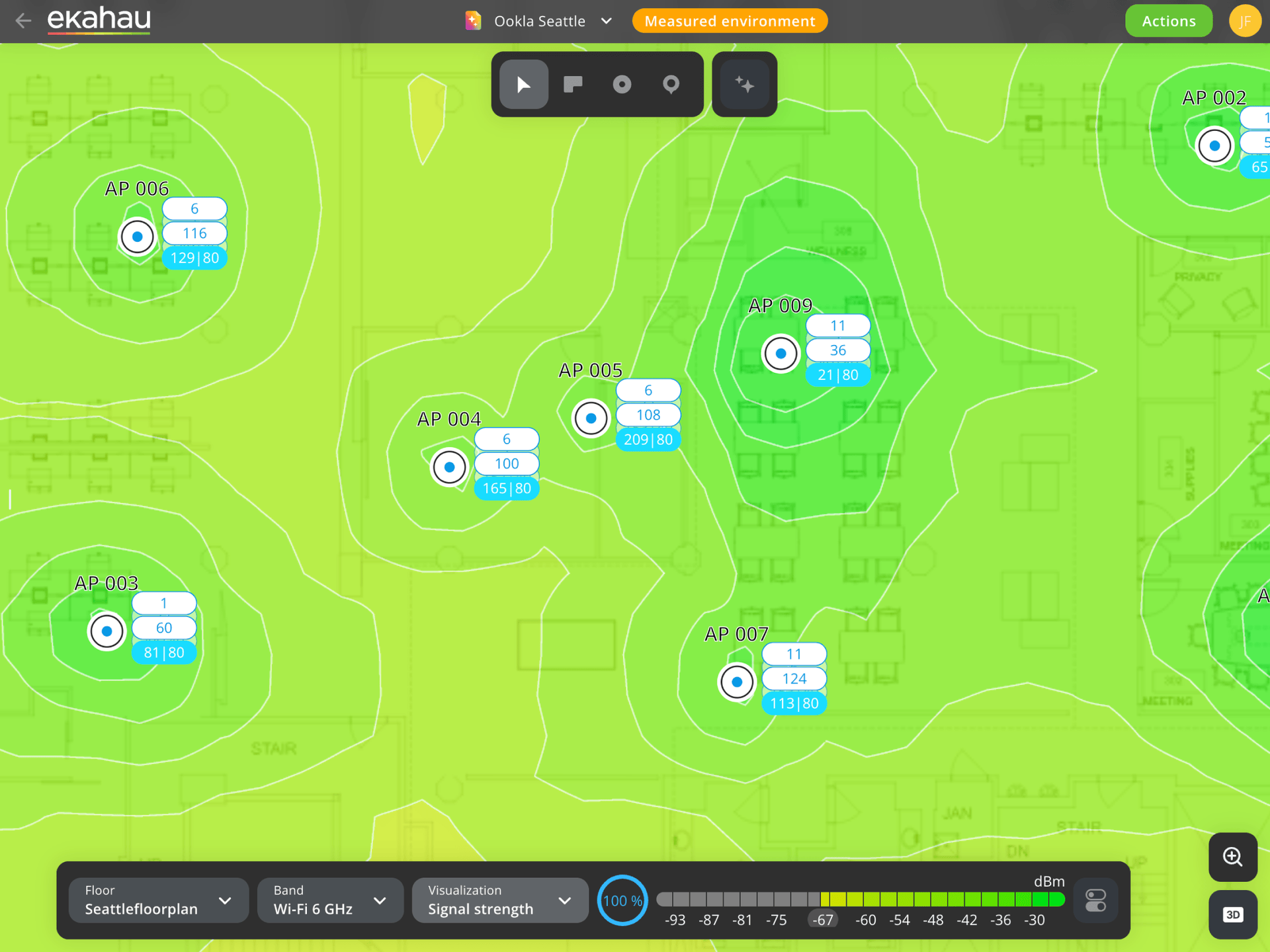
A Bakersfield site survey from WiFi Hotshots starts with Ekahau AI Pro predictive modeling and closes with post-install validation heatmaps — every engagement a fixed-fee SOW, not hourly billing.
We cover the full Kern County footprint from our Valencia HQ on a 90-minute dispatch: Chevron and Aera Energy well-pads across the Kern River, Midway-Sunset, and Elk Hills fields, Grimmway and Bolthouse carrot packinghouses and cold-storage rooms, Kern Medical’s Level II trauma campus and the Dignity Health / Adventist Health acute-care network, CSUB and Bakersfield College lecture halls, Kern High School District’s 19 comprehensive campuses, and the Tehachapi Pass wind farm control rooms. See the enterprise wireless services overview, the full enterprise network services portfolio, our engineering credentials and certifications, or send us your floor plans to start a scope call.
Why Bakersfield Wireless Survey Projects Fail Without an RF Baseline
Kern County building stock is not generic. Oilfield control buildings at Chevron Kern River, Aera Energy Midway-Sunset, California Resources Corporation Elk Hills, and Berry Petroleum sit inside Class I Division 2 hazardous-location boundaries per API RP 500 4th Edition (2023) — and pad-adjacent VFD and pump-control noise pushes the 5 GHz noise floor from a generic enterprise ‑90 dBm toward ‑85 dBm or worse. Agricultural packinghouses across Grimmway Farms (approximately 10 million lb of carrots per day across 40,000-plus acres), Bolthouse Farms, and Wonderful Company pistachio and almond plants are metal-shell buildings with plastic-sheeted pallets and condensing cold-storage rooms — signal voids a predictive-only model consistently misses.
Kern Medical’s 222-bed Level II trauma facility, Bakersfield Memorial, Adventist Health Bakersfield, and the Mercy Hospital Downtown and Southwest campuses mix steel-framed acute-care towers with 1950s and 1960s legacy wings where as-built drawings are decades out of date. KHSD’s 19 comprehensive high schools and the district’s 42,000-student footprint layer CMU-block classroom corridors against open gymnasium and auditorium shells.
Deploying APs without a measured RF baseline means your channel plan is built on assumptions, not data. When a Zebra WT6300 freezer-rated wearable drops association in a carrot cold-storage cell or a Spectralink Versity handset holds to a ‑82 dBm AP two patient rooms away, the root cause is always the same: the pre-deployment work was skipped or compressed. Every Bakersfield site survey we run starts with this measured baseline, not a floor-plan-only prediction.
A Bakersfield site survey is not optional for complex environments — it is the engineering step that separates a network that works from one that generates tickets. The design target for a general enterprise data environment is a minimum ‑67 dBm RSSI at cell edge with at least 25 dB SNR. For voice-grade networks — Vocera Smartbadge, Spectralink Versity, Ascom — tighten to ‑65 dBm and add a 15–20% cell overlap requirement at the ‑67 dBm boundary to support fast BSS transition under 802.11r.
For oilfield SCADA polling and telemetry, ‑67 dBm at the pad boundary is the durable target with 20 dB SNR over the local VFD noise floor. None of those thresholds can be confirmed by looking at a floor plan. They require measurement.
Ekahau Predictive Survey Methodology: Floor Plan Ingestion to AP Placement Map
Every Bakersfield site survey begins in Ekahau AI Pro, the design and analysis module within the Ekahau Connect platform. The workflow starts with floor plan import at measured scale — either CAD-exported PDF or a photographed as-built drawing re-scaled to a known distance. Wall types are assigned material attenuation values: glass, drywall, CMU, poured concrete, concrete with rebar, sheet-metal ag-building cladding, and insulated cold-storage panel each carry different dB-per-meter loss figures.
For oilfield control buildings under NFPA 70 (NEC) Article 500 / 501 Class I Division 2 classification, the predictive model flags the HazLoc boundary early so AP selection narrows to Class-rated hardware (Cisco Catalyst IW9167E-HZ or HPE Aruba AP-587EX) before coverage geometry is finalized.
For cold-storage and freezer rooms, insulated metal panel and densely stacked pallet loads are assigned attenuation values that reflect real packinghouse operating conditions, not an empty-warehouse idealization. Once the floor plan is calibrated, the predictive engine runs AP placement simulations against the design requirement profile — coverage at ‑67 dBm RSSI, channel plan, and secondary-AP overlap for 802.11k neighbor list population. The output is an AP count per floor with placement coordinates and a draft bill of materials.
For a Bakersfield site survey deployment, predictive design typically covers 1,200–2,000 sq ft per AP on 5 GHz and 6 GHz radios in open-plan office environments. High-density spaces — CSUB lecture halls, Kern Medical ED bays and OR suites, KHSD classrooms at 1 AP per room with 45 concurrent clients at peak, Mechanics Bank Arena seating bowls — require tighter placement intervals driven by client count and MOS score targets rather than coverage radius alone.
Cold-storage and freezer cells run at 1 AP per 2,000–2,500 sq ft at the outer perimeter to account for metal-rack and pallet signal voids. Oilfield outdoor well-pad coverage spaces APs 800–1,500 ft apart with directional antennas, driven by terrain (berms, separation distances) rather than square-footage alone. Predictive survey is accurate for standard construction. On atypical Kern materials — sheet-metal ag-building cladding, insulated cold-storage panel, Class I Division 2 zone boundaries at the wellhead, and lead-lined imaging suites at Kern Medical and the Dignity Health campuses — the predictive model flags uncertainty zones that require an AP-on-a-Stick validation pass before hardware procurement.
- AP count per floor with X/Y placement coordinates exportable to AutoCAD or PDF overlay
- Channel plan: 2.4 GHz channels 1/6/11 for coverage; 5 GHz 20/40/80 MHz assignments per zone; 6 GHz LPI channel selection for Wi-Fi 6E and Wi-Fi 7 APs (indoor LPI class, no AFC required per FCC Part 15 Subpart E); outdoor 6 GHz standard-power requires AFC coordination
- Per-band heatmap exports showing RSSI, SNR, secondary coverage (802.11k), and co-channel interference overlay
AP-on-a-Stick Validation for Kern County Venues: Energy, Agriculture, Healthcare, and Higher Ed
AP-on-a-Stick (APoS) methodology mounts a production-model AP on a telescopic pole at the intended deployment height — typically 12–18 ft for ceiling-tile office environments, 25–40 ft for high-bay packinghouses and arena catwalks, and pole-top for outdoor well-pad configurations. The Ekahau Sidekick 2 attaches to the survey laptop via USB-C and runs four tri-band radios scanning 2.4, 5, and 6 GHz simultaneously at 50 sweeps per second across the full 2,400–7,125 MHz range.
The surveyor walks the floor while the Sidekick 2’s nine custom 3D antennas record passive RF measurements at every point — RSSI, SNR, noise floor, and co-channel interference — across every visible AP. That measurement data overwrites the predictive model where they differ, producing a hybrid design that combines simulation efficiency with field accuracy.
Kern County venues that mandate APoS as a required phase of a Bakersfield site survey rather than predictive-only include any facility where drawings do not reflect reality. Oilfield control buildings at the Kern River, Midway-Sunset, and Elk Hills operations carry hazardous-location boundaries that require Class-rated AP selection confirmed before mounting; VFD and pump-motor noise floors need spectrum-analyzer capture from the Sidekick 2 before channel planning can proceed. Agricultural cold-storage and freezer rooms across Grimmway Farms, Bolthouse Farms, Sun-Maid, and Wonderful Company operations are lined with stainless and insulated metal panel — signal voids behind pallet stacks and condenser decks will not show up in a predictive-only pass.
Kern Medical (222 licensed beds, Level II Trauma since November 15, 2001, running Cerner Millennium EMR), Bakersfield Memorial (385 general acute plus 48 critical care under Dignity Health), Adventist Health Bakersfield (approximately 253 licensed beds per HCAI), and the Mercy Hospital Downtown and Southwest campuses all carry infection-control constraints on above-ceiling access that require cable routing to be confirmed before the first AP is mounted; lead-lined imaging suites boundary as RF-opaque zones on the heat map.
CSUB’s 375-acre main campus, Bakersfield College’s 153-acre campus, and KHSD’s 19-school comprehensive footprint all need room-by-room passive validation to confirm that hallway-only AP plans hold signal at the back of a 30-plus-seat classroom — they rarely do. These institutions are referenced as venue archetypes, not as claimed engagements.
- Energy and oilfield: Class I Division 2 HazLoc boundary capture with Cisco Catalyst IW9167E-HZ or HPE Aruba AP-587EX; VFD and pump-motor noise-floor measurement; SCADA polling path validation at ‑67 dBm with 20 dB SNR over local noise
- Agriculture and cold chain: freezer-rated AP placement at 1 per 2,000–2,500 sq ft; Zebra WT6300 and WT6400 wearable client validation at ‑30°C operating range; FSMA Rule 204 traceability handheld performance at Critical Tracking Events (enforcement deferred to July 20, 2028 per the Continuing Appropriations Act of 2026)
- Healthcare: infection-control ceiling-plenum constraints confirmed before cable pathways are routed; lead-lined imaging suite boundaries flagged as RF-opaque zones requiring AP relocation; VoWLAN handset roaming exercised on Spectralink Versity, Vocera, and Ascom form factors with 802.11r FT enabled (not Adaptive) per Spectralink best-practice guidance
- Higher ed and K-12: 1 AP per classroom density planning for KHSD’s 42,000-student footprint; seat-by-seat capacity modeling for CSUB lecture halls; residence-hall roaming validation across wing transitions; outdoor quad coverage with outdoor-rated APs on 6 GHz standard power with AFC coordination
Floor plans and device counts are all we need to scope the work — most Bakersfield site survey engagements across Kern County are quoted on a fixed-fee SOW within three business days of a 30–60 minute scoping call.
Passive and Active Validation: Throughput, Roaming, and Voice MOS Testing
A passive survey records every RF signal in the environment without associating to any SSID. The Ekahau Sidekick 2 listens — it measures what the air contains, not what a connected session reports. Passive surveys are used for pre-deployment environment assessment (neighbor AP inventory, noise floor, DFS radar event detection) and for post-install coverage confirmation. DFS event rates in Kern County are not generic, and every Bakersfield site survey we run captures them.
Meadows Field Airport (BFL) ground-based ATC radar is DFS-proximate to industrial and commercial sites in north Bakersfield and Oildale; Edwards AFB test radar and Naval Air Weapons Station (NAWS) China Lake operations drive measurably higher radar-event rates on UNII-2A and UNII-2C channels in eastern Kern near Rosamond, California City, and Ridgecrest. Validate DFS exposure with field measurement before enabling DFS channels in production. The output is a heatmap for every band, every floor, at every survey waypoint — color-coded RSSI, SNR, and secondary coverage for 802.11k neighbor list validation.
Active validation associates to the production SSID and measures what the client actually experiences. iPerf3 bidirectional throughput runs confirm uplink and downlink capacity against the designed channel width. Roaming tests exercise 802.11r fast BSS transition — the protocol is designed to shorten roaming interruptions, and 50 ms or less is the accepted voice-grade handoff target that 802.11r was built to support. Active testing with a roaming test client confirms whether the deployed controller configuration actually achieves it or whether a misconfigured minimum RSSI threshold is stalling the handoff.
For voice-over-Wi-Fi migration engagements — Cisco Webex Calling, CUCM, or Teams Phone — the active test also captures a MOS (Mean Opinion Score) trace across the full walking route. A voice-grade network targeting MOS 4.0+ requires the ‑67 dBm RSSI and 25 dB SNR thresholds to hold at cell edge without exception. Any area that drops below those targets appears as a gap in the post-install validation report, with a remediation recommendation tied to a specific AP or configuration change. The independent post-install validation report is the deliverable your operations team, auditor, or next engineer can pick up without context.
Kern County Market Constraints: Oil Field RF, Agricultural Facility Steel, and Tehachapi Wind Farm Outdoor
Oilfield Hazardous-Location Classification at Chevron Kern River, Aera Midway-Sunset, and Elk Hills
Kern County hosts three of the largest oilfields in California. Midway-Sunset holds an estimated 27 billion barrels of oil in place with cumulative production approaching 4 billion barrels through 2023; Kern River has produced roughly 2.2 billion barrels cumulative with a peak of 141,000 bbl/day in 1985; Elk Hills sits at roughly 1.5 billion barrels cumulative.
Chevron and Aera Energy together produce well over 100,000 bbl/day from Kern fields. Wellhead, separator, treater vessel, and loading-rack zones are classified Class I Division 2 hazardous location under NFPA 70 (NEC) 2023 Articles 500 and 501, per the API Recommended Practice 500 4th Edition (2023) for Division-based classification. Standard enterprise APs cannot be installed in those zones.
Current-generation hazardous-location AP references are the Cisco Catalyst IW9167E-HZ (three 802.11ax radios, Class I Division 2, ATEX Zone 2/22, IECEx, IP67, ‑50°C to +75°C operating) and the HPE Aruba AP-587EX (Wi-Fi 6, Class I Division 2, ATEX Zone 2, IP66, ‑40°C to +65°C).
The predecessor Cisco IW-6300H reached end-of-sale on July 26, 2024 and is not a current selection. Wiring in the classified zone follows NEC Article 501 rigid metal conduit or MI cable with listed seals at boundary transitions; intrinsically safe circuits under NEC Article 504 are separately assessed for BLE or 802.15.4 outputs. WFHS is not a licensed electrical contractor for hazardous-area installation — the wireless design, AP placement drawing, and validation report are our scope; the HazLoc install itself is coordinated with the operator’s approved contractor.
Agricultural Facility Sheet-Metal, Cold-Storage Condensation, and FSMA Rule 204 Traceability
Kern is a top-10 California agricultural county. Grimmway Farms (headquartered in Bakersfield) handles approximately 10 million lb of carrots per day across more than 40,000 acres and operates 20 facilities; together with Bolthouse Farms the two account for roughly 80% of the U.S. fresh-carrot supply. Wonderful Company processes pistachios, almonds, and pomegranates out of Central Valley operations; Sun-Maid operates the 640,000 sq ft Kingsburg raisin packing facility. Packinghouse floors, produce-wash zones, cold rooms, and freezer cells each carry different AP enclosure requirements.
IP66 minimum is required for produce-wash zones; IP67 is required for freezer transitions where warm humid loading-dock air hits cold interior surfaces and condensation forms. The Bakersfield site survey deliverable flags the IP rating per zone so procurement does not mix an IP65 ceiling AP into a condensation-prone freezer dock. Operating range must cover ‑30°C freezer to +55°C loading-dock in Kern summer; the Cisco IW9167E Heavy Duty operates ‑50°C to +75°C with margin.
Ammonia-refrigeration atmospheres do not affect RF propagation materially but drive enclosure corrosion standards — NEMA 4X stainless for condenser-deck mounting. Handheld client fleets include Zebra WT6400 freezer-rated wearables (Wi-Fi 6E) and Zebra WT6300 (rated ‑30°C freezer operation). FDA FSMA Rule 204 (the Food Traceability Final Rule) covers roughly 16 food categories with enhanced recordkeeping at Critical Tracking Events; FDA enforcement has been deferred to July 20, 2028 per the Continuing Appropriations Act of 2026, but the wireless design work is the same — validated handheld performance at every Critical Control Point along the cold chain.
Where the survey identifies switch-port PoE or pathway gaps that will bottleneck handheld retransmits, cabling infrastructure review is scoped as a parallel workstream in the same fixed-fee SOW.
Tehachapi Wind Farm Outdoor, Solar Farms, and Kern Summer Thermal Derating
The Tehachapi Pass Wind Resource Area covers roughly 800 sq mi and delivers a combined 3,507 MW across five wind farms; the Alta Wind Energy Center is the largest individual facility at 1,550 MW and was the largest wind farm in the United States as of 2022. Solar farms across Rosamond, California City, and the Mojave Desert corridor add gigawatt-scale photovoltaic footprints. Control-room and maintenance-building wireless for these facilities looks ordinary on paper, but outdoor AP coverage for wind-turbine service corridors and solar-field inverter pads runs into a Kern-specific thermal problem.
Bakersfield summer urban temperatures run 100–108°F routinely; the Kern valley floor to desert edge runs 110+°F; solar loading on a dark-enclosure outdoor AP adds 20–30°F to the ambient, which pushes sustained junction temperatures toward 130–140°F. Specify APs rated to +65°C minimum for outdoor deployment (Aruba AP-587EX) or +75°C for the most demanding cases (Cisco IW9167E Heavy Duty). Summer dust-storm activity in the San Joaquin Valley is real — IP66 minimum dust-tight rating is a requirement, not an optional upgrade. Tehachapi Pass elevation (roughly 4,000 ft) adds freezing-temperature and wind-loading constraints for outdoor mounts.
Per California Title 24 Part 6, AP cable pathways through the building envelope in new construction and major renovations must be coordinated with the general contractor and the Authority Having Jurisdiction. Portions of eastern and southern Kern (Tehachapi, Frazier Park, Lake Isabella, the Greenhorn Mountains, the Kern River Canyon) are classified as Very High Fire Hazard Severity Zones per Cal Fire OSFM mapping — 641,441 acres of Very High plus 781,819 acres of High FHSZ across Kern; outdoor AP mounts in those zones carry NFPA 70 Article 240, Title 24 Part 9 fire-code, and Cal Fire defensible-space constraints that the WFHS site plan flags for the installing contractor.
WFHS is not an ERRCS integrator — where a Kern County hospital, county facility, or multi-story building triggers Emergency Responder Radio Coverage System requirements, the Bakersfield site survey report flags the gap, documents the location, and coordinates referral to a licensed ERRCS contractor rather than a Wi-Fi vendor. Our approach to clinical wireless environments covers both the survey methodology and the post-construction validation sequence.
Scope a Bakersfield Site Survey.
Send floor plans to sales@wifihotshots.com or call (844) 946-8746 — we return a fixed-fee SOW, not a multi-week proposal cycle.
Survey Deliverables: Heat Maps, BOM, Install Runbook, and Validation Report
At the close of every Bakersfield site survey engagement, the client receives a complete document set — not a summary slide deck. The Ekahau project file (.esx) is included in every handoff so a future engineer can reopen the exact survey, adjust wall materials, or re-run the coverage model without starting from scratch. The platform mix — Cisco Catalyst 9800 (IOS-XE 17.15.x mainline for Wi-Fi 7 support), Cisco Meraki MR, HPE Aruba Central (AOS-10), Juniper Mist, RUCKUS One, ExtremeCloud IQ — does not change the deliverable set. Every engagement ships with the same documentation regardless of vendor, because the documentation belongs to the client, not the vendor.
Current-generation Wi-Fi 7 indoor APs on our working reference list include the Cisco CW9178I (4×4:4 802.11be, 24 Gbps aggregate, dual 10 Gbps ports) and CW9176I; Wi-Fi 6E outdoor for AFC-coordinated standard-power deployment is the Cisco CW9163E (IP67, integrated GPS). For oilfield and packinghouse HazLoc zones the short list is Cisco IW9167E-HZ or HPE Aruba AP-587EX.
Guest and BYOD onboarding — NAC and zero trust policy or cloud-native captive portal, certificate-based authentication — is scoped as a separate design workstream when the survey reveals that the existing SSID architecture does not segment guest traffic. AP refresh and controller migration planning for Cisco Catalyst 9800, Meraki MR, HPE Aruba Central, Juniper Mist, RUCKUS One, and ExtremeCloud IQ is scoped separately where the survey identifies a controller version or capacity constraint.
- Ekahau project file (.esx) plus annotated heatmap exports per band (2.4, 5, 6 GHz) per floor: RSSI, SNR, secondary coverage (802.11k), and co-channel interference overlay
- Vendor-agnostic AP bill of materials with AP model, mount type, antenna selection, PoE class requirement, enclosure IP/NEMA rating, and cabling length per drop
- Installation runbook: AP placement drawing, cable pathway map, switch port assignment, VLAN/SSID configuration notes, and HazLoc boundary callouts for the contractor
- Post-install validation report: passive heatmap confirmation, iPerf3 throughput results, 802.11r roaming handoff timing, and MOS trace data for voice-grade engagements
- Design warranty: WFHS stands behind the AP count and placement — if coverage gaps appear at post-install validation that were not present in the design, we remediate the design at no additional cost
Bakersfield Site Survey Coverage and Kern County Service Map
WiFi Hotshots dispatches from Valencia (Santa Clarita Valley) to Bakersfield on a roughly 90-minute drive up I-5 or Highway 14 / Highway 58 — the durable Kern dispatch window for a same-day field mobilization. Coverage runs the full Kern County footprint: Bakersfield proper (population approximately 419,000 as of the January 2025 state estimate, ninth largest city in California) including downtown, the Rosedale and Seven Oaks west-side corridor, Oildale and the north-Bakersfield industrial belt, and the Southwest and Southeast residential / healthcare campuses.
North Kern includes Shafter, Wasco, Delano, and McFarland agricultural towns; south Kern includes Arvin, Lamont, Taft, and Maricopa; east Kern includes Tehachapi, California City, Rosamond, and Ridgecrest (the gate city for NAWS China Lake); north-east Kern includes Lake Isabella and the Kern River Canyon; the southwest corner at I-5 includes Buttonwillow, Lost Hills, and Frazier Park. The Kern metro area sits at approximately 751,000 and the full county at approximately 922,500 per 2024 ACS figures.
Greenfield and brownfield engagements across Kern County span multiple verticals. Energy, agriculture, and healthcare sites include Chevron Kern River Oilfield and Aera Energy Midway-Sunset operations, Grimmway Farms and Bolthouse Farms packinghouses and cold-storage, Wonderful Company processing plants, Sun-Maid Kingsburg, Kern Medical’s 222-bed Level II trauma campus, the Dignity Health Bakersfield Memorial and Mercy Hospital Downtown and Southwest sites, Adventist Health Bakersfield, and Memorial Hospital.
Education, venue, and transportation sites include CSUB’s 375-acre main campus, Bakersfield College’s 153-acre main campus plus Delano, Weill, and SouthWest satellites, Taft College, Kern High School District’s 19 comprehensive campuses and 6 alternative sites (42,000-plus students), Bakersfield City School District (TK-8, 28,365 students for 2024-25), Panama-Buena Vista USD, Mechanics Bank Arena (the rebranded Rabobank Arena), the Bakersfield Fox Theater, Meadows Field Airport (BFL, approximately 195,000 annual enplanements), and the Tehachapi Pass wind-resource control rooms.
Edwards Air Force Base and NAWS China Lake are adjacent federal facilities — direct base work is out of scope, but the contractor ecosystem around Rosamond, California City, and Ridgecrest is served.
Multi-site Bakersfield site survey engagements across Kern County are coordinated from a single SOW and a single point of contact. For enterprise clients with facilities across multiple Southern California regions, we dispatch into adjacent service areas without a separate mobilization charge. The geo-family below shows the regional pages where market-specific survey details — LA metro density, San Fernando Valley media and aerospace, Antelope Valley aerospace testing, Inland Empire warehouse density, Orange County biotech and hospitality, coastal constraints — are documented for each sub-market.
Representative Engagement Profiles — Bakersfield / Kern County Region
Oil & gas operations — Bakersfield site survey for upstream and midstream HazLoc sites
The Kern oilfield archetype maps to an upstream producer operating thousands of wells across the Kern River, Midway-Sunset, or Elk Hills fields — the scale familiar to anyone who knows Chevron, Aera Energy, California Resources Corporation, or Berry Petroleum.
Typical scope covers Class I Division 2 hazardous-location AP placement at wellheads, separators, treater vessels, and loading racks per NFPA 70 (NEC) 2023 Articles 500 and 501 and API RP 500 4th Edition (2023); outdoor well-pad coverage with Cisco IW9167E-HZ or HPE Aruba AP-587EX at 800–1,500 ft AP-to-AP spacing driven by terrain; SCADA polling path validation at ‑67 dBm with 20 dB SNR over local VFD noise floor (spectrum analyzer capture with Ekahau Sidekick 2); control-room coverage at 1 AP per 2,500 sq ft for open floors with tighter intervals at instrumentation closets; coexistence planning with 900 MHz licensed telemetry radios.
WFHS designs and validates the wireless; the hazardous-area install itself is coordinated with the operator’s approved electrical contractor. Chevron, Aera, CRC, and Berry are referenced here as venue archetypes, not as claimed engagements.
Agricultural cold-storage and processing wireless for packinghouse operations
The Kern agricultural archetype maps to a multi-facility produce or nut operation handling millions of pounds per day across packing, wash, cold-storage, and freezer zones — the scale familiar to anyone who knows Grimmway Farms, Bolthouse Farms, Wonderful Company, or Sun-Maid.
Typical scope covers packinghouse floor coverage at 1 AP per 3,000–4,000 sq ft on Wi-Fi 6 5 GHz 20/40 MHz channels (tighter if legacy Wi-Fi 4/5 scanners remain in fleet); cold-storage and freezer cell coverage at 1 AP per 2,000–2,500 sq ft at the outer perimeter to account for pallet and metal-rack signal voids; IP66 enclosures for produce-wash zones and IP67 for freezer transitions where condensation forms; NEMA 4X stainless enclosures for ammonia-refrigeration condenser decks; handheld client validation for Zebra WT6400 and WT6300 wearables across the ‑30°C freezer range; FDA FSMA Rule 204 traceability handheld performance at Critical Tracking Events (enforcement deferred to July 20, 2028).
The deliverable set includes a per-zone heat map that explicitly shows cold-storage coverage behind fully loaded pallets, not just an empty-room idealization. Grimmway, Bolthouse, Wonderful, and Sun-Maid are referenced here as venue archetypes, not as claimed engagements.
Regional-hospital clinical-wireless network migration
The Kern healthcare archetype maps to a 200- to 450-licensed-bed acute-care facility with med-surg floors, ED bays, OR suites, and ICU, plus a Level II Trauma designation in the region — the scale familiar to anyone who knows Kern Medical (222 beds, Level II Trauma since November 15, 2001, Cerner Millennium EMR), Bakersfield Memorial (385 general acute plus 48 critical care under Dignity Health), Adventist Health Bakersfield (approximately 253 licensed beds per HCAI), or the Mercy Hospital Downtown (144 beds) and Southwest (78 plus 106-bed tower) Dignity Health sites.
The Bakersfield site survey scope on a regional-hospital engagement covers a phased wireless migration with ‑65 dBm cell edges on voice-grade floors and ‑60 dBm in ED and OR, 20–25% cell overlap, VoWLAN-grade 802.11r FT roaming for Spectralink Versity and Vocera Smartbadge (Spectralink best-practice guidance specifies FT=enabled, not Adaptive), RTLS overlay for equipment and infant location services, AAMI TIR18:2010-aligned medical device EMC assessment, and 1 AP per ~1,000 sq ft on ED and imaging floors. HIPAA-aligned network segmentation is a design input, not a compliance claim. Kern Medical, Dignity Health, and Adventist Health facilities are referenced here as venue archetypes, not as claimed engagements.
Higher-education urban-campus wireless refresh
The Kern higher-education archetype maps to a multi-building state-university or community-college campus with lecture halls, library stacks, residence halls, and outdoor quad coverage — the scale familiar to anyone who knows CSU Bakersfield (375-acre main campus, 11,000-plus students fall 2025) or Bakersfield College (153-acre main campus with Delano, Weill, and SouthWest satellite campuses, approximately 46,500 annual headcount).
Typical scope covers lecture halls at 1 AP per 800–1,200 sq ft with 20 MHz channels for client-count capacity; library-stack coverage at 1 AP per 2,000 sq ft with per-row steel-shelving attenuation budgeted at 6–8 dB; residence-hall roaming at 1 AP per 2–3 rooms at minimum (modern builds often go 1-per-room); outdoor quad and pathway coverage with outdoor-rated APs on 6 GHz standard power and AFC coordination; airtime accounting for BYOD, guest, eduroam, and IoT SSID overhead (each SSID costs roughly 0.5–1% airtime in beaconing).
The Bakersfield site survey deliverable set is formatted for review by campus IT governance and E-rate / state procurement review where applicable, including the Bakersfield City School District and Kern High School District Category 2 submission template. CSUB and Bakersfield College are referenced here as venue archetypes, not as claimed engagements.
Bakersfield Wireless Site Survey FAQs
How long does a Bakersfield enterprise wireless site survey take?
Timeline depends on scope. A single-floor commercial space in downtown Bakersfield or a clinic building on the Kern Medical or Dignity Health side of town with complete as-built drawings can be predictively modeled and quoted within three business days of the scoping call. An AP-on-a-Stick field validation for that same floor takes one to two days on-site.
Multi-building campus engagements — CSUB-scale higher ed, Kern Medical- or Bakersfield Memorial-scale clinical campuses, KHSD-scale multi-school rollouts, or multi-pad oilfield operations across the Kern River and Midway-Sunset fields — typically run two to four weeks from floor plan receipt to final deliverable.
Every engagement is scoped and quoted as a fixed-fee SOW before work begins.
Our 90-minute dispatch from Valencia to Bakersfield means mobilization is fast, and the timeline, scope, and deliverables are defined in writing.
We do not bill hourly against an open-ended estimate.
When should a Bakersfield or Kern County site use AP-on-a-Stick validation over predictive-only wireless design?
A predictive survey uses Ekahau AI Pro within Ekahau Connect to model RF propagation through a calibrated floor plan. No physical measurement occurs — the software simulates signal paths through assigned wall materials and produces coverage heatmaps and an AP placement plan. It is fast and accurate for standard construction materials.
An AP-on-a-Stick survey mounts a production-model AP on a telescopic pole at the intended deployment height, and the Ekahau Sidekick 2 captures real measurements — actual RSSI, SNR, and noise floor — as the surveyor walks the floor.
For Kern County buildings with atypical attenuation (sheet-metal ag-building cladding, insulated cold-storage panel, Class I Division 2 hazardous-location zones at the wellhead, lead-lined imaging suites, CMU-block school corridors) or where as-built drawings are unreliable, the AP-on-a-Stick pass is required before procurement.
Most WFHS engagements include both: predictive for initial design and AP count, AP-on-a-Stick for validation before the BOM is finalized.
On a bakersfield site survey, do you cover all of Kern County, or just Bakersfield proper?
All of Kern County on the same 90-minute dispatch from Valencia. Coverage runs from Bakersfield city and Oildale through north-Kern agricultural communities (Shafter, Wasco, Delano, McFarland) and south-Kern fields (Arvin, Lamont, Taft, Maricopa) out to east-Kern energy and defense-adjacent communities (Tehachapi, Rosamond, California City, Ridgecrest) and north-east mountain / canyon communities (Lake Isabella, Frazier Park, Stallion Springs).
The southwest corner at I-5 (Buttonwillow, Lost Hills) is inside the same dispatch.
We also dispatch into adjacent service areas — Santa Clarita, Antelope Valley, LA metro, Inland Empire, and the Central Coast — under the same fixed-fee SOW structure.
Federal facilities at Edwards Air Force Base and NAWS China Lake are out of scope for direct base work, but the contractor ecosystem around Rosamond, California City, and Ridgecrest is served.
What does a wireless site survey cost in Bakersfield?
Every engagement is priced as a fixed-fee SOW — we do not bill hourly. Scope variables that drive cost: building square footage, number of floors, number of buildings, construction type (standard drywall vs. CMU block vs. sheet-metal ag-building vs. insulated cold-storage panel vs. hazardous-location Class I Division 2 oilfield zone), required survey type (predictive only, AP-on-a-Stick, or combined predictive-plus-validation), and whether post-install validation and a formal validation report are in scope.
Outdoor oilfield pad coverage and Tehachapi wind-farm or solar-field outdoor work are quoted with a field-condition supplement.
We return a written SOW quote within three business days of the scoping call of receiving floor plans and a scope description.
Send floor plans to sales@wifihotshots.com or call (844) 946-8746. No engagement begins without the client signing off on the fixed-fee price first.
On a bakersfield site survey, can WFHS scope hazardous-location (Class I Div 2) APs for oilfield operations?
Yes, for design and validation. Current-generation HazLoc AP references are the Cisco Catalyst IW9167E-HZ (Class I Division 2, ATEX Zone 2/22, IECEx, IP67, ‑50°C to +75°C, three 802.11ax radios) and HPE Aruba AP-587EX (Class I Division 2, ATEX Zone 2, IP66, Wi-Fi 6, ‑40°C to +65°C). The predecessor Cisco IW-6300H reached end-of-sale July 26, 2024 and is not a current selection.
Classification boundaries follow NFPA 70 (NEC) 2023 Articles 500 and 501 and API Recommended Practice 500 4th Edition (2023) for Division-based classification (API RP 505 3rd Edition January 2025 applies where the operator uses the Zone system).
WFHS designs, selects hardware, places AP on the drawing, and validates coverage.
We are not a licensed electrical contractor for hazardous-area installation — the NEC 501 conduit / MI cable install with listed seals at boundary transitions is coordinated with the operator’s approved contractor.
Where the operator needs a scoped Class I Division 2 field-validation pass with Ekahau Sidekick 2 spectrum analysis over VFD and pump-motor noise, that is a deliverable we produce routinely.
Can WFHS survey a cold-storage or freezer packinghouse without stopping production?
Yes. Passive survey requires no network access and causes zero disruption to production traffic — the Ekahau Sidekick 2 listens passively and never associates to any SSID. We routinely survey operating carrot, almond, pistachio, and pomegranate packinghouses during active shift production.
The surveyor carries a freezer-rated laptop bag and a cold-soaked battery kit for freezer-cell walkthroughs; operating-range requirements for the handheld client fleet (Zebra WT6400 Wi-Fi 6E wearables, Zebra WT6300 wearables rated to ‑30°C) are validated against the actual freezer temperature, not a spec-sheet idealization.
Active iPerf3 throughput testing and 802.11r roaming tests require a brief association to a production or test SSID, which does not affect other clients.
Full load testing is scheduled during off-shift hours if the operator requests it.
The pre-survey coordination document identifies which test phases, if any, require a production pause.
Do you survey CSUB, Bakersfield College, and KHSD campuses differently than corporate offices?
The survey instruments are the same; the design targets differ. CSUB-scale higher education and KHSD-scale K-12 are designed for 1:1 client device density per classroom or lecture hall seat, not the lower density of a corporate open-plan floor. That changes the AP placement interval, the channel width selection (20 MHz standard in high-density zones), and the roaming design.
KHSD covers 19 comprehensive high schools plus 6 alternative sites (25 total) and serves approximately 42,000–43,000 students; Bakersfield City School District is a separate TK-8 district with 28,365 students for the 2024-25 school year and a separate E-rate Form 471 applicant.
E-rate procurement requirements mean the deliverable set must include documentation compatible with the district’s Category 2 equipment and installation submission.
For CSUB-scale higher education, outdoor coverage across the 375-acre main campus — quads, pathways, athletic, and residence halls — requires outdoor-rated APs on 6 GHz standard power with AFC coordination, and ADA-accessible AP mounting locations are a hard constraint.
CSUB, Bakersfield College, and KHSD are referenced here as venue archetypes, not as claimed engagements.
What happens when a Bakersfield wireless site survey turns up Kern County RF issues not in the original scope?
The fixed-fee SOW covers the defined scope. If the survey uncovers something outside that scope — an ERRCS gap requiring a licensed BDA integrator at a Kern Medical or Dignity Health campus, a structured cabling deficiency that needs remediation before APs can be installed at a Grimmway or Bolthouse packinghouse, a DFS radar event pattern near Meadows Field or the Edwards / China Lake eastern-Kern corridor that requires channel-plan revision, or a hazardous-location classification dispute that requires operator electrical-engineering review — we document the finding in the validation report with a clear description of the issue and its location.
We then issue a separate change-order estimate for any additional WFHS scope and, where the finding is outside wireless engineering (like ERRCS installation or HazLoc-classified electrical install), we refer to the appropriate licensed contractor.
The client is never billed above the SOW total without a signed change order first.
That is the operational definition of a fixed-fee engagement.
Do outdoor APs actually survive Bakersfield summer temperatures on a metal-roof pump pad?
Most do not at sustained temperature — one does. The Cisco Catalyst IW9167E-HZ heavy-duty hazardous-location AP is rated -50°C to +75°C (-58°F to 167°F) with an IP67 enclosure. The Cisco Meraki CW9163E outdoor Wi-Fi 6E AP is rated -40°C to +65°C and the HPE Aruba 580EX Series (AP-585EX / AP-587EX) stops at +65°C as well.
Bakersfield summer highs over 115°F under direct solar load on an unshaded oilfield mast easily push enclosure temperatures past 65°C, so the CW9163E and 580EX need shade or radome mitigation.
For Kern pump pads without shade structures, the IW9167E-HZ is the spec that matches measured conditions rather than catalog copy.
What hazardous-location certifications does WFHS design against for Kern County oilfield APs?
Class I Division 2 per NEC Article 500 and API RP 500, plus ATEX Zone 2/22 where operators also require European conformity. The Cisco Catalyst IW9167E-HZ is UL, ATEX, and IECEx certified for Class I Division 2 and ATEX Zone 2/22.
Per NEC Article 500.7-500.8, all electrical equipment in a Class I Div 2 area must be listed by a recognized testing laboratory (UL, CSA, FM Global, IECEx) matching the classification.
Cisco HazLoc deployments accept passive antennas only (except GNSS-OUT-TNC) and enforce maximum inductance of 50 uH and maximum capacitance of 0.01 uF — that constraint eliminates most commodity high-gain yagis.
Aruba AP-587EX requires ATEX/IECEx-certified cable glands (M20x1.5, minimum IP66); a non-certified gland voids the HazLoc rating. WFHS scope includes RF design; the hazardous-location install is coordinated with the operator’s approved electrical contractor.
How does Cisco URWB differ from Wi-Fi for pump-jack backhaul between remote Kern pads?
Cisco Ultra-Reliable Wireless Backhaul (URWB) on the IW9167E delivers low-latency make-before-break handoffs for mobile industrial applications — Wi-Fi was not designed for that traffic profile. URWB operates in 5 GHz unlicensed spectrum, and the IW9167E can run Wi-Fi and URWB simultaneously on one radio chassis. Topologies supported include Fixed Mesh and Point-to-Multipoint, which is the typical pattern for a central compressor station connecting multiple remote pump pads.
Configuration runs through a Catalyst 9800 controller on IOS-XE 17.15 or later, or a standalone URWB Manager.
For Kern pad clusters, the practical win is deterministic path behavior: cellular LTE backhaul is rate-limited and carrier-dependent, while a URWB PTMP link carries SCADA telemetry on spectrum the operator controls.
What RF engineering differences does WFHS model for Kern County cold-storage packinghouses?
Cold-storage design is AP-per-zone, not penetration-based. Insulated wall panels on cold sides of packinghouses block external RF, and the predictive model has to be re-walked for each temperature zone rather than assuming a single contiguous envelope.
Standard enterprise APs are rated roughly 0°C to +40°C — deployment inside freezers requires APs rated for low temperature or heated enclosures, and for freezer zones below 0°C the practical choice is a heavy-duty AP like the Cisco IW9167E (-50°C floor) rather than a commodity office model.
Zebra warehouse scanners on supported Wi-Fi 6 handhelds default to a -65 dBm RSSI roaming threshold, which drives the cell-edge target on the packinghouse floor.
WFHS’s wireless site survey adds AP-on-a-Stick validation inside each temperature zone before BOM signoff.
Do 6 GHz Wi-Fi 6E / Wi-Fi 7 channels actually help oilfield outdoor deployments?
Yes, with a constraint. The FCC allocated 1200 MHz in the 6 GHz band (5925-7125 MHz) in April 2020 across four UNII sub-bands, but outdoor operation is permitted only in UNII-5 (5925-6425 MHz) and UNII-7 (6525-6875 MHz) under 47 CFR 15.407 — UNII-6 and UNII-8 are indoor-only. Wi-Fi 7 adds 320 MHz channels in 6 GHz, 4K-QAM, Multi-Link Operation, and Preamble Puncturing.
Arista’s C-460E supports 320 MHz in 6 GHz and 160 MHz in 5 GHz, and Juniper Mist RRM assigns 6 GHz bands with preferred scanning channels so radios can run 20/40/80/160/320 MHz widths.
For Kern oilfield pad clusters, UNII-5 and UNII-7 plus AFC gives operators a way to escape saturated 5 GHz UNII-1/3 bands when 6 GHz client adoption is present.
What roaming thresholds and 802.11r targets does WFHS survey to at Kern Medical Center or Adventist Health?
RSSI at -65 dBm or better with a minimum SNR of 25 dB (based on a -90 dBm noise floor). Those are the Vocera WLAN requirements for VCS app, smartphones with VCS, and badges,
and they match Cisco’s VoWLAN recommendation of -65 dB signal level with SNR of 25 dB or more, validated using the actual handset at the desired data rate. On 2.4 GHz, Vocera mandates channels 1, 6, and 11 for channel separation.
IEEE 802.11r Fast BSS Transition (published 2008) collapses BSS transition delay to roughly 50 ms from the 500+ ms seen on prior standards.
WFHS surveys clinical floors to -65 dBm primary with 15-20% overlap on every voice path so both RSSI and fast-roam latency budgets are satisfied before cutover.
What encryption baseline does WFHS require at CSUB, Bakersfield College, and Kern healthcare floors?
WPA3-Enterprise at minimum, with the 192-bit mode where the vertical warrants it. WPA3-Enterprise 192-bit offers equivalent 192-bit cryptographic strength and has been positioned by the Wi-Fi Alliance for networks transmitting sensitive data in government, finance, and healthcare. WPA3 mandates Protected Management Frames on all connections, which blocks deauthentication-based DoS, honeypot, and eavesdropping vectors. WPA3 has been mandatory for Wi-Fi CERTIFIED devices since July 2020.
The 192-bit mode requires TLS 1.2 or later and key length greater than 3072 bits, with AES-GCMP-256 and SHA-384 on the Catalyst 9800 per Cisco’s WPA3 deployment guide.
Before finalizing any 802.1X build at Kern Medical or CSUB, WFHS verifies RADIUS redundancy, certificate authority topology, and EAP-TLS supplicant readiness. See network security architecture for the broader posture.
How does WFHS handle wireless coexistence at Tehachapi wind farms with existing telemetry?
By separating on spectrum and measuring before committing a channel plan. FCC 47 CFR Part 90 Industrial/Business Pool covers licensed land-mobile radio and telemetry in 450-470 MHz and 800 MHz ranges. The 902-928 MHz ISM band is unlicensed Part 15.247 spectrum, widely used for FHSS SCADA telemetry on pump-jacks, pipelines, and tanks.
Rotating wind-turbine blades produce Doppler shift, and towers plus blades obstruct, reflect, and refract electromagnetic waves, causing fade and scattering on nearby radio links per DOE and IEEE wind-farm RF research.
For Kern wind-farm Wi-Fi 6 and Wi-Fi 6E control networks, WFHS designs outside the 902-928 MHz zone technology-wise and confirms licensed telemetry has not drifted into unlicensed bands.
Spectrum monitoring during the AP-on-a-Stick walk is mandatory, not optional.
What makes Arista CloudVision CUE different for a rural Bakersfield multi-site deployment?
Closed-loop operational telemetry that reduces truck rolls across long Kern distances. Arista CloudVision CUE (Cognitive Unified Edge) is a cloud-native, AI/ML-driven management plane for wired and wireless.
Client Emulation and Network Profiling turn the multi-function radio inside Arista APs into a synthetic test client, proactively validating VoIP paths, DHCP and DNS reachability, and critical application responses before end users see failures. The self-healing mesh lets non-root APs auto-select the best path to a root node and reconverge on link failure without operator action.
Cognitive management is backed by Arista NetDB, a state-based cloud database with streaming telemetry for proactive fault resolution.
Pad-to-pad truck rolls in Kern County can easily run 30-90 minutes one way; Client Emulation plus cognitive root-cause analysis compresses mean time to detection without dispatching an engineer.
How does Arista WIPS classify rogue APs in a Kern Valley state prison-adjacent deployment?
Arista WIPS uses the patented Marker Packet technique to classify wireless devices as Authorized, Rogue, or External. A Rogue is an unauthorized AP connected to the enterprise wired network;
an External is a neighboring AP not connected to the monitored wired network — and the distinction matters because only Rogues justify active containment. Detection mechanics: the AP radio scans all channels, spending 120 ms per channel on each WIPS sweep.
Automatic prevention runs at four configurable levels, with simultaneous blocking across 2.4 GHz, 5 GHz, and 6 GHz bands.
State correctional facilities in the Kern Valley corridor enforce strict rogue and unauthorized device detection policies, and WFHS tunes WIPS scan schedules and classification thresholds during the survey so the deployment matches the facility’s security posture at cutover.
What is the coverage difference between Arista C-250/C-260 and C-360/C-460 in high-density Kern classrooms?
Radio count and 6 GHz capability. The Arista C-250 is a 12-stream Wi-Fi 6 AP (8×8:8 on 5 GHz plus 4×4:4 on 2.4 GHz). The C-260 adds a dedicated 2×2 third radio for continuous scanning of 2.4 and 5 GHz.
The Wi-Fi 6E C-360 is a quad-radio platform — 4×4 on 6 GHz, 4×4 on 5 GHz, 4×4 on 2.4 GHz, plus a 2×2 tri-band scan radio — enabling OFDMA and MU-MIMO on all three bands.
The Wi-Fi 7 C-460 is a 4×4 tri-radio 802.11be platform with a 2×2 scan radio and supports Multi-Link Operation, Preamble Puncturing, and 4K-QAM; the C-460E supports 320 MHz in 6 GHz and 160 MHz in 5 GHz.
For CSUB and Bakersfield College classroom densities of 30-35 devices plus IoT, the C-360 is the right spec today; the C-460 and C-460E only pay off once Wi-Fi 7 client adoption crosses roughly 30% and outdoor 6 GHz AFC is provisioned.
What does the Ekahau Sidekick 2 actually measure during a Bakersfield AP-on-a-Stick walk?
Calibrated tri-band RF across 2.4, 5, and 6 GHz with an amplitude range of -20 to -92 dBm. The Ekahau Sidekick 2 carries four tri-band Wi-Fi radios plus a tri-band spectrum analyzer, sweeps up to 50 times per second at maximum accuracy, resolves frequency at 19 kHz over an 80 MHz capture width,
and uses nine dedicated internal 3D antennas for omnidirectional measurement consistency. The AP-on-a-Stick methodology freezes the selected AP so one physical unit can be placed in multiple locations and treated as distinct survey targets.
The surveyor walks to build the cell edge at -80 dBm on 5 GHz to validate the -65 dBm primary cell boundary.
On a Kern oilfield mast, a warehouse high-bay, or a classroom wing, that measurement is what distinguishes a validated design from a predicted one.
What AP mounting height and spacing does WFHS model for Kern high-bay packing and warehouse floors?
Three design tiers by ceiling height, per the Aruba warehouse design guide and CWNP’s practical warehouse reference. Under 20 ft uses standard omni enterprise APs. From 20 to 30 ft uses directional high-bay antennas — one directional AP can cover multiple adjacent pick aisles when aimed correctly. From 30 to 45 ft uses long-range directional antennas with a lower AP count per square foot.
Metal racking attenuation is severe at every tier, so a predictive-only design is unreliable: AP-on-a-Stick inside packed aisles is mandatory, not a nice-to-have.
WFHS measures rack-aisle signal with product present rather than bare racking, because pallets of produce, citrus, or canned goods shift the RF picture enough to invalidate a predictive model that assumed empty shelves at benchmark time.
Can WFHS design ISA-100.11a or WirelessHART mesh for oilfield process control?
Not directly — and that scope boundary is intentional. ISA-100.11a (ANSI/ISA-100.11a-2011) operates in 2.4 GHz ISM on the IEEE 802.15.4 PHY and MAC, uses 16 channels at 250 Kbps raw rate with configurable TDMA slots, layers 6LoWPAN (IETF RFC 4944) for IPv6 over 802.15.4, applies AES-128 encryption with hop-to-hop plus end-to-end key separation, and uses channel blacklisting and adaptive hopping for 2.4 GHz coexistence with Wi-Fi.
WFHS is an RF engineering firm, not a process-control systems integrator.
What we do survey is the 2.4 GHz coexistence picture between ISA-100.11a or WirelessHART sensor meshes and enterprise Wi-Fi. The ISA-100.11a gateway design itself is handled by the automation integrator (Emerson, Honeywell, Yokogawa), and we map the RF overlap so the enterprise AP channel plan protects the process-control mesh.
What 6 GHz AFC compliance does WFHS verify at Kern outdoor sites?
Standard-power 6 GHz outdoor operation only in UNII-5 (5925-6425 MHz) and UNII-7 (6525-6875 MHz), under control of an FCC-approved Automated Frequency Coordination service per 47 CFR 15.407. UNII-6 and UNII-8 are indoor-only. AFC coordinates standard-power 6 GHz unlicensed operation to protect incumbent fixed-link licensees from interference. The Cisco Meraki CW9163E ships with a built-in GPS antenna for AFC location reporting, with an external GPS antenna available as an option.
FCC KDB 987594 D02 provides the EMC measurement guidance for the 6 GHz band.
For Kern oilfield outdoor deployments, WFHS confirms the AFC registration path is vendor-managed on the deployed platform and that GPS fix availability is workable on remote pad clusters — sites with obstructed sky view can fail AFC GPS provisioning and fall back to 5 GHz.
Do Juniper Mist AP45 and AP43 provide the same predictive-survey validation feedback as Ekahau?
They serve a different phase of the lifecycle. The Mist AP45 is a quad-radio 4×4 Wi-Fi 6E AP with maximum data rates of 4800 Mbps on 6 GHz, 2400 Mbps on 5 GHz, and 1148 Mbps on 2.4 GHz; its fourth radio is a network, location, security sensor plus synthetic test client and spectrum monitor.
The AP43 is a tri-radio 4×4 Wi-Fi 6 AP with 2400 Mbps on 5 GHz and 1148 Mbps on 2.4 GHz; its third radio handles sensor, synthetic client, and spectrum monitor duty.
Mist AI RRM runs a two-tier model — daily global optimization around 2-3 a.m. local plus event-driven local RRM that monitors capacity SLE and acts on deviations.
Ekahau is design and validation before deployment; Mist AI is continuous operation after deployment. The two are complementary, not competing artifacts.
What does WFHS survey for Kern County Fairgrounds event wireless?
High-density design with measured spectrum, not catalog assumptions. Cisco Meraki’s practical threshold is roughly 25 clients per radio or 50 clients per AP, and a location qualifies as high-density when more than 30 clients connect to a single AP. The 802.11 standard is only usable below 40% airtime utilization, and 20 MHz channels are strongly preferred in high-density because wider channels reduce non-overlapping channel count and create spectral inefficiency.
Meraki’s RX-SOP targets at high density are -76/-78/-80 dBm (High/Med/Low) on 5 GHz and -79/-82/-85 dBm on 2.4 GHz, with a minimum SNR of 25 dB throughout coverage.
WFHS walks the fairgrounds footprint with the Ekahau Sidekick 2 during venue access (not during the event), then delivers an AP map and a rental gear spec sized for 5-day event windows.
What is the difference between IEEE 802.11r, 11k, and 11v, and which does WFHS verify at Kern hospitals and classrooms?
All three are verified when the client fleet supports them — and only then. 802.11r Fast BSS Transition (published 2008) redefines security key negotiation so it runs in parallel with association, targeting BSS transitions under 50 ms (versus 500+ ms on prior standards). 802.11k Radio Resource Measurement (rolled into IEEE 802.11-2020) lets an AP deliver Neighbor Reports so a client roams with knowledge of nearby BSS channels. 802.11v Wireless Network Management (also in IEEE 802.11-2020) adds BSS Transition Management so an AP can request that a client roam to a specific target AP.
The 11k/11v/11r bundle is available on current-generation Cisco Catalyst 9800, Aruba, Juniper Mist, Arista, and Ruckus controllers.
WFHS confirms client-fleet support during the survey — Vocera, Spectralink, Apple iOS, Chromebooks — and enables Fast Transition plus neighbor reports on voice SSIDs only once the fleet passes compatibility testing.
What DFS constraints apply to 5 GHz outdoor UNII-2 channels near Meadows Field and Edwards AFB?
Mandatory Dynamic Frequency Selection with a 60-second Channel Availability Check and a 10-second Channel Move Time. Per FCC 47 CFR 15.407, UNII devices on 5.25-5.35 GHz (UNII-2A) and 5.47-5.725 GHz (UNII-2C) must run DFS. After radar detection, normal traffic is allowed for 200 ms, then transmissions must cease on the operating channel within 10 seconds. Detection threshold is -64 dBm for standard-power devices (200 mW-1 W).
Terminal Doppler Weather Radar operates at 5600-5650 MHz; UNII devices within 35 km of a TDWR must keep primary transmit frequency at least 30 MHz center-to-center from the TDWR frequency.
WFHS captures DFS events during AP-on-a-Stick walks near Meadows Field and Edwards AFB and excludes UNII-2 from SSIDs whose fleet cannot survive a channel move event.
WiFi Hotshots is a minority-owned, engineer-led wireless services firm with 25 years of enterprise networking leadership. Our Bakersfield site survey practice runs on Ekahau Connect with Ekahau ECSE certified survey engineers and a multi-CCIE bench — every engagement a fixed-fee SOW, vendor-agnostic, and documented to a standard your operations team can reference for the life of the infrastructure.
For warehouse and packinghouse survey work across the Kern agricultural corridor, clinical wireless environments for Kern Medical and the Dignity Health / Adventist Health campuses, or Wi-Fi 7 design work for a greenfield CSUB or control-room build, the methodology and deliverable set are identical: measure first, design to data, validate before the invoice closes.
Bakersfield Site Survey — Further Reading
Adjacent disciplines that intersect with a Bakersfield or Kern County site-survey engagement in any modern enterprise wireless build. Each link below describes how the destination service line interacts specifically with Kern-County axes — oil-field hazardous-area Class I Division 2 zones at Aera, Chevron, ExxonMobil, and California Resources Corporation wellheads; agricultural mesh and IoT in Wonderful and Grimmway packinghouses with FSMA 204 traceability; aerospace-adjacency CMMC 2.0 and ITAR posture near Edwards AFB and Mojave Air & Space Port; healthcare HIPAA at Kaiser Permanente Bakersfield and Adventist Health Bakersfield; K-12 FERPA at Kern High School District and Bakersfield City School District; CSU Bakersfield and Bakersfield College Eduroam and dormitory roaming; and oil-field SCADA / OPC UA backhaul on the operator’s spectrum — not the destination service line in the abstract.
- Campus LAN refresh — the wired access fabric the surveyed Bakersfield AP estate trunks back to in non-hazardous indoor environments: per-AP IEEE 802.3bt Type 4 (90 W) PoE budget per IEEE 802.3bt-2018 verified at the Catalyst 9300X-48HX / Aruba CX 6300M / EX4400-48MP / Arista 720XP downlink for KHSD high-school IDFs, Bakersfield City School District TK-8 closets, CSU Bakersfield residence-hall riser stacks, and Bakersfield College academic-building MDFs; multigig (2.5 / 5 / 10GBASE-T) negotiation per IEEE 802.3bz sized for tri-radio Wi-Fi 7 throughput at Kaiser Permanente Bakersfield and Adventist Health Bakersfield clinical-wing AP density; and the dynamic VLAN / RF-profile mapping at the access-switch port that the post-install Sidekick 2 trace honors against the operator’s segmentation policy for ag-ERP, clinical EHR, and student-information-system traffic separation.
- Data center fabric design — the EVPN-VXLAN spine-leaf fabric the wireless controller estate (Catalyst 9800, Aruba 9240 + Mobility Conductor, Mist Edge, ExtremeCloud IQ Controller) anchors to and through which post-survey telemetry traverses for multi-site Kern County deployments: VRF placement of the controller HA pair across leaf zones at a Kern County operator data center or co-located Bakersfield regional facility, MTU 9216 jumbo-frame enforcement on the controller-to-AP CAPWAP tunnel path across the 90-minute Valencia-to-Bakersfield dispatch corridor, and the spine-leaf seam capacity that absorbs incast when 500–2,000 surveyed APs across multiple Kern oilfield pads, packinghouse sites, and school-district campuses simultaneously synchronize firmware after a fixed-fee SOW multi-site rollout.
- SD-WAN fabric design and migration — the branch transport carrying CAPWAP control / data tunnels from a remote Kern oilfield pad, Tehachapi wind-farm control building, or a Lost Hills / Maricopa / Taft satellite site to the central wireless controller (or cloud-managed dashboard at Valencia HQ): per-app SLA-class probing for CAPWAP keepalive jitter across long Kern distances, application-aware path selection on RADIUS / TACACS+ to ISE / ClearPass / Mist Access Assurance for 802.1X EAP-TLS supplicant authentication that the Bakersfield survey scope assumed, and the voice-survivability lens for Vocera / Spectralink / 8821 VoWiFi handsets when the underlay flips to backup carrier — one-way-delay budget per ITU-T G.114 stays under 150 ms or the post-install MOS trace at Adventist Health Bakersfield or Kern Medical clinical floors fails the 4.0+ acceptance gate.
- Network security architecture — the policy plane the surveyed Bakersfield WLAN edge feeds into post-association at four Kern-specific compliance perimeters: WPA3-Enterprise per the Wi-Fi Alliance WPA3 specification for clinical floors at Kaiser Permanente Bakersfield and Adventist Health Bakersfield aligned with HIPAA Security Rule 45 CFR Part 164 Subpart C; CMMC 2.0 Level 2 segmentation for aerospace-adjacency contractor sites near Edwards AFB and Mojave Air & Space Port aligned with NIST SP 800-171 Rev 3 CUI controls; OT-network segmentation at Aera, Chevron, ExxonMobil, and California Resources Corporation oilfield SCADA aligned with NIST SP 800-82 Rev 3 Guide to OT Security; and FERPA-aligned student-data segmentation per 20 U.S.C. § 1232g for KHSD and Bakersfield City School District E-rate Form 471 deployments.
- Unified communications migrations — the VoWiFi handset deployment the Bakersfield survey targets a voice-grade RSSI / SNR floor for at named Kern healthcare and clinical sites: −65 dBm RSSI cell-edge, 25 dB SNR minimum (per Cisco VoWLAN deployment guide), 20–25% cell overlap to support sub-50 ms IEEE 802.11r-2008 Fast BSS Transition roaming, and the post-install MOS 4.0+ target captured against the designed voice-grade SSID for Vocera VCS app, Vocera badges, Spectralink IP-DECT, Ascom myco wireless smartphones, and Cisco 8821 handsets across Kaiser Permanente Bakersfield outpatient clinic floors, Adventist Health Bakersfield trauma wings, and Mercy / Memorial nursing-shift handoff routes — before the SBC and CUCM / Webex Calling / Teams Phone cutover sign-off.
- Structured cabling — the Cat 6A horizontal cable plant that the surveyed AP at every Auto-Planner Kern-County coordinate lands on (excluding the Class I Division 2 hazardous-zone APs, which use NEC Article 501 conduit / MI cable / listed seal pathway coordinated with the operator’s licensed electrical contractor at Aera, Chevron, ExxonMobil, and California Resources Corporation wellhead and treater-vessel zones): per ANSI/TIA-568.2-E Cat 6A category certification at the 100 m channel length sized for tri-radio Wi-Fi 7 backhaul at CSU Bakersfield residence halls and Bakersfield College academic buildings, per ANSI/TIA-606-D labeling and administration so every Auto-Planner AP-ID maps cleanly to a named cable run on the closeout drawing set at KHSD and Bakersfield City School District E-rate Form 471 deliverables, and bundled-cable thermal de-rating per ANSI/TIA TSB-184-A in dense AP-and-camera bundles at Wonderful and Grimmway packinghouse production floors.
- AI-ready infrastructure — the inference and edge-compute plane that hosts post-survey analytics + AIOps wireless features for Kern operators: Marvis (Mist) and Aruba Central NetInsight and Meraki AI and ExtremeCloud IQ CoPilot streaming-telemetry pipelines that turn the surveyed Bakersfield deployment into a continuously-tuned RF environment; agricultural computer-vision inference at Wonderful and Grimmway packinghouse-line cameras (sort, defect, foreign-object detection) that depends on a Wi-Fi 6 / 6E / 7 backhaul the survey designed to handle the upstream-burst profile; and oilfield-edge analytics at Aera, Chevron, ExxonMobil, and California Resources Corporation that pull SCADA telemetry from IEC 62541 (OPC UA) servers across the surveyed wireless overlay into a regional inference plane, with the GPU / RoCEv2 east-west fabric placement decided so the inference tier does not contend with the safety-critical SCADA path on the same uplink.
- Independent validation testing — vendor-neutral post-install validation of the surveyed Bakersfield network across all five Kern-axis verticals: passive heatmap re-walk with the NetAlly AirCheck G3 Pro as a second instrument independent of the Sidekick 2 archive (oil-field hazardous-area pad clusters, agricultural packinghouse production floors, aerospace-adjacency contractor sites, healthcare clinical wings, K-12 / CSUB / Bakersfield College classrooms), active iPerf3 throughput against the designed channel width, 802.11r roaming-handoff timer trace per IEEE 802.11-2024, MOS / R-factor MOS-on-Wi-Fi capture against the designed voice-grade SSID at Kern Medical and Adventist Health Bakersfield, and a remediation-keyed deliverable tied to specific AP / channel / power / configuration changes — deliverable explicitly contrasted with a screenshot of the cloud-controller dashboard, which is what most integrators close out on.
Bakersfield Site Survey Engineering References
Technical claims on this page are cited against the following primary sources. Coverage targets (‑67 dBm RSSI, 25 dB SNR) are per the Cisco Meraki Site Survey Guidance and Meraki RF Design Best Practices. 802.11r fast BSS transition roaming target (50 ms or less, voice-grade) is an industry-accepted deployment threshold.
Ekahau Sidekick 2 hardware specifications per Ekahau Sidekick 2 product page. Wi-Fi 7 certification per Wi-Fi Alliance CERTIFIED 7 Resources; Wi-Fi 6 and 6E per Wi-Fi Alliance CERTIFIED 6 Resources. FCC 6 GHz device class definitions (LPI, Standard Power, VLP) per FCC Part 15 Subpart E and FCC DOC-407628A1 (November 2024). Hazardous-location classification per API RP 500/505 announcement and NFPA 70 (NEC) 2023 Articles 500 and 501.
Cisco hazardous-location AP specifications per Cisco IW9167E Heavy Duty Hazardous Locations Solution Overview; HPE Aruba hazardous-location AP specifications per HPE Aruba 580EX Series. FSMA Rule 204 traceability compliance date per FDA FSMA Final Rule with enforcement deferral to July 20, 2028 per the Continuing Appropriations Act of 2026. CWNP CWDP design methodology per CWNP CWDP certification page. California Title 24 Part 6 energy code per California Energy Commission. Kern County FHSZ mapping per Cal Fire OSFM (641,441 acres Very High; 781,819 acres High). Bakersfield population figure per US Census Bureau QuickFacts (approximately 419,000 as of the January 2025 state estimate).