

Wireless Site Survey Orange County — Ekahau Predictive, Onsite, and Coastal-Validated
A Orange County site survey from WiFi Hotshots — delivered fixed-fee with Ekahau AI Pro and ECSE-certified engineers — is the same engagement as a Orange County wireless site survey, with the wireless scope made explicit in the SOW. Ekahau ECSE certified engineers deliver every Orange County wireless site survey as a fixed-fee SOW — 45–60 minute dispatch from our Valencia HQ to Anaheim, Irvine, and the OC coast.
WiFi Hotshots is a vendor-agnostic enterprise network engineering firm serving Orange County customers, Anaheim and Irvine enterprises, OC coastal venues, and network engineering teams across Orange County and the broader US market.
Ekahau ECSE — Certified Survey Engineer on every engagement
Multi-CCIE engineering bench
Fixed-fee SOW — no T&M surprises
25 years of enterprise networking leadership
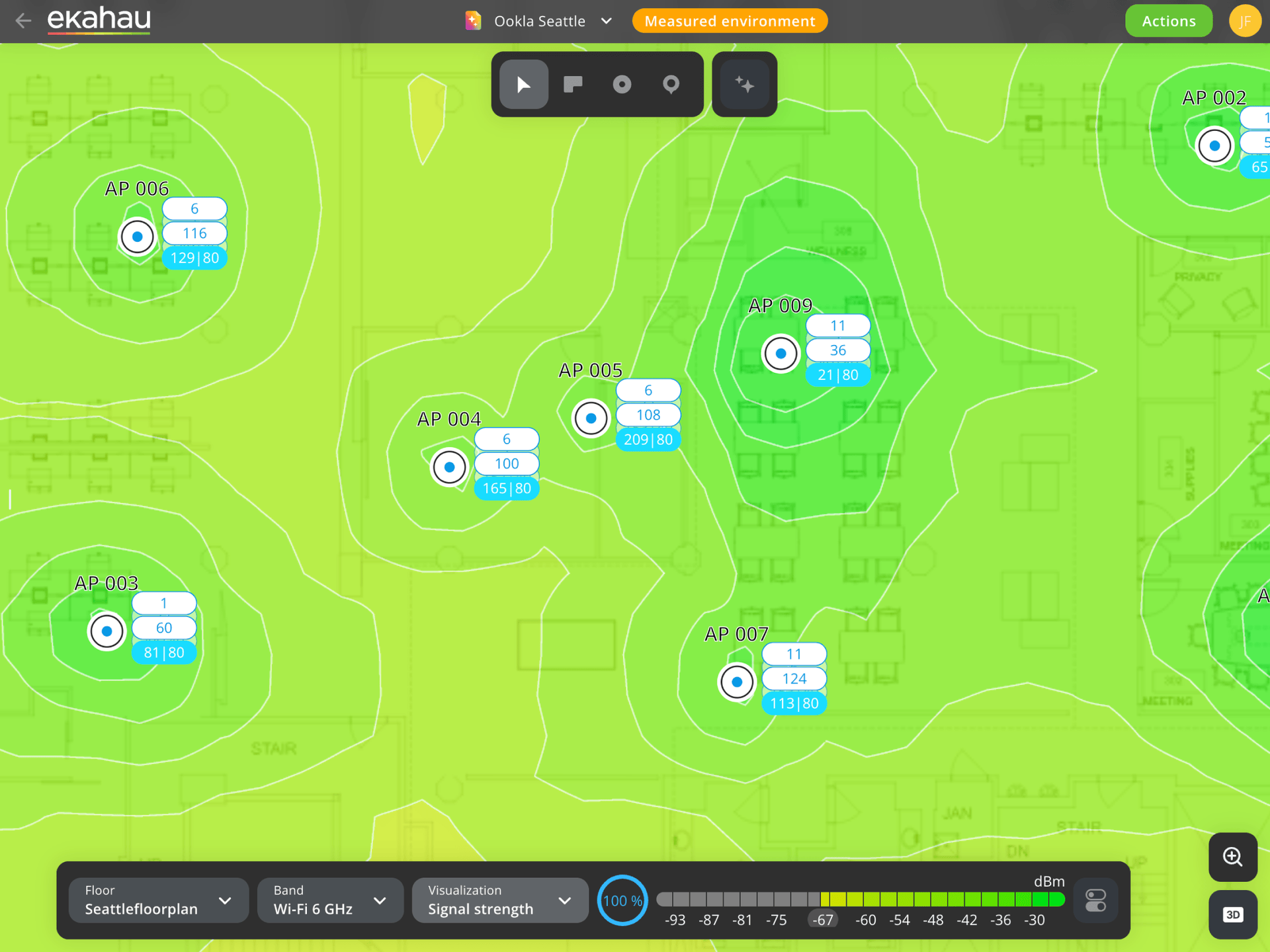
An Orange County wireless site survey from WiFi Hotshots starts with Ekahau predictive modeling and closes with post-install validation heatmaps — every engagement a fixed-fee SOW, not hourly billing. We cover the full county on a 45–60 minute dispatch from Valencia to Anaheim and Irvine: UC Irvine and Chapman lecture halls, Saddleback and Orange Coast College classrooms, clinical floors at Hoag Memorial Newport, the UC Irvine academic medical campuses in Orange and Irvine, CHOC Children’s, and Providence St.
Joseph Orange, biotech clean-room RF coexistence at Edwards Lifesciences and CooperVision, Anaheim Convention Center’s 1.8 million sq ft high-density event space, Disneyland Resort guest-facing wireless, coastal outdoor APs in Newport Beach and Laguna Beach salt-air environments, aerospace-adjacent campuses at Boeing Seal Beach and Anduril Costa Mesa (standard enterprise WLAN scope only — no classified or SCIF work), and CMU-block K-12 classrooms across Capistrano, Irvine, Santa Ana, and Newport-Mesa Unified districts. See the enterprise wireless services overview, the full enterprise network services portfolio, our engineering credentials and certifications, or send us your floor plans to start a scope call.
Why Orange County Wireless Survey Projects Fail Without an RF Baseline
Orange County building stock is not generic. Irvine Spectrum and South Coast Metro office towers are Class A glass-façade mid-rises and high-rises with low-emissivity (low-E) glazing that attenuates 5 GHz signals in the 20–25 dB range per pane — assemblies that predictive RF models tuned to clear-glass office stock routinely underestimate, producing phantom outdoor-to-indoor coverage that vanishes the moment a tenant moves in.
Coastal corridors from Seal Beach through Huntington Beach, Newport Beach, Laguna Beach, Dana Point, and San Clemente carry year-round marine-layer humidity and documented salt-air corrosion that eats non-4X enclosures and standard carbon-steel mounts within 12–24 months — an outdoor AP in a generic polycarbonate housing on the Balboa Peninsula is a replacement ticket waiting to happen.
Newport-Mesa and older Costa Mesa commercial corridors carry 1960s stucco-over-wire-lath construction where the metal lath layer behaves like a Faraday mesh at 5 GHz and above, killing cross-building RF propagation that standard drywall models would suggest is fine. Disneyland Resort and the Anaheim resort district layer open-air parade routes and queueing plazas against 50-plus-year-old back-of-house service tunnels — two completely different RF environments on the same contiguous property.
Biotech clean-rooms at the Cota Center (Edwards Lifesciences, AbbVie/Allergan, CooperVision) require RF coexistence planning against ISM-band process-control equipment on the same floor. Deploying APs without a measured RF baseline means your channel plan is built on assumptions, not data. When a Spectralink Versity handset drops on a Hoag Newport patient floor or a Zebra scanner misses the back of an Anaheim Convention Center ballroom, the root cause is always the same: the pre-deployment work was skipped or compressed.
An enterprise wireless site survey in Orange County is not optional for complex environments — it is the engineering step that separates a network that works from one that generates tickets.
The design target for a general enterprise data environment is a minimum ‑67 dBm RSSI at cell edge with at least 25 dB SNR. For voice-grade networks — Vocera Smartbadge, Spectralink Versity, Ascom — the target tightens to ‑65 dBm at cell edge with at least 25 dB SNR, and you add a 15–20% cell overlap requirement at the ‑65 dBm boundary to support fast BSS transition under 802.11r. None of those thresholds can be confirmed by looking at a floor plan. They require measurement.
Ekahau Predictive Survey Methodology: Floor Plan Ingestion to AP Placement Map
Every WFHS Orange County wireless site survey engagement begins in Ekahau AI Pro, the design and analysis module within the Ekahau Connect platform. The workflow starts with floor plan import at measured scale — either CAD-exported PDF or a photographed as-built drawing re-scaled to a known distance. Wall types are assigned material attenuation values: clear glass, low-E glass, drywall, CMU, stucco-over-wire-lath, poured concrete, and concrete with rebar each carry different dB-per-meter loss figures.
For Irvine Spectrum and South Coast Metro towers, the low-E glazing is treated separately from standard office glass; the 20–25 dB per-pane attenuation at 5 GHz materially changes where an outdoor-facing AP can reach and where it cannot. For biotech clean-room shells in the Cota Center / Irvine Spectrum corridor, stainless interior partitions and HEPA plenum steel are treated as high-attenuation assemblies distinct from generic drywall.
Once the floor plan is calibrated, the predictive engine runs AP placement simulations against the design requirement profile — coverage at ‑67 dBm RSSI (‑65 dBm for VoWLAN), channel plan, and secondary-AP overlap for 802.11k neighbor list population. The output is an AP count per floor with placement coordinates and a draft bill of materials.
For Orange County deployments, predictive design typically covers 1,200–2,000 sq ft per AP on 5 GHz and 6 GHz radios in open-plan office environments. High-density spaces — UC Irvine and Cal State Fullerton lecture halls seating 200-plus, Anaheim Convention Center exhibit halls during 5,000-plus concurrent-association events, patient floors at the UC Irvine academic medical centers or Hoag Newport, Capistrano and Irvine Unified classrooms at 1 AP per room with 30–35 concurrent devices — require tighter placement intervals driven by client count and airtime utilization rather than coverage radius alone.
Predictive survey is accurate for standard construction. On atypical OC materials — low-E Class A glazing, stucco-over-wire-lath 1960s corridors, concrete-plus-rebar shear walls, biotech clean-room stainless partitions, lead-lined imaging suites at OC academic medical centers and MemorialCare campuses — the predictive model flags uncertainty zones that require an AP-on-a-Stick validation pass before hardware procurement.
- AP count per floor with X/Y placement coordinates exportable to AutoCAD or PDF overlay
- Channel plan: 2.4 GHz channels 1/6/11 for coverage; 5 GHz 20/40/80 MHz assignments per zone (20 MHz standard in high-density Anaheim Convention Center and university lecture halls); 6 GHz LPI channel selection for Wi-Fi 6E and Wi-Fi 7 APs (indoor LPI class, no AFC required per FCC Part 15 Subpart E)
- Per-band heatmap exports showing RSSI, SNR, secondary coverage (802.11k), and co-channel interference overlay
AP-on-a-Stick Validation for OC Venues: Healthcare, Higher Ed, Hospitality, and Biotech
AP-on-a-Stick (APoS) methodology is the field-measurement backbone of any Orange County wireless site survey where drawings cannot be trusted. APoS mounts a production-model AP on a telescopic pole at the intended deployment height — typically 12–18 ft for ceiling-tile environments, 25–40 ft for convention-hall grid-iron and arena conditions. The Ekahau Sidekick 2 attaches to the survey laptop via USB-C and runs four tri-band radios scanning 2.4, 5, and 6 GHz simultaneously at 50 sweeps per second across the full 2,400–7,125 MHz range, with a full 2.4/5/6 GHz scan completing in 1.68 seconds.
The surveyor walks the floor while the Sidekick 2’s nine custom 3D antennas record passive RF measurements at every point — RSSI, SNR, noise floor, and co-channel interference — across every visible AP. That measurement data overwrites the predictive model where they differ, producing a hybrid design that combines simulation efficiency with field accuracy.
Orange County venues that mandate APoS rather than predictive-only include any facility where drawings do not reflect reality. Clinical floors at the UC Irvine academic medical system in Orange, the 2025-opened UC Irvine medical campus in Irvine (the first all-electric acute-care hospital in the US, pursuing LEED Platinum), Hoag Memorial Newport, Hoag Irvine, CHOC Children’s, Providence St. Joseph Orange, and MemorialCare Long Beach carry infection-control constraints on above-ceiling access that require cable routing to be confirmed before the first AP is mounted; lead-lined imaging suites boundary as RF-opaque zones on the heat map, and nurse-call and biomed RTLS overlays need coexistence confirmation on their dedicated RF schemes.
UC Irvine’s 1,500-plus-acre main campus, Chapman’s Orange campus, Cal State Fullerton’s 236-acre urban campus, and community-college rooms at Saddleback, Orange Coast College, and Cypress all require seat-by-seat density confirmation in 200-plus-seat lecture halls, with eduroam federation meaning a Chapman or UC Irvine credential auto-associates at a sister campus — the SSID strategy has to account for it.
Anaheim Convention Center’s 1.8 million sq ft (the largest convention center on the West Coast after the 2017 $190M expansion) runs on Smart City Networks’ 10 Gb backbone, and transient event coverage requires APoS for booth-floor airtime modeling under 5,000-plus concurrent associations. Disneyland Resort and Disney California Adventure combine guest-facing wireless for 50,000-plus daily attendees with back-of-house operations WLAN across tunnels and service corridors; outdoor queueing plazas behave differently from indoor ride buildings.
Biotech clean-rooms in the Irvine Spectrum and Cota Center corridor (Edwards Lifesciences, Allergan/AbbVie, CooperVision) require RF coexistence modeling against 2.4 GHz process-control equipment and cleanroom stainless envelopes. These institutions are referenced as venue archetypes, not as claimed engagements.
- Healthcare: infection-control ceiling-plenum constraints confirmed before cable pathways are routed; lead-lined imaging suite boundaries flagged as RF-opaque zones requiring AP relocation; VoWLAN handset roaming exercised on Spectralink Versity, Vocera Smartbadge, and Ascom form factors at the ‑65 dBm voice-grade cell edge
- Higher education and community college: seat-by-seat density modeling in lecture halls targeting 30–35 concurrent devices per AP; residence-hall roaming validation across wing transitions; eduroam SSID cross-campus validation across UC Irvine, Cal State Fullerton, Chapman, and the OC community-college district
- Hospitality and convention: in-room vs. hallway AP density testing for Ritz-Carlton Laguna Niguel, Monarch Beach, Balboa Bay Resort, and the Anaheim resort district (1 AP per room or 1 per 2 rooms for premium properties); Anaheim Convention Center booth-floor airtime modeling under 5,000-plus concurrent associations
- Biotech and clean-room: 2.4 GHz ISM coexistence with process-control equipment; stainless-partition attenuation capture; 21 CFR Part 11 / GAMP 5 documentation-compatible survey reporting
Floor plans and device counts are all we need to scope the work — most Orange County engagements are quoted on a fixed-fee SOW within three business days of a 30–60 minute scoping call.
Passive and Active Validation: Throughput, Roaming, and Voice MOS Testing
A passive survey records every RF signal in the environment without associating to any SSID. The Ekahau Sidekick 2 listens — it measures what the air contains, not what a connected session reports. Passive surveys are used for pre-deployment environment assessment (neighbor AP inventory, noise floor, DFS radar event detection) and for post-install coverage confirmation. DFS event rates in Orange County are not generic. John Wayne Airport (SNA) ground-based ATC radar is DFS-proximate to Irvine, Santa Ana, Costa Mesa, and Newport Beach commercial buildings inside the 5-mile ring; UNII-2A and UNII-2C channels see measurably higher radar-event rates near SNA than in inland OC.
The Part 77 airspace review requirement for structures greater than 200 ft AGL within 3.5 miles of SNA also applies to rooftop AP mounting on the tallest Newport Center and Irvine Spectrum buildings. Validate DFS exposure with field measurement before enabling DFS channels in production. The output is a heatmap for every band, every floor, at every survey waypoint — color-coded RSSI, SNR, and secondary coverage for 802.11k neighbor list validation.
Active validation associates to the production SSID and measures what the client actually experiences. iPerf3 bidirectional throughput runs confirm uplink and downlink capacity against the designed channel width. Roaming tests exercise 802.11r fast BSS transition — the protocol is designed to shorten roaming interruptions, and 50 ms or less is the accepted voice-grade handoff target that 802.11r was built to support.
Active testing with a roaming test client confirms whether the deployed controller configuration actually achieves it or whether a misconfigured minimum RSSI threshold is stalling the handoff (Spectralink Versity handsets in particular allow configurable minimum-RSSI policy per firmware, and WFHS guidance per the Spectralink Versity Best Practices Guide is to disable the minimum-RSSI floor and enable aggressive roaming in clinical settings).
For voice-over-Wi-Fi migration engagements — Cisco Webex Calling, CUCM, or Teams Phone — the active test also captures a MOS (Mean Opinion Score) trace across the full walking route. A voice-grade network targeting MOS 4.0+ requires the ‑65 dBm RSSI and 25 dB SNR thresholds to hold at cell edge without exception. Any area that drops below those targets appears as a gap in the post-install validation report, with a remediation recommendation tied to a specific AP or configuration change. The independent post-install validation report is the deliverable your operations team, auditor, or next engineer can pick up without context.
Orange County Market Constraints: Coastal Corrosion, Title 24 / CalGreen, and ANCA / SNA Operations
Coastal Salt-Spray Corrosion: NEMA 4X, IP66, and Stainless-Steel Mounts
The six official OC coastal cities — Seal Beach, Huntington Beach, Newport Beach, Laguna Beach, Dana Point, and San Clemente — carry year-round marine-layer humidity and documented salt-spray corrosion. An outdoor AP in a generic polycarbonate housing on the Balboa Peninsula, at the Huntington Beach Pier, or along Pacific Coast Highway in Laguna fails inside 12–24 months of deployment: connector oxidation, mount corrosion, and enclosure gasket degradation all cascade. NEMA 4X is the correct enclosure specification for coastal OC outdoor APs — NEMA 4X adds corrosion-resistance qualification (200-hour salt-spray test) to NEMA 4’s water-tightness, and IEC 60529 IP ratings do not cover corrosion on their own.
IP66 (dust-tight + strong water jets) or IP67 (dust-tight + temporary immersion) is a useful complementary spec, but the coastal survey calls out NEMA 4X or equivalent plus stainless-steel (316-grade) mounting hardware. Cisco Catalyst CW9163E Wi-Fi 6E outdoor APs are IP67 rated with an operating temperature range of ‑40°C to +65°C (extending to +55°C with solar derating) and a 100 mph sustained / 165 mph gust wind rating — appropriate for OC coastal and foothill Santa Ana wind exposure.
Cisco Catalyst IW9167E Heavy Duty APs (IP67, ‑50°C to +75°C) cover hardened industrial and port-adjacent use. The survey deliverable specifies enclosure and mount hardware for every outdoor AP location within the coastal attenuation zone.
California Title 24 Part 6, CalGreen, and LEED Coordination
California Title 24 Part 6 (the California Energy Code) and the CalGreen Building Code set prescriptive requirements for building envelope thermal performance and sustainability metrics that affect ceiling and wall penetration approvals in energy-efficient occupancies — particularly in buildings targeting LEED certification.
The 2025-opened UC Irvine medical campus in Irvine is pursuing LEED Platinum as the 6th all-electric acute-care hospital nationally, and the Title 24 / CalGreen envelope requirements drive coordination on every AP penetration through insulated drywall or Class A glass curtain wall. In new OC construction and major renovations (academic medical expansions, Chapman campus additions, new Irvine Spectrum Class A towers, Anaheim resort-district hotels, and Capistrano and Irvine Unified new school builds), the AP cable pathway from the IDF closet to the ceiling grid plenum must be routed through approved penetrations coordinated with the general contractor and the Authority Having Jurisdiction (AHJ).
On a WFHS survey engagement, the deliverable includes a cable pathway recommendation with flagged penetration points — so the contractor has the routing map before they start cutting, not after. For outdoor AP mounting, the California Building Code 2022 Chapter 16 references ASCE 7-16 for wind load calculations; most OC urban corridors qualify Exposure Category B, coastal new-build often Exposure C, and coastal-bluff Exposure D only with strict terrain/distance proof.
Santa Ana wind peaks inland at OC’s Fremont and Deer Canyons have measured 64–65 mph with regional gust potential forecast at 80 mph (historically 110 mph) — the engineering case for wind-load-rated mounts and strain-relief on foothill and hillside outdoor APs. Where the survey identifies below-ceiling pathway gaps or insufficient PoE capacity at the switch port, cabling infrastructure review is scoped as a parallel workstream in the same fixed-fee SOW.
John Wayne Airport (SNA) ANCA Curfew, Part 77, and DAS Coordination
John Wayne Airport (SNA) operates under the Airport Noise and Capacity Act (ANCA) Settlement Agreement with the most restrictive commercial-airline noise curfew in the United States — a general-aviation and commercial curfew that limits overnight operations. The curfew itself does not affect wireless design, but it directly governs outdoor AP construction windows for any building inside the SNA flight path from Irvine through Newport Beach and Santa Ana. Rooftop AP mounting on the tallest Irvine Spectrum, Newport Center, and Costa Mesa buildings within 3.5 miles of SNA and greater than 200 ft AGL triggers FAA Part 77 airspace review.
OC fire codes (referencing NFPA 72 and NFPA 1221) also drive Emergency Responder Radio Coverage Systems (ERRCS) requirements consistent with the IFC Section 510 thresholds: buildings exceeding three stories above grade, 50,000 sq ft total floor area, or 10,000 sq ft basement area typically trigger ERRCS. ERRCS mandates 99% signal coverage in critical areas (command centers, elevator lobbies, exit stairs) and 90% in remaining areas throughout the building.
The OC academic medical campuses in Orange and Irvine, Hoag Memorial Newport and Hoag Irvine, CHOC Children’s, Providence St. Joseph Orange, Anaheim Convention Center, the Disneyland Resort hotels, and the Newport Center / South Coast Plaza high-rises all exceed the 50,000 sq ft and three-story thresholds. The ERRCS BDA (bi-directional amplifier) donor antennas and remote units share plenum space with enterprise Wi-Fi APs. On a WFHS site survey, we identify existing ERRCS infrastructure in the ceiling plenum and route AP cable pathways to avoid conflict with BDA cabling.
WFHS is not an ERRCS integrator — if the survey reveals an ERRCS coverage gap or a BDA installation that does not satisfy the NFPA 1221 signal level requirements, the correct next step is a licensed ERRCS contractor, not a Wi-Fi vendor. We flag the gap, document the location, and coordinate referral. Hospital campuses represent the most complex ERRCS coordination scenario in OC; our approach to clinical wireless environments covers both the survey methodology and the post-construction validation sequence.
Scope an Orange County Site Survey.
Send floor plans to sales@wifihotshots.com or call (844) 946-8746 — we return a fixed-fee SOW, not a multi-week proposal cycle.
Survey Deliverables: Heat Maps, BOM, Install Runbook, and Validation Report
At the close of every Orange County wireless site survey engagement, the client receives a complete document set — not a summary slide deck. The Ekahau project file (.esx) is included in every handoff so a future engineer can reopen the exact survey, adjust wall materials, or re-run the coverage model without starting from scratch. The platform mix — Cisco Catalyst 9800, Cisco Meraki MR, HPE Aruba Central (AOS-10), Juniper Mist, RUCKUS One, ExtremeCloud IQ — does not change the deliverable set. Every engagement ships with the same documentation regardless of vendor, because the documentation belongs to the client, not the vendor.
For OC outdoor deployments, Cisco Catalyst CW9163E Wi-Fi 6E (IP67, NEMA 4X-compatible enclosure, 100 mph sustained / 165 mph gust wind rating) is the current-generation default; Meraki MR86 is end-of-sale, and the CW9163E / CW9166 family is specified for new coastal and Santa Ana-wind-exposed outdoor mounts.
Guest and BYOD onboarding — NAC and zero trust policy or cloud-native captive portal, certificate-based authentication — is scoped as a separate design workstream when the survey reveals that the existing SSID architecture does not segment guest traffic. AP refresh and controller migration planning for Cisco Catalyst 9800 (IOS-XE 17.15+ for Wi-Fi 7), Meraki MR, HPE Aruba Central, Juniper Mist, RUCKUS One, and ExtremeCloud IQ is scoped separately where the survey identifies a controller version or capacity constraint.
- Ekahau project file (.esx) plus annotated heatmap exports per band (2.4, 5, 6 GHz) per floor: RSSI, SNR, secondary coverage (802.11k), and co-channel interference overlay
- Vendor-agnostic AP bill of materials with AP model, mount type (316 stainless for coastal), antenna selection, PoE class requirement, enclosure rating (NEMA 4X / IP66 / IP67 per zone), and cabling length per drop
- Installation runbook: AP placement drawing, cable pathway map, switch port assignment, VLAN/SSID configuration notes for the contractor, and SNA Part 77 / ANCA construction-window callouts where applicable
- Post-install validation report: passive heatmap confirmation, iPerf3 throughput results, 802.11r roaming handoff timing, and MOS trace data for voice-grade engagements
- Design warranty: WFHS stands behind the AP count and placement — if coverage gaps appear at post-install validation that were not present in the design, we remediate the design at no additional cost
Orange County Wireless Site Survey Coverage and Service Map
WiFi Hotshots dispatches from Valencia (Santa Clarita Valley) to the full Orange County footprint on a 45–60 minute drive time to Anaheim and Irvine. OC is a single-county service area with 34 incorporated cities and several unincorporated communities. North OC coverage runs through Anaheim, Fullerton, Buena Park, Placentia, Yorba Linda, Brea, and La Habra. Central OC covers Santa Ana, Orange, Tustin, Irvine, and Costa Mesa — the Irvine Spectrum, South Coast Metro, and Newport Center Class A office corridors plus the Cota Center biotech cluster.
South OC runs through Mission Viejo, Lake Forest, Laguna Hills, Laguna Niguel, Laguna Woods, Aliso Viejo, Rancho Santa Margarita, San Clemente, San Juan Capistrano, Dana Point, and unincorporated Ladera Ranch. West OC coverage includes Cypress, Stanton, Westminster, Garden Grove, Fountain Valley, La Palma, Los Alamitos, and Villa Park, plus unincorporated Midway City. The six official OC coastal cities — Seal Beach, Huntington Beach, Newport Beach, Laguna Beach, Dana Point, and San Clemente — share the same salt-air enclosure specification.
Greenfield and brownfield engagements across the county include the 2025-opened UC Irvine medical campus in Irvine, the Anaheim Convention Center’s 1.8 million sq ft facility operated on Smart City Networks’ 10 Gb backbone, Honda Center’s 18,900-capacity arena and the adjacent OCVibe / ARTIC transit-hub district, Disneyland Resort and Disney California Adventure, John Wayne Airport (SNA), and biotech clean-rooms at Edwards Lifesciences, Allergan/AbbVie, and CooperVision.
K-12 coverage runs across Capistrano USD, Irvine USD, Santa Ana USD, Orange USD, Saddleback Valley USD, Newport-Mesa USD, Tustin USD, Placentia-Yorba Linda USD, Anaheim Union HSD, Garden Grove USD, Huntington Beach Union HSD, Fountain Valley SD, and Los Alamitos USD. Aerospace and defense-adjacent campuses at Boeing Seal Beach, Raytheon Fullerton, and Anduril Costa Mesa are scoped for standard enterprise WLAN only — classified, SCIF, and controlled-environment work is out of scope. WiFi Hotshots does not claim, and does not provide, classified / SCIF / SAP / cleared-facility work.
Multi-site Orange County engagements are coordinated from a single SOW and a single point of contact. For enterprise clients with facilities across multiple Southern California regions, we dispatch into adjacent service areas without a separate mobilization charge. Major freeway access from Valencia is via I-5 south to Anaheim, the CA-91 / SR-91 corridor east into OC’s north county, CA-57 / SR-57 through Orange, CA-55 / SR-55 through Costa Mesa and Newport, CA-22 / SR-22 through Garden Grove, and I-405 through the Long Beach / Seal Beach / Huntington Beach coastal approach; the CA-73 / SR-73 San Joaquin Hills Toll and CA-241 / SR-241 Foothill Toll corridors carry south OC access.
The geo-family below shows the regional pages where market-specific survey details — LA metro density, SFV dispatch, Inland Empire warehouse density, San Diego biotech and AFC exclusion, Palm Desert hospitality, Antelope Valley aerospace, Bakersfield energy — are documented for each sub-market.
Representative Engagement Profiles — Orange County Region
Higher-ed STEM campus wireless refresh
The OC higher-education archetype for an Orange County wireless site survey maps to a 1,000-plus-acre research university with 30,000-plus enrolled students and a dedicated health-sciences footprint — the scale familiar to anyone who knows UC Irvine, or a 236-acre urban campus serving 40,000-plus students like Cal State Fullerton, or a religious private research university like Chapman on the Orange Old Towne campus.
Typical scope covers lecture halls seating 200-plus at 30–35 concurrent devices per AP, STEM research buildings with RF-sensitive instrumentation requiring coexistence planning, a 200,000-plus sq ft library with dense stack zones where predictive-only modeling is inadequate, residence halls operating at 1:1 to 1:3 device density, and outdoor quad coverage on 6 GHz standard power with AFC coordination.
High-density lecture halls use 20 MHz channels for client-count capacity rather than wider channels for throughput. eduroam federation is a design input — UC Irvine, Cal State Fullerton, and Chapman are all in the same realm, so cross-campus visitors auto-associate with their home-institution credentials and the SSID strategy has to account for that auto-association load. The deliverable set — per-floor heatmaps, vendor-agnostic AP BOM, and post-install validation report — is formatted for review by campus IT governance. UC Irvine, Cal State Fullerton, and Chapman are referenced here as venue archetypes, not as claimed engagements.
Regional-hospital clinical-wireless network migration
The OC regional-hospital archetype maps to a 200- to 1,500-bed acute-care facility with med-surg floors, ED bays, OR suites, ICU, and outpatient clinics — the scale familiar to anyone who knows the OC academic medical system (roughly 1,461 beds across the UC Irvine flagship in Orange, the 2025-opened UC Irvine medical campus in Irvine, and four network hospitals), Hoag Memorial Newport, Hoag Irvine, CHOC Children’s, Providence St. Joseph Orange, or MemorialCare Long Beach.
Typical scope for an Orange County wireless site survey on this profile covers a phased wireless migration with ‑65 dBm voice-grade cell edges at clinical depth, VoWLAN-grade roaming for Spectralink Versity, Vocera Smartbadge, and Ascom handsets (with minimum-RSSI policy disabled and aggressive roaming enabled per Spectralink Best Practices), EHR bedside workflow coverage, RTLS overlay for patient location services on a parallel RF scheme (active-RFID or BLE), and ERRCS ceiling-plenum conflict identification across buildings meeting the 50,000 sq ft / three-story threshold.
WPA3-Enterprise or WPA2-Enterprise encryption with HIPAA-aligned network segmentation is a design input, not a compliance claim. The 2025-opened UC Irvine Irvine campus as the US’s first all-electric acute-care hospital adds a Title 24 / LEED Platinum coordination layer to any expansion survey there. The deliverable set is formatted for review by the health system’s IT governance committee. The OC academic medical system, Hoag, CHOC, Providence, and MemorialCare are referenced here as venue archetypes, not as claimed engagements.
Biotech clean-room wireless and process-control coexistence
The OC biotech archetype maps to a clean-room-anchored R&D and manufacturing campus in the Irvine Spectrum, Cota Center, or South Coast Metro corridor — the scale familiar to anyone who knows Edwards Lifesciences, Allergan/AbbVie, or CooperVision. Typical scope covers RF coexistence modeling with 2.4 GHz ISM-band process-control equipment, stainless-partition attenuation capture with the Ekahau Sidekick 2, HEPA plenum steel routing constraints above the cleanroom ceiling, 21 CFR Part 11 and ISPE GAMP 5 documentation-compatible survey reporting, and segmented SSID design isolating R&D, manufacturing, and corporate traffic.
Clean-room WLAN coexists with — not competes with — the validated process-control network. The deliverable includes explicit attenuation values captured for stainless cleanroom partitions rather than generic drywall estimates, so the as-built matches the design when the cleanroom validation team runs its own performance qualification. Edwards Lifesciences, Allergan/AbbVie, and CooperVision are referenced here as venue archetypes, not as claimed engagements.
K-12 and hillside campus wireless across coastal and inland OC
The OC K-12 archetype for an Orange County wireless site survey maps to a 50,000-plus-student unified district with 50-plus schools across coastal, inland, and hillside terrain — the scale familiar to anyone who knows Capistrano Unified, Irvine Unified, Santa Ana Unified, Orange Unified, Saddleback Valley Unified, or Newport-Mesa Unified.
Typical scope covers 1 AP per classroom design across CMU-block construction from the 1950s–1970s, 1:1 Chromebook density at 30–35 concurrent devices, voice-quality targets for district-standardized Wi-Fi calling, coastal-school outdoor AP NEMA 4X specification for Newport-Mesa and coastal Capistrano campuses, hillside / canyon campus outdoor coverage in south-OC terrain (Mission Viejo, Laguna Hills, San Juan Capistrano), CIPA / E-rate Category 2 FY2026–2030 documentation requirements with a $201.57 per-student budget floor, and content-filter-visible VLAN identification on survey deliverables.
The filing window for FY2026 closes April 1, 2026. Higher-ed hillside campuses like Concordia University Irvine and coastal-view community colleges like Saddleback also fit this hillside engagement pattern. The K-12 campus wireless design methodology covers the full survey and E-rate documentation workflow. Capistrano, Irvine, Santa Ana, Orange, Saddleback Valley, and Newport-Mesa Unified are referenced here as venue archetypes, not as claimed engagements.
Orange County Wireless Site Survey FAQs
How long does an Orange County enterprise wireless site survey take?
Timeline depends on scope. A single-floor commercial space in the Irvine Spectrum, South Coast Metro, or Newport Center Class A office corridor with complete as-built drawings can be predictively modeled and quoted within three business days of the scoping call. An AP-on-a-Stick field validation for that same floor takes one to two days on-site.
Multi-building campus engagements — UC Irvine-scale or CSUF-scale higher ed, OC academic-medical or Hoag-scale clinical campuses, Anaheim Convention Center event coverage, or district-wide K-12 rollouts across Capistrano or Irvine Unified — typically run two to four weeks from floor plan receipt to final deliverable.
Every engagement is scoped and quoted as a fixed-fee SOW before work begins.
Our 45–60 minute dispatch from Valencia to Anaheim and Irvine means mobilization is predictable, and the timeline, scope, and deliverables are defined in writing.
We do not bill hourly against an open-ended estimate.
Why do Orange County enterprise sites near the coast or theme-park districts often require AP-on-a-Stick validation on top of predictive modeling?
A predictive survey uses Ekahau AI Pro to model RF propagation through a calibrated floor plan. No physical measurement occurs — the software simulates signal paths through assigned wall materials and produces coverage heatmaps and an AP placement plan. It is fast and accurate for standard construction materials.
An AP-on-a-Stick survey mounts a production-model AP on a telescopic pole at the intended deployment height, and the Ekahau Sidekick 2 captures real measurements — actual RSSI, SNR, and noise floor — as the surveyor walks the floor.
For OC buildings with atypical attenuation (low-E Class A glazing, stucco-over-wire-lath, concrete-plus-rebar shear walls, biotech cleanroom stainless partitions, lead-lined imaging suites, CMU block) or where as-built drawings are unreliable, the AP-on-a-Stick pass is required before procurement.
Most WFHS engagements include both: predictive for initial design and AP count, AP-on-a-Stick for validation before the BOM is finalized.
Do you cover all of Orange County, or just Anaheim/Irvine?
All 34 incorporated cities of Orange County plus the unincorporated communities. North OC: Anaheim, Fullerton, Buena Park, Placentia, Yorba Linda, Brea, La Habra. Central OC: Santa Ana, Orange, Tustin, Irvine, Costa Mesa. South OC: Mission Viejo, Lake Forest, Laguna Hills, Laguna Niguel, Laguna Woods, Aliso Viejo, Rancho Santa Margarita, San Clemente, San Juan Capistrano, Dana Point.
Coastal: Seal Beach, Huntington Beach, Newport Beach, Laguna Beach, Dana Point, San Clemente.
West OC: Cypress, Stanton, Westminster, Garden Grove, Fountain Valley, La Palma, Los Alamitos, Villa Park.
Unincorporated: Ladera Ranch, Midway City, Rossmoor, Coto de Caza, and others. Dispatch from Valencia is 45–60 minutes via I-5 / CA-91 / I-405.
We also dispatch into adjacent service areas — LA metro, SFV, Inland Empire, San Diego — under the same fixed-fee SOW structure.
SNA airport engagements are quoted with airport-access credentialing and Part 77 / ANCA coordination factored in.
What does a wireless site survey cost in Orange County?
Every engagement is priced as a fixed-fee SOW — we do not bill hourly. Scope variables that drive cost: building square footage, number of floors, number of buildings, construction type (standard drywall vs. CMU block vs. stucco-over-wire-lath vs. low-E Class A curtain wall vs. biotech cleanroom stainless vs. coastal-exposure outdoor), required survey type (predictive only, AP-on-a-Stick, or combined predictive-plus-validation), coastal-corrosion enclosure specification (NEMA 4X and 316 stainless for Newport / Laguna / Huntington / Dana Point / San Clemente / Seal Beach outdoor), and whether post-install validation and a formal validation report are in scope.
We return a written SOW quote within three business days of the scoping call of receiving floor plans and a scope description.
Send floor plans to sales@wifihotshots.com or call (844) 946-8746.
No engagement begins without the client signing off on the fixed-fee price first.
What deliverables do we receive after a WFHS site survey?
Every engagement produces: the Ekahau project file (.esx) for future re-use; annotated heatmap exports per frequency band (2.4, 5, 6 GHz) per floor showing RSSI, SNR, secondary coverage (802.11k), and co-channel interference;
a vendor-agnostic AP bill of materials with mount type (316 stainless for coastal), antenna, PoE class, enclosure rating (NEMA 4X / IP66 / IP67), and cabling callouts; an installation runbook for the contractor; and a post-install validation report with passive heatmap confirmation, iPerf3 throughput results, 802.11r handoff timing, and MOS trace data for voice-grade engagements.
The deliverable set is the same regardless of the AP vendor — Cisco, Meraki, HPE Aruba, Juniper Mist, RUCKUS, or Extreme.
Outdoor Wi-Fi 6E APs default to Cisco Catalyst CW9163E (MR86 is end-of-sale) for coastal and Santa Ana-wind exposure.
The documentation belongs to the client and is formatted for a 10-year shelf life.
Can WFHS survey in a live Orange County production environment without downtime?
Yes. Passive survey requires no network access and causes zero disruption to production traffic — the Ekahau Sidekick 2 listens passively and never associates to any SSID. Active throughput testing and roaming validation require a brief association to a production or test SSID, which does not affect other clients on the network.
Full iPerf3 load testing, which generates several hundred Mbps of synthetic traffic to stress the uplink, is scheduled during off-hours or in a maintenance window if the client requests it.
We have conducted passive surveys in live OC clinical patient floors, biotech cleanrooms with active process-control workflows, Anaheim Convention Center event setups, and Disneyland Resort guest-facing environments without interrupting production operations.
Hospital and cleanroom environments typically drive a pre-survey coordination call with clinical engineering or the validation team to identify access windows that do not conflict with active patient care or validated production runs.
The pre-survey coordination document we send before mobilization identifies which test phases, if any, require an off-hours window.
Do you survey UC Irvine, Chapman, and OC K-12 campuses differently than corporate offices?
The survey instruments are the same; the design targets differ. UC Irvine-scale and Cal State Fullerton-scale higher education, Chapman private university, OC community colleges (Saddleback, Orange Coast, Cypress, Fullerton College, Santa Ana College, Irvine Valley, Coastline),
and OC K-12 districts (Capistrano, Irvine, Santa Ana, Orange, Saddleback Valley, Newport-Mesa, Tustin, Placentia-Yorba Linda, Anaheim UHSD, Garden Grove, Huntington Beach UHSD, Fountain Valley, Los Alamitos) are designed for 1:1 client device density per classroom or lecture hall seat targeting 30–35 concurrent associations per AP, not the lower density of a corporate open-plan floor.
That changes the AP placement interval, the channel width selection (20 MHz standard in high-density zones), and the roaming design.
K-12 engagements are typically scheduled during summer recess to allow room-by-room passive walkthroughs in CMU-block buildings where hallway-only AP plans fail under classroom load.
E-rate procurement requirements mean the deliverable set must include documentation compatible with the district’s Category 2 equipment and installation submission for the FY2026–2030 funding cycle. eduroam federation (UC Irvine, Cal State Fullerton, Chapman all in the same realm) is designed into the SSID strategy so cross-campus visitors auto-associate without IT intervention.
UC Irvine, Chapman, Cal State Fullerton, and the OC K-12 districts are referenced here as venue archetypes, not as claimed engagements.
How does an Orange County wireless site survey handle coastal or theme-park RF issues outside the original scope?
The fixed-fee SOW covers the defined scope. If the survey uncovers something outside that scope — an ERRCS gap requiring a licensed BDA integrator at an OC academic medical, Hoag, CHOC, or Providence campus, a structured cabling deficiency that needs remediation before APs can be installed in a Newport Center or Irvine Spectrum tower, a DAS antenna placement conflict inside the Anaheim Convention Center or Honda Center, or a coastal-corrosion failure of existing outdoor APs that requires NEMA 4X replacement — we document the finding in the validation report with a clear description of the issue and its location.
We then issue a separate change-order estimate for any additional WFHS scope and, where the finding is outside wireless engineering (like ERRCS installation or classified-environment work at aerospace-adjacent campuses), we refer to the appropriate licensed contractor.
The client is never billed above the SOW total without a signed change order first.
That is the operational definition of a fixed-fee engagement.
Do Wi-Fi 7 access points change how we survey Irvine Spectrum-class office towers?
Yes. Wi-Fi 7 introduces 320 MHz channel widths in 6 GHz (Standard Power mode limits the US to a single 320 MHz channel), Multi-Link Operation across 2.4, 5, and 6 GHz concurrently, and preamble puncturing that carves out only the interfered 20 MHz subchannel within an 80/160/320 MHz bonded channel. The IEEE 802.11be standard targets at least one mode at 30 Gbps-plus.
That reshapes the survey: every floor must be validated across all three bands in the same session, 4K-QAM proximity is modeled separately from edge coverage, and the predictive model must account for MLO band-steering behavior rather than treating 5 and 6 GHz as independent plans.
Do low-emissivity glass curtain walls on Class A Irvine Spectrum towers actually block Wi-Fi?
Yes, and they are one of the more aggressive attenuators in the OC tower stock. Low-E coatings were engineered to reflect infrared energy, which overlaps the 5 and 6 GHz Wi-Fi bands enough that signal will not reliably penetrate the envelope from an AP placed one floor above or below. The practical consequence: no coverage borrowing across curtain-wall floors and no shared APs between floors separated by low-E glass.
Ekahau AI Pro predictive modeling uses per-wall attenuation values, but library defaults under-represent modern coated glass — we field-measure each pane with Sidekick 2 during calibration walk and feed the measured dB into the model before producing the Orange County site survey deliverable.
Does proximity to SNA radar and Part 77 airspace affect our rooftop AP and DFS channel strategy?
Yes. Two separate issues stack near John Wayne (SNA). First, 14 CFR Part 77 requires FAA Form 7460-1 notification at least 45 days prior to any construction or alteration exceeding 200 ft AGL within specified distances of the airport — and construction equipment (cranes, lifts) is not exempt. If rooftop or mast work enters scope, we flag the OE/AAA filing timeline in the survey SOW.
Second, DFS channels in UNII-2A/C are exposed to more frequent radar detection events near coastal and airport radar.
The survey deliverable includes a Sidekick spectrum-scan log over representative hours so your controller’s DFS channel plan is based on measured empirical reliability, not vendor defaults.
Should OC enterprises plan CBRS private LTE/5G alongside Wi-Fi?
Sometimes — and CBRS does not interfere with Wi-Fi because it operates in 3.5 GHz, not the Wi-Fi bands. CBRS uses the three-tier Spectrum Access System: Incumbent Access, Priority Access License (PAL — 10 MHz channels licensed county-by-county within 3550–3650 MHz), and General Authorized Access (GAA — zero-cost, must accept interference from PAL and Incumbent).
A SAS coordinates the tiers using approved Environmental Sensing Capability sensors.
In practice, CBRS fits outdoor-to-indoor yard coverage, SIM-authenticated IoT, and areas where Wi-Fi roaming across large outdoor zones is not viable. Wi-Fi remains the primary indoor fabric. We scope CBRS as a parallel deliverable when the use case justifies it, not a replacement.
Can we use 6 GHz Wi-Fi 6E/7 for outdoor coverage on Costa Mesa corporate campuses?
Only with Standard Power (SP) APs coordinated by AFC. Low-Power Indoor (LPI) 6 GHz APs are restricted by FCC rule to indoor operation — not permitted outdoors, in vehicles, or on battery-powered outdoor devices. Standard Power APs are authorized in UNII-5 (5.925–6.425 GHz) and UNII-7 (6.525–6.875 GHz) at up to 36 dBm EIRP (23 dBm/MHz PSD); client devices are capped at 30 dBm EIRP.
SP devices must query an Automated Frequency Coordination system before using channels, so incumbent fixed-service microwave links stay protected.
If your rollout assumes outdoor 6 GHz on rooftops or courtyards, we confirm the AP hardware is SP-certified and the deployment is registered with an approved AFC provider.
What cable plant and PoE budget should we plan for today to avoid re-pulling for Wi-Fi 7?
Pull two Category 6A runs to every AP location and budget 802.3bt Class 6 (60 W) PoE++ on the switch port. ANSI/TIA-568.1-E requires minimum two Cat 6A runs to each wireless AP, and Wi-Fi 7 APs need dual 10GBASE-T connections to deliver full aggregate data rates. The Arista C-460 Wi-Fi 7 AP, for example, requires 802.3bt Class 6 PoE++ with dual 10GbE PHY uplinks.
Cat 6 only supports 10GBASE-T to about 55 m, which is under-spec for a standard 100 m channel — pulling Cat 6 now means re-pulling when the AP refresh lands.
Dual Cat 6A also gives you LAG, redundancy, and full 100 m support in one pass.
How do ERRCS (public-safety radio) requirements affect my Wi-Fi site survey scope?
ERRCS is a separate scope from Wi-Fi, but the two share cable pathways and building penetrations, so we raise it at survey kickoff. NFPA 1225 (2022) Chapter 18 requires 95% floor-area radio coverage in general building areas and 99% in critical areas — command centers, fire pump rooms, exit stairs, passageways, elevator lobbies, and sprinkler section valves.
NFPA 72 sets the minimum inbound and outbound signal strength at -95 dBm with DAQ 3.0 audio quality.
If your OC new-construction permit requires ERRCS, the riser and cable-tray schedule has to accommodate the donor antenna, BDA, and coax run alongside the Wi-Fi structured cabling. Coordinating both trades early prevents demolition later.
What wireless encryption does HIPAA require for OC health systems?
HIPAA 45 CFR § 164.312(e)(1) requires covered entities to implement technical security measures to guard against unauthorized access to e-PHI transmitted over electronic networks. Encryption itself is an “addressable” specification under 45 CFR § 164.312(a)(2)(iv) and (e)(2)(ii), meaning it must be implemented if your risk assessment determines it is reasonable and appropriate — which, for modern Wi-Fi, it effectively always is.
Practically, OC health systems deploy WPA3-Enterprise 192-bit, which activates Protected Management Frames by default (MFPR bit set to 1 in RSN Capabilities) and provides 192-bit cryptographic strength.
That is the Wi-Fi Alliance’s recommended posture for healthcare, finance, and government networks carrying sensitive data.
How does PCI DSS 4.0 affect wireless scope at OC retail locations?
PCI DSS requires quarterly wireless scans of all Cardholder Data Environments — every 90 days, maximum interval between scans — with rogue wireless devices detected and eliminated. “Quarterly” is defined in PCI DSS v4.0 as at least once every three months. Acceptable methods include wireless analyzer sweeps, physical inspection, or wireless IDS, and most multi-site OC retailers (South Coast Plaza tenants, Irvine Spectrum, The District) combine them.
For that reason, we scope retail wireless scanning as a recurring subscription engagement, not a one-time deliverable.
The initial wireless site survey establishes baseline rogue posture and AP inventory; the quarterly scan service maintains the PCI attestation between assessments.
Do OC-based financial firms with NY operations need special wireless controls under NY DFS?
Yes. 23 NYCRR Part 500 applies to Covered Entities regulated by NY DFS regardless of where the equipment sits physically — an Irvine or Newport Beach office handling NY-regulated workloads is in scope.
Section 500.12 mandates MFA for any individual accessing a Covered Entity’s Information Systems, defined as verification of at least two factors from knowledge, possession, or inherence (full MFA implementation deadline was November 1, 2025 under the Second Amendment).
Section 500.13(a) requires a documented asset inventory program, and wireless APs are in-scope assets.
The clean architecture that satisfies both: WPA3-Enterprise 802.1X with MFA, a certificate-authenticated device inventory, and a signed AP asset list refreshed on every controller change.
What wireless requirements apply under CMMC 2.0 for OC defense contractors?
CMMC 2.0 Level 2 is built on NIST SP 800-171 and specifically requires two wireless controls: AC.L2-3.1.16 “Authorize wireless access prior to allowing such connections” and AC.L2-3.1.17 “Protect wireless access using authentication and encryption.” The DoD CIO CMMC Assessment Guide Level 2 v2.13 (September 2024) is the authoritative reference.
For OC aerospace and defense contractors handling CUI, the practical implementation is WPA3-Enterprise or WPA2-Enterprise with FIPS-validated crypto, an explicit authorization workflow for any new wireless endpoint, and SSID-level segregation so the survey deliverable documents which SSIDs carry CUI traffic versus contractor-general or guest.
We build that SSID/VLAN map into the design before AP placement is finalized.
How do you validate voice-over-Wi-Fi for healthcare handsets at OC hospitals?
Active validation, not passive heatmapping. Vocera specifies a minimum -65 dBm RSSI with a minimum SNR of +25 dB based on a -90 dBm noise floor across all badge models (B3000n, V5000 Smartbadge, C1000 Minibadge), and single-band operation — avoid inter-band roaming deployments.
Spectralink Versity 95 and 96 support 802.11r adaptive fast-transition as of firmware R2.1.1; the Versity 92 supports FT but not adaptive, which changes roam behavior when adaptive is enabled on the controller.
Our survey measures packet loss, jitter, and MOS during an active call walk, not just RSSI.
We also model AP capacity: a flooded AP (concurrent call count exceeding capacity) will degrade every active call on that radio regardless of signal.
How do we survey rack-heavy distribution centers common in Orange and Santa Ana industrial zones?
AP-on-a-Stick field validation with a tri-band Ekahau Sidekick 2, run through the actual aisles. Warehouse rack attenuation varies by 10 dB or more depending on whether racking is empty or stocked, the inventory material (metal stock attenuates very differently from cardboard), and aisle orientation relative to the AP — predictive-only surveys miss those swings.
Common OC distribution-center handhelds (Zebra TC53/TC58 on Qualcomm 6490) support Wi-Fi 6E, so the survey validates both 5 GHz-only and 6 GHz-capable fleet segments.
For high-bay ceilings, the Cisco Catalyst 9166D1 directional-antenna Wi-Fi 6E AP focuses RF downward into the aisle across all three bands rather than spraying into the joists above.
Which current-gen Wi-Fi 6E APs do you recommend for OC enterprise offices?
We are vendor-agnostic and size the AP to the environment, not the logo. Cisco Catalyst 9166 runs three 4×4 radios across 2.4/5/6 GHz with environmental sensors; the 9136 adds a hexa-radio architecture (two 4×4 plus an 8×8) for the densest floors. Meraki MR57 is tri-radio 4×4:4 with a 7.78 Gbps aggregate frame rate, a dedicated fourth radio for WIDS/WIPS, and dual 5 Gbps mGig uplinks.
Juniper Mist AP45 delivers 4800 Mbps on 6 GHz and 2400 Mbps on 5 GHz with four 4×4 radios and a scanning radio.
HPE Aruba 650 Series hits 7.8 Gbps aggregate with dual 5 Gbps ports. The survey decides which fits your density and ceiling height.
Which Wi-Fi 7 APs are production-ready for OC offices ready to skip Wi-Fi 6E?
Two families are shipping and shovel-ready. The Arista C-460 runs three 4×4 Wi-Fi 7 access radios on 2.4/5/6 GHz with a dedicated tri-band 2×2 multifunction scan radio, integrated L1+L5 GNSS, and a HADM-enabled BLE IoT radio on the Qualcomm Networking Pro 1220 platform. Uplinks are dual 10GbE PHYs with dual 802.3bt Class 6 PoE++ inputs.
The dedicated scan radio provides continuous WIPS across all three bands.
The Arista C-460E is the enterprise-grade form-factor variant with the same radio architecture. On the Cisco Meraki side, the CW9172I / CW9176I / CW9178I indoor family delivers MLO, 320 MHz 6 GHz, and preamble puncturing with cloud-managed provisioning.
Can we consolidate OC multi-site Wi-Fi on one virtual controller?
Yes. The Cisco Catalyst 9800-CL (Cloud) “Large” scale template supports up to 6000 access points and 64,000 clients per instance, which covers nearly any OC enterprise portfolio on a single controller. Deployable on private hypervisors (VMware, KVM) or public cloud (AWS, Google Cloud, Azure), it runs IOS XE with full feature parity to the physical 9800 appliances and supports Cisco and Catalyst Wi-Fi 6, 6E, and 7 APs.
Smaller templates exist for focused deployments: Medium at 1000 APs / 10,000 clients and Small at 200 APs / 3000 clients.
We size the template during the design phase so the HA pair, AP licensing, and client scale match your actual site count, not a marketing ceiling.
What location accuracy can Cisco Spaces/Hyperlocation deliver for OC hospital asset tracking?
In an optimal deployment, Cisco Spaces locates associated wireless clients to about one meter accuracy with 50% error distance. That level requires Hyperlocation, which combines RSSI with Angle of Arrival (AoA) from specialized hardware modules for precise triangulation. Cisco’s Location Accuracy Test tool validates measured versus calculated device location at a three-second display refresh so AP placement can be tuned before go-live.
Without AoA Hyperlocation modules, accuracy degrades to RSSI trilateration at zone-level presence — useful for room-scale, not for IV-pump-scale asset tracking.
For OC health systems expecting meter-level location, we scope Hyperlocation infrastructure (modules, AP placement density, cabling) as a separate line item from signal coverage.
How do we approach high-density Wi-Fi at OC venues like Anaheim Convention Center and Honda Center?
Tight channel plans, narrow channel widths, and directional antennas. Cisco’s High Client Density Design Guide is explicit: 20 MHz channel width is highly recommended for all high-density deployments — it is better to place more APs on 20 MHz channels than to run 40 MHz secondary channels that carry data frames much less efficiently than two independent 20 MHz cells.
Use every available channel in the regulatory domain, including DFS (and TDWR where permitted), after validating radar impact.
For stadium-class venues, Cisco’s Connected Stadium Wi-Fi Solution is the reference architecture, and the Catalyst 9104 specialized narrow-beam stadium antenna focuses RF into defined seating sectors rather than broadcasting omnidirectionally. Survey scope includes sector modeling, not just coverage contours.
What outdoor AP platform applies for OC coastal city deployments?
For Huntington Beach, Newport Beach, Dana Point, and similar shoreline sites, specify outdoor-rated APs with factory corrosion-resistant enclosures and stainless-steel mounting hardware. The HPE Aruba 670 Series Outdoor Access Points are purpose-designed for environmentally challenging locations including high-humidity and salt-air exposure.
Outdoor 6 GHz coverage has a hard constraint: FCC rules prohibit Low-Power Indoor (LPI) 6 GHz devices outdoors, so any outdoor 6 GHz AP must be Standard Power (AFC-coordinated) certified.
Coastal installations near shoreline are also subject to coastal-development and visual-impact rules, so we coordinate siting with property management and any AHJ holding jurisdiction over the coastal zone before locking placement in the design.
What safety standards apply when surveying high-ceiling OC venues and hospitals?
OSHA 29 CFR § 1910.28 requires fall protection for any employee on a walking-working surface with an unprotected side or edge four feet or more above a lower level — that includes stairway landings, holes (including skylights), dockboards, and rope-descent systems. AP-on-a-Stick surveys above 8–10 feet require ladder or lift scope with qualified operators; we build rental cost and operator certification into the SOW, not as a change order.
For OC hospital work under HCAI permits, the Seismic Certification Preapproval (OSP) program covers non-structural component anchorage per CBC 1705.14.3 / 1705A.14.3 and ASCE 7 Section 13.2.2.
AP mounting for Non-Structural Performance Category components must satisfy the NPC spec — we coordinate with the OSHPD-approved anchorage contractor on the install.
WiFi Hotshots is a minority-owned, engineer-led wireless services firm with 25 years of enterprise networking leadership. Our Orange County wireless site survey practice runs on Ekahau Connect with Ekahau ECSE certified survey engineers and a multi-CCIE bench — every engagement a fixed-fee SOW, vendor-agnostic, and documented to a standard your operations team can reference for the life of the infrastructure.
For clinical wireless environments across the OC’s academic medical, Hoag, CHOC, and Providence campuses or Wi-Fi 7 design work for a greenfield biotech expansion in the Irvine Spectrum or a new Class A tower in South Coast Metro, the methodology and deliverable set are identical: measure first, design to data, validate before the invoice closes. Request a Fixed-Fee SOW and we return a written quote within three business days of the scoping call of receiving your floor plans.
Orange County Site Survey — Further Reading
Adjacent disciplines that intersect with an Orange County wireless site survey on every greenfield, brownfield, and migration build — the wired access fabric that powers the AP, the data-center leaf the WLAN controller anchors to, the SD-WAN edge that hands voice and clinical traffic out, the security plane that enforces WPA3-Enterprise + EAP-TLS at the OC tenant boundary, the SBC perimeter that carries Wi-Fi-calling SIP-TLS and SRTP, the Cat 6A horizontal cable plant terminated at the AP, the GPU and inference cluster that hosts contact-center agent-assist for OC retail and hospitality, and the post-install validation pass that proves the deliverable. Each link below describes how the destination service line interacts specifically with the OC site-survey deliverable — not with that service line in the abstract.
- Campus LAN refresh — the wired access fabric the OC AP plant powers and trunks into: 802.3bt Type 4 (90 W) PoE++ at the access-switch downlink for tri-radio Wi-Fi 7 APs across Allergan / Edwards Lifesciences / Hyundai HQ Fountain Valley headquarters per IEEE 802.3bt-2018, multigig 2.5 / 5 / 10GBASE-T uplink negotiation per IEEE 802.3bz for 6 GHz peak-demand traffic in Class A Irvine Spectrum and South Coast Metro towers, and the post-authentication dynamic VLAN landing at ISE / ClearPass / Mist Access Assurance that runs on top of the 802.1X EAP-TLS supplicant flow per IETF RFC 5216 for OC tenant segmentation.
- Data center fabric design — the EVPN-VXLAN spine-leaf overlay that hosts the wireless controller cluster (Catalyst 9800-CL or 9240-MCR) and the OC-anchor AAA / RADIUS / NAC plane: per IETF RFC 7348 VXLAN tunneling and IETF RFC 7432 EVPN signaling, with VRF placement that determines whether biotech (Boehringer Ingelheim, Endologix), medical-device manufacturing (Edwards Lifesciences), and clinical (UCI Health, CHOC, Hoag, Providence Mission OC) tenants share a fabric or sit behind a hard tenant boundary aligned to HIPAA Security Rule technical safeguards and FDA 21 CFR Part 11 electronic-records integrity controls.
- SD-WAN fabric design and migration — the dual-carrier WAN edge that hands clinical, retail, hospitality, and corporate traffic out from OC sites with per-app SLA probing, SIP-TLS / SRTP-aware path selection, and DSCP-marking preservation across MPLS-replacement internet underlays; the IPsec / IKEv2 underlay per IETF RFC 7296 carries the overlay across OC carrier transport (Frontier, Spectrum Business, Cox Business) and Disneyland Resort / Anaheim Convention Center venue-side handoff, with the LAN-side trunk handshake (VLAN, MTU, BFD) between the wireless-controller campus core and the SD-WAN edge that has to match exactly for VoWLAN and Webex-Calling survivability.
- Network security architecture — the WPA3-Enterprise + EAP-TLS + per-SSID dynamic VLAN policy plane that the OC AP plant feeds into, with NAC enforcement on Cisco ISE / HPE Aruba ClearPass / Juniper Mist Access Assurance per IETF RFC 5216 EAP-TLS and the modern IETF RFC 9190 EAP-TLS 1.3 update, plus PCI DSS 4.0.1 cardholder-data-environment segmentation per PCI DSS 4.0.1 for South Coast Plaza, Fashion Island, and Disneyland Resort retail tenants and HIPAA Security Rule segmentation across UCI Health, CHOC, Hoag, and Providence campuses.
- Unified communications migrations — the SBC perimeter and Webex Calling / Teams Phone Direct Routing / Zoom Phone media plane that consumes the OC WLAN as its first-hop transport: voice-grade −65 dBm RSSI / 25 dB SNR / 20-25% cell overlap targets that hold a Spectralink Versity, Vocera, or Cisco 8821 handset roam under 50 ms per IEEE 802.11r-2008 Fast BSS Transition, SIP-TLS signaling encryption per IETF RFC 5630, and SRTP media encryption per IETF RFC 3711 for clinical voice across OC academic-medical, CHOC, Hoag, and Providence campuses where the conversation budget cannot tolerate a re-authentication delay.
- Structured cabling — the Cat 6A horizontal cable plant that terminates at every OC AP location, with channel certification per ANSI/TIA-568.2-E at the 100 m channel length, bundled-cable thermal de-rating per ANSI/TIA TSB-184-A for dense AP-and-camera bundles in Anaheim Convention Center high-density event coverage zones, and pathway-and-spaces coordination per ANSI/TIA-569-D for South County biotech cleanroom envelopes and lead-lined imaging suites where the cable plant route determines AP placement before the survey heatmap can be drawn.
- AI-ready infrastructure — the GPU and inference cluster that hosts contact-center agent-assist, real-time transcription, conversational-AI voicebots, and computer-vision analytics for OC retail (South Coast Plaza, Fashion Island), hospitality (Disneyland Resort, Anaheim Convention Center), and clinical-imaging (UCI Health, CHOC, Hoag DICOM workflow) workloads; the sub-200 ms voicebot turn-around budget requires inference placement adjacent to the SBC media-anchor leg or the OC academic-medical EVPN-VXLAN tenant, not behind a regional firewall hop, with WLAN-side QoS topology that gives gradient-update and inference-callback traffic precedence over guest browsing on shared 5 / 6 GHz uplinks per Wi-Fi Alliance Passpoint Hotspot 2.0 federated-guest framing.
- Independent validation testing — post-install certification of every OC AP plant, with passive heatmap confirmation per band, iPerf3 bidirectional throughput per channel-width plan, IEEE 802.11r handoff timing under the 50 ms voice-grade target, MOS trace per ITU-T P.800.1 across the walking route for clinical and contact-center voice, and DFS event-log capture against the John Wayne Airport (SNA) UNII-2A / UNII-2C radar-proximity envelope; deliverable is a vendor-neutral acceptance report keyed to CWNP CWDP survey methodology, FERPA-compatible documentation for OC K-12 (per FERPA) districts (CUSD, OUSD, IUSD), and ANSI/TIA-568.2-E channel-acceptance framing for the structured-cabling closeout — not a screenshot of a vendor cloud-controller dashboard.
Orange County Site Survey Engineering References
Technical claims on this page are cited against the following primary sources. Coverage targets (‑65 dBm voice-grade RSSI, ‑67 dBm data-grade RSSI, 25 dB SNR) are per the Cisco Meraki Signal-to-Noise Ratio and Wireless Signal Strength guidance and Meraki RF Design Best Practices. 802.11r fast BSS transition roaming target (50 ms or less, voice-grade) is an industry-accepted deployment threshold.
Ekahau Sidekick 2 hardware specifications per Ekahau Sidekick 2 product page. Wi-Fi 7 certification per Wi-Fi Alliance CERTIFIED 7 Resources; Wi-Fi 6 and 6E per Wi-Fi Alliance CERTIFIED 6 Resources. FCC 6 GHz device class definitions (LPI, Standard Power, VLP) per FCC Part 15 Subpart E. ERRCS applicability thresholds and coverage percentages (99% critical / 90% remaining) per BOMA LAFD ERRCS article citing LA County fire code (NFPA 72 / NFPA 1221); OC fire code is consistent with the IFC Section 510 thresholds.
Signal level minimums per NFPA 1221, Standard for the Installation, Maintenance, and Use of Emergency Services Communications Systems, and International Fire Code Section 510. CWNP CWDP design methodology per CWNP CWDP certification page. NetAlly AirCheck G3 Pro for independent post-install validation across 2.4, 5, and 6 GHz. California Title 24 Part 6 energy code per California Energy Commission. California Building Code 2022 Chapter 16 wind load references ASCE 7-16.
John Wayne Airport (SNA) operational constraints per FAA Part 77 airspace review for structures greater than 200 ft AGL within 3.5 miles of SNA. OC academic-medical system bed count and 2025 Irvine campus opening per UC Health academic health centers reference. Anaheim Convention Center 1.8 million sq ft facility scope per Visit Anaheim primary source. Spectralink Versity RSSI policy and aggressive-roaming guidance per the Spectralink Versity Best Practices Guide on support.spectralink.com. Cisco Catalyst CW9163E (outdoor Wi-Fi 6E, IP67, ‑40°C to +65°C, 100 mph sustained / 165 mph gust) and Catalyst IW9167E Heavy Duty (IP67, ‑50°C to +75°C) per Cisco product data sheets.