

Wireless Site Survey Los Angeles: predictive design plus on-site validation
Ekahau ECSE certified engineers and a multi-CCIE bench deliver every Los Angeles wireless site survey as a fixed-fee SOW — no hourly billing, no scope surprises.
WiFi Hotshots is a vendor-agnostic enterprise network engineering firm serving enterprise customers, enterprise architects, infrastructure buyers, and network engineering teams across Los Angeles County and greater Southern California.
Ekahau ECSE — Certified Survey Engineer on every engagement
Multi-CCIE engineering bench
Fixed-fee SOW — no T&M surprises
25 years of enterprise networking leadership
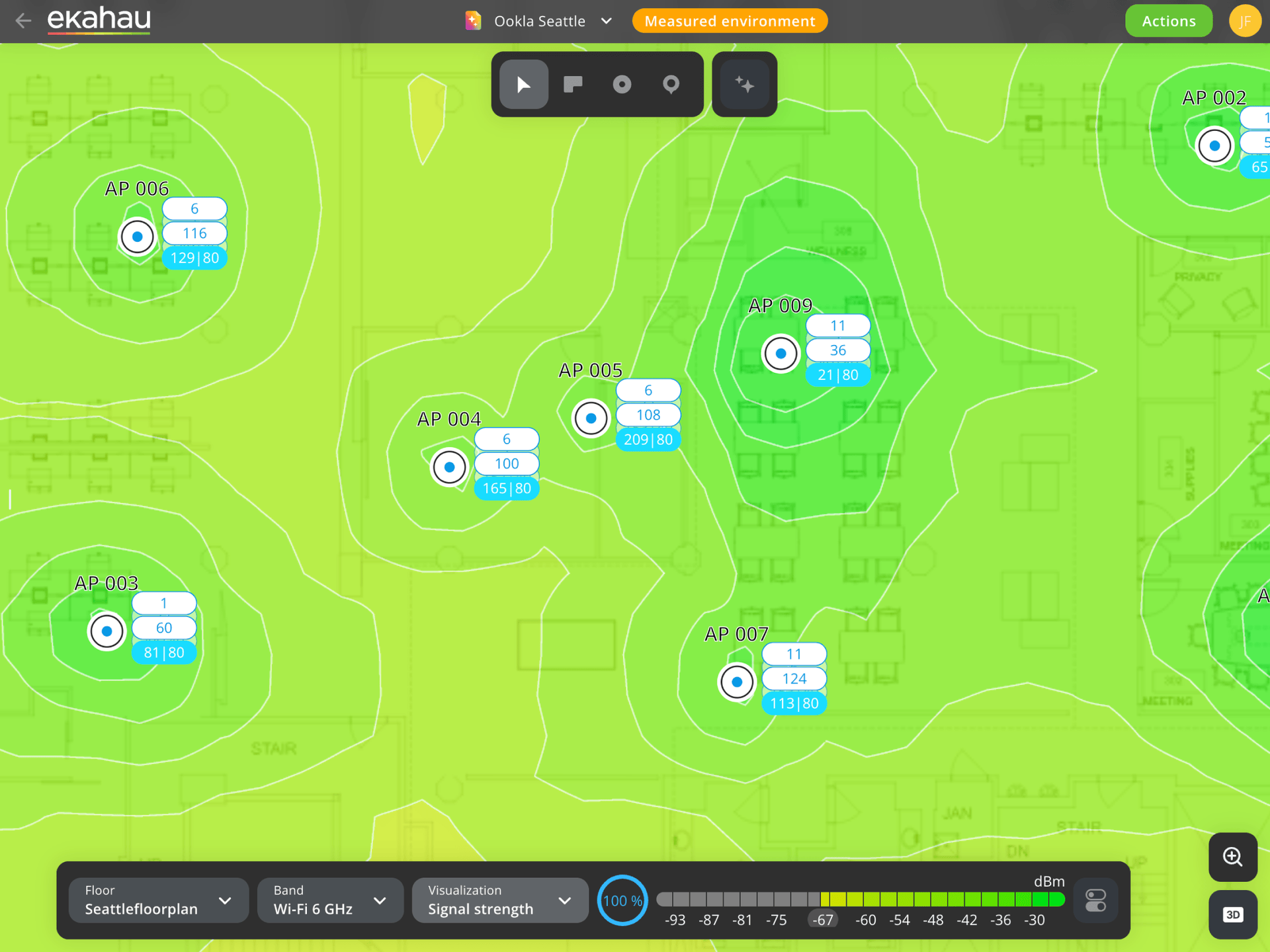
A Los Angeles wireless site survey from WiFi Hotshots starts with Ekahau predictive modeling and closes with post-install validation heatmaps — every engagement a fixed-fee SOW, not hourly billing. We cover the full metro: DTLA office towers, LAUSD campuses, hospital floors at Cedars-Sinai and UCLA Health, distribution centers in City of Industry and Vernon, and stadium-scale venues from SoFi to Crypto.com Arena. See the enterprise wireless services overview, the full enterprise network services portfolio, our engineering credentials and certifications, or send us your floor plans to start a scope call.
Why Los Angeles Wireless Survey Projects Fail Without an RF Baseline
Los Angeles building stock is not generic. DTLA’s Bunker Hill towers are poured-in-place concrete with post-1994 seismic shear walls — assemblies that predictive RF models tuned to standard drywall-and-stud office stock routinely underestimate. Validation passes confirm attenuation through rebar-reinforced shear walls and let the engineering team reconcile the predictive heat map with measured reality. Westside medical campuses mix steel-framed towers with 1960s masonry wings where as-built drawings are decades out of date.
A Los Angeles site survey in these clinical wings typically requires AP-on-a-Stick validation, not predictive-only, because the attenuation differential between a 1965 masonry corridor and a 2012 steel-framed tower on the same campus exceeds 15 dB at 5 GHz. Hollywood and Burbank production campuses layer open soundstage spans against dense multi-tenant office build-out — two completely different RF environments on the same 25-acre lot.
Deploying APs without a measured RF baseline means your channel plan is built on assumptions, not data. When a Zebra TC-series scanner drops association mid-aisle or a Spectralink handset holds to a ‑82 dBm AP three rooms away, the root cause is always the same: the pre-deployment work was skipped or compressed.
An enterprise wireless site survey in Los Angeles is not optional for complex environments — it is the engineering step that separates a network that works from one that generates tickets. The design target for a general enterprise data environment is a minimum ‑67 dBm RSSI at cell edge with at least 25 dB SNR. For voice-grade networks — Vocera Smartbadge, Spectralink, Ascom — those targets hold, and you add a 15–20% cell overlap requirement at the ‑67 dBm boundary to support fast BSS transition under 802.11r. None of those thresholds can be confirmed by looking at a floor plan. They require measurement.
Ekahau Predictive Survey Methodology: Floor Plan Ingestion to AP Placement Map
Every WFHS engagement begins in Ekahau AI Pro, the design and analysis module within the Ekahau Connect platform. The workflow starts with floor plan import at measured scale — either CAD-exported PDF or a photographed as-built drawing re-scaled to a known distance. Wall types are assigned material attenuation values: glass, drywall, CMU, poured concrete, and concrete with rebar each carry different dB-per-meter loss figures.
For seismic retrofit shear walls, the model requires a concrete-plus-rebar attenuation assignment, not a generic concrete value, because the rebar grid adds measurable additional loss at 5 GHz and above. Once the floor plan is calibrated, the predictive engine runs AP placement simulations against the design requirement profile — coverage at ‑67 dBm RSSI, channel plan, and secondary-AP overlap for 802.11k neighbor list population. The output is an AP count per floor with placement coordinates and a draft bill of materials.
For LA deployments, predictive design typically covers 1,200–2,000 sq ft per AP on 5 GHz and 6 GHz radios in open-plan office environments. High-density spaces — conference rooms with 30+ seats, hospital patient floors, classroom clusters — require tighter placement intervals driven by client count and MOS score targets rather than coverage radius alone. Predictive survey is accurate for standard construction. On atypical materials — lath-and-plaster, structural steel, lead-lined imaging suites — the predictive model flags uncertainty zones that require an AP-on-a-Stick validation pass before hardware procurement.
- AP count per floor with X/Y placement coordinates exportable to AutoCAD or PDF overlay
- Channel plan: 2.4 GHz channels 1/6/11 for coverage; 5 GHz 20/40/80 MHz assignments per zone; 6 GHz LPI channel selection for Wi-Fi 6E and Wi-Fi 7 APs (indoor LPI class, no AFC required per FCC Part 15 Subpart E)
- Per-band heatmap exports showing RSSI, SNR, secondary coverage (802.11k), and co-channel interference overlay
AP-on-a-Stick Validation for LA Venues: High-Ceiling Warehouses, Hospitals, and School Buildings
AP-on-a-Stick (APoS) methodology mounts a production-model AP on a telescopic pole at the intended deployment height — typically 12–18 ft for ceiling-tile environments, 25–40 ft for high-bay warehouse or arena conditions. The Ekahau Sidekick 2 attaches to the survey laptop via USB-C and runs four tri-band radios scanning 2.4, 5, and 6 GHz simultaneously at 50 sweeps per second across the full 2,400–7,125 MHz range.
The surveyor walks the floor while the Sidekick 2’s nine custom 3D antennas record passive RF measurements at every point — RSSI, SNR, noise floor, and co-channel interference — across every visible AP. That measurement data overwrites the predictive model where they differ, producing a hybrid design that combines simulation efficiency with field accuracy.
The Los Angeles site survey engagements that mandate APoS rather than predictive-only share one trait: drawings do not reflect reality. High-bay distribution centers in the City of Industry, Compton, and Vernon have 40+-ft ceilings with steel racking that creates shadow zones invisible to a flat-floor predictive model.
Hospital campuses throughout the LA metro — the kind of multi-building clinical environments common at Cedars-Sinai, Providence Holy Cross in Mission Hills, and UCLA Health in Westwood — carry infection-control constraints on above-ceiling access that require cable routing to be confirmed before the first AP is mounted. LAUSD school buildings, many constructed with CMU-block exterior walls and central corridor layouts, need room-by-room passive validation to confirm that a hallway-only AP plan holds signal at the back of a 30-seat classroom. These institutions are referenced as venue archetypes, not as claimed engagements.
- High-ceiling industrial: aisle-by-aisle attenuation capture through steel racking; directional antenna modeling for above-rack coverage zones in City of Industry and Carson corridor facilities
- Healthcare: infection-control ceiling-plenum constraints confirmed before cable pathways are routed; lead-lined imaging suite boundaries flagged as RF-opaque zones requiring AP relocation
- Education: 1:1 device density planning per classroom; roaming validation across wing transitions and portable-classroom clusters where hallway APs alone are insufficient at the back of a 30-seat room
Floor plans and device counts are all we need to scope the work — most Los Angeles engagements are quoted on a fixed-fee SOW within three business days of a 30–60 minute scoping call.
Passive and Active Validation: Throughput, Roaming, and Voice MOS Testing
A passive survey records every RF signal in the environment without associating to any SSID. The Ekahau Sidekick 2 listens — it measures what the air contains, not what a connected session reports. Passive surveys are used for pre-deployment environment assessment (neighbor AP inventory, noise floor, DFS radar event detection) and for post-install coverage confirmation. The output is a heatmap for every band, every floor, at every survey waypoint — color-coded RSSI, SNR, and secondary coverage for 802.11k neighbor list validation.
Active validation associates to the production SSID and measures what the client actually experiences. iPerf3 bidirectional throughput runs confirm uplink and downlink capacity against the designed channel width. Roaming tests exercise 802.11r fast BSS transition — the protocol is designed to shorten roaming interruptions, and 50 ms or less is the accepted voice-grade handoff target that 802.11r was built to support. Active testing with a roaming test client confirms whether the deployed controller configuration actually achieves it or whether a misconfigured minimum RSSI threshold is stalling the handoff.
For voice-over-Wi-Fi migration engagements — Cisco Webex Calling, CUCM, or Teams Phone — the active test also captures a MOS (Mean Opinion Score) trace across the full walking route. A voice-grade network targeting MOS 4.0+ requires the ‑67 dBm RSSI and 25 dB SNR thresholds to hold at cell edge without exception. Any area that drops below those targets appears as a gap in the post-install validation report, with a remediation recommendation tied to a specific AP or configuration change. The independent post-install validation report is the deliverable your operations team, auditor, or next engineer can pick up without context.
Los Angeles Market Constraints: Seismic Retrofits, Title 24, and DAS Overlay
Seismic Retrofit Construction: RF Attenuation in Concrete Shear Walls
The 1994 Northridge earthquake triggered mandatory seismic retrofits across DTLA, the Westside, and the mid-Wilshire corridor. The standard retrofit strategy added concrete shear walls — floor-to-ceiling poured concrete panels, often reinforced with #5 or #6 rebar at 12-inch spacing — to the interior cores of 1960s and 1970s steel-frame office buildings. Generic predictive models treat interior walls as drywall or light partition.
A concrete shear wall with a rebar grid attenuates a 5 GHz signal substantially more per panel than the 3–4 dB a single drywall partition produces. A building with multiple shear wall panels between the AP and the far corner of the floor plan may show full coverage in the predictive simulation and deliver a ‑80 dBm signal at the desk. Accurate predictive modeling for these buildings requires material-specific attenuation input, and that input comes from an initial passive scan, not from a vendor’s default material library.
Title 24 and Ceiling Penetration Coordination
California Title 24 Part 6 (the California Energy Code) sets prescriptive requirements for building envelope thermal performance that affect ceiling and wall penetration approvals in energy-efficient occupancies — particularly in buildings targeting LEED certification or CEC compliance. In new construction and major renovations, the AP cable pathway from the IDF closet to the ceiling grid plenum must be routed through approved penetrations coordinated with the general contractor and the Authority Having Jurisdiction (AHJ).
On a WFHS survey engagement, the deliverable includes a cable pathway recommendation with flagged penetration points — so the contractor has the routing map before they start cutting, not after. Where the survey identifies below-ceiling pathway gaps or insufficient PoE capacity at the switch port, cabling infrastructure review is scoped as a parallel workstream in the same fixed-fee SOW.
Public-Safety DAS Overlay and Enterprise Wi-Fi Coexistence
Los Angeles County fire code (referencing NFPA 72 and NFPA 1221) requires Emergency Responder Radio Coverage Systems (ERRCS) in any building that exceeds three stories above grade, has 50,000 sq ft or more of total floor area, has a basement area of 10,000 sq ft or more, or has any basement two or more stories below grade. ERRCS mandates 99% signal coverage in critical areas (command centers, elevator lobbies, exit stairs) and 90% in remaining areas throughout the building. The ERRCS BDA (bi-directional amplifier) donor antennas and remote units share plenum space with enterprise Wi-Fi APs.
On a WFHS site survey, we identify existing ERRCS infrastructure in the ceiling plenum and route AP cable pathways to avoid conflict with BDA cabling. WFHS is not an ERRCS integrator — if the survey reveals an ERRCS coverage gap or a BDA installation that does not satisfy the NFPA 1221 signal level requirements, the correct next step is a licensed ERRCS contractor, not a Wi-Fi vendor. We flag the gap, document the location, and coordinate referral. Hospital campuses represent the most complex ERRCS coordination scenario in the LA market; our approach to clinical wireless environments covers both the survey methodology and the post-construction validation sequence.
Scope a Los Angeles Site Survey.
Send floor plans to sales@wifihotshots.com or call (844) 946-8746 — we return a fixed-fee SOW, not a multi-week proposal cycle.
Survey Deliverables: Heat Maps, BOM, Install Runbook, and Validation Report
At the close of every Los Angeles wireless site survey engagement, the client receives a complete document set — not a summary slide deck. The Ekahau project file (.esx) is included in every handoff so a future engineer can reopen the exact survey, adjust wall materials, or re-run the coverage model without starting from scratch. The platform mix — Cisco Catalyst 9800, Cisco Meraki MR, Aruba Central, Juniper Mist, Ruckus, Extreme — does not change the deliverable set.
Every engagement ships with the same documentation regardless of vendor, because the documentation belongs to the client, not the vendor. Guest and BYOD onboarding — NAC and zero trust policy or cloud-native captive portal, certificate-based authentication — is scoped as a separate design workstream when the survey reveals that the existing SSID architecture does not segment guest traffic. AP refresh and controller migration planning for Cisco Catalyst 9800, Meraki, Aruba Central, Juniper Mist, Ruckus, and Extreme is scoped separately where the survey identifies a controller version or capacity constraint.
- Ekahau project file (.esx) plus annotated heatmap exports per band (2.4, 5, 6 GHz) per floor: RSSI, SNR, secondary coverage (802.11k), and co-channel interference overlay
- Vendor-agnostic AP bill of materials with AP model, mount type, antenna selection, PoE class requirement, and cabling length per drop
- Installation runbook: AP placement drawing, cable pathway map, switch port assignment, and VLAN/SSID configuration notes for the contractor
- Post-install validation report: passive heatmap confirmation, iPerf3 throughput results, 802.11r roaming handoff timing, and MOS trace data for voice-grade engagements
- Design warranty: WFHS stands behind the AP count and placement — if coverage gaps appear at post-install validation that were not present in the design, we remediate the design at no additional cost
Los Angeles Wireless Site Survey Coverage and Service Map
WiFi Hotshots dispatches every Los Angeles site survey from Valencia (Santa Clarita Valley) and covers the full Los Angeles County footprint without a mileage charge: Downtown LA and the Bunker Hill financial district, Hollywood and the Burbank/Glendale media corridor (Warner Bros., Disney, NBCU), the Westside (Century City, Santa Monica, Culver City, Playa Vista tech corridor), East LA and the El Sereno industrial zone, San Pedro and the Wilmington port logistics corridor, the LAX corridor and El Segundo aerospace belt (Northrop Grumman, Raytheon, Boeing, SpaceX Hawthorne), Pasadena and the San Gabriel Valley, Northridge and the entire San Fernando Valley, and Long Beach.
Engagements at the Port of Los Angeles and Port of Long Beach — container crane coverage, gate/OCR fixed wireless, reefer-plug-zone noise assessment — are quoted with a separate field-condition supplement because port RF environments require field validation; predictive modeling alone is insufficient where steel container stacks reconfigure the RF environment daily.
Multi-site Los Angeles County engagements are coordinated from a single SOW and a single point of contact. For enterprise clients with facilities across multiple Southern California regions, we dispatch into adjacent service areas without a separate mobilization charge. The geo-family below shows the regional pages where market-specific survey details — desert heat, seaport logistics, Inland Empire warehouse density, Antelope Valley aerospace — are documented for each sub-market.
Representative Engagement Profiles — Los Angeles Region
Multi-campus healthcare network refresh
Multi-campus Southern California health systems — the clinical-grade wireless environments common at Cedars-Sinai, UCLA Health, Providence, and Kaiser regional campuses — operate with clinical handset coverage requirements, EHR bedside workflows, biomedical device roaming, and governance committees that gate all RF change windows.
A Los Angeles site survey in these clinical environments typically covers a phased wireless migration with ‑67 dBm cell edges at clinical depth, ‑65 dBm voice-grade coverage for Vocera and Spectralink handsets, ‑72 dBm IoT coverage for biomedical telemetry, VoWLAN-grade roaming under 802.11r, RTLS coexistence modeling for patient location services, and ERRCS ceiling-plenum conflict identification across buildings meeting the Los Angeles County 50,000 sq ft threshold.
HIPAA-aligned network segmentation is a design input, not a compliance claim. Joint Commission survey readiness is factored into the change-window plan. The deliverable set — per-floor heatmaps, vendor-agnostic AP BOM, and post-install validation report — is formatted for review by the health system’s IT governance committee.
Enterprise headquarters outdoor wireless
Large LA-area corporate headquarters campuses — the kind of 1.5–2 million sq ft mixed-use grounds common in the Playa Vista tech corridor, Century City, and the El Segundo aerospace belt — require outdoor wireless coverage across open-air collaboration areas, covered walkways, and rooftop event spaces.
A Los Angeles site survey at these campuses combines predictive outdoor modeling with AP-on-a-Stick validation at ground level to confirm that building-face reflections and terrain elevation changes are captured before outdoor AP mounting locations are finalized. Wi-Fi 6E APs operating as LPI indoor-class devices on 6 GHz are specified for covered areas; standard-power outdoor APs with AFC coordination are scoped for open-ground zones per FCC Part 15 Subpart E.
Large-scale K-12 district deployment
Large Southern California K-12 districts — LAUSD-era CMU-block construction, 1960s–80s modernization stock, mixed portable and permanent classroom footprints — require predictive surveys that account for 1 AP per classroom density, voice-quality targets for district-standardized Wi-Fi calling, and E-rate-aligned deliverable packages. A Los Angeles site survey for LAUSD-scale districts must address CMU-block exterior wall attenuation, 1:1 Chromebook density, the LAUSD 2:1 AP ratio exception for high-density classroom bundles, and roaming validation under 802.11r across wing-to-wing transitions where hallway-AP-only designs consistently fail under active classroom load. Typical scope covers multi-site phased deployment with per-campus heat-map validation before go-live. The K-12 campus wireless design methodology covers the full survey and E-rate documentation workflow.
Transit fleet wireless upgrade
Southern California transit agencies operating mixed bus and light rail fleets require RF characterization of vehicle-interior environments — fiberglass panels, window glazing, metal frame construction — and a channel strategy that accounts for Doppler shift and handoff between wayside APs at station stops. A Los Angeles site survey for transit rolling stock follows the same APoS methodology as fixed-facility engagements, with antenna polarization and mount specifications driven by vehicle-interior geometry rather than ceiling-tile grid. The deliverable includes AP mounting specifications, antenna type and polarization recommendations, and a channel-reuse plan compatible with the agency’s existing spectrum allocations.
Stadium and arena venue RF
LA-region venue scale runs from SoFi Stadium (LA Rams, LA Chargers) and Intuit Dome to Crypto.com Arena, the LA Coliseum, Rose Bowl, and the soundstage-plus-office campuses of the Hollywood entertainment corridor. A Los Angeles site survey for venue-class RF begins with an empty-seat predictive model and closes with AP-on-a-Stick validation under a staged load profile — 3,000+ concurrent associations per zone for bowl-class seating, directional antenna sectorization for upper decks, and 802.11r-assisted roaming through concourse transitions. Hollywood production campuses and the Coliseum/Arena venue cluster share a single RF challenge: the building-face reflections and crowd-body attenuation that appear only under load cannot be predicted, only measured.
Los Angeles Wireless Site Survey FAQs
How long does a Los Angeles enterprise wireless site survey take?
Timeline depends on scope. A single-floor commercial space with complete as-built drawings can be predictively modeled and quoted within three business days of the scoping call. An AP-on-a-Stick field validation for that same floor takes one to two days on-site. Multi-building campus engagements or healthcare facilities requiring voice-grade and RTLS coexistence modeling typically run two to four weeks from floor plan receipt to final deliverable.
Every engagement is scoped and quoted as a fixed-fee SOW before work begins — the timeline, scope, and deliverables are defined in writing.
We do not bill hourly against an open-ended estimate.
Should a Los Angeles enterprise site be designed with predictive, AP-on-a-Stick, or both?
A predictive survey uses Ekahau Connect to model RF propagation through a calibrated floor plan. No physical measurement occurs — the software simulates signal paths through assigned wall materials and produces coverage heatmaps and an AP placement plan. It is fast and accurate for standard construction materials.
An AP-on-a-Stick survey mounts a production-model AP on a telescopic pole at the intended deployment height, and the Ekahau Sidekick 2 captures real measurements — actual RSSI, SNR, and noise floor — as the surveyor walks the floor.
For buildings with atypical attenuation (seismic shear walls, lead-lined suites, steel racking, CMU block) or where as-built drawings are unreliable, the AP-on-a-Stick pass is required before procurement.
Most WFHS engagements include both: predictive for initial design and AP count, AP-on-a-Stick for validation before the BOM is finalized.
On a los angeles site survey, do you cover all of Los Angeles County, or just central LA?
All of Los Angeles County — no mileage charge within the county. That includes DTLA, Hollywood, the Westside (Santa Monica, Century City, Culver City), East LA, San Pedro, Long Beach, Pasadena, the San Gabriel Valley, Northridge, and the full San Fernando Valley. We also dispatch into adjacent service areas — the Inland Empire, Orange County, Ventura County, and south toward San Diego — under the same fixed-fee SOW structure.
Port of LA and Port of Long Beach engagements are quoted separately given port-access credentialing requirements and specialized field conditions.
LA County coverage also includes Lancaster, Palmdale, Pomona, Torrance, El Monte, Downey, West Covina, Norwalk, South Gate, Whittier, Alhambra, Lakewood, Bellflower, Baldwin Park, Lynwood, Redondo Beach, Pico Rivera, Montebello, and Monterey Park.
What does a wireless site survey cost in Los Angeles?
Every engagement is priced as a fixed-fee SOW — we do not bill hourly. Scope variables that drive cost: building square footage, number of floors, number of buildings, construction type (standard drywall vs. concrete / CMU / atypical materials), required survey type (predictive only, AP-on-a-Stick, or combined predictive-plus-validation), and whether post-install validation and a formal validation report are in scope.
We return a written SOW quote within three business days of the scoping call of receiving floor plans and a scope description.
Send floor plans to sales@wifihotshots.com or call (844) 946-8746. No engagement begins without the client signing off on the fixed-fee price first.
On a los angeles site survey, what deliverables do we receive after a WFHS site survey?
Every engagement produces: the Ekahau project file (.esx) for future re-use; annotated heatmap exports per frequency band (2.4, 5, 6 GHz) per floor showing RSSI, SNR, secondary coverage (802.11k), and co-channel interference; a vendor-agnostic AP bill of materials with mount type, antenna, PoE class,
and cabling callouts; an installation runbook for the contractor; and a post-install validation report with passive heatmap confirmation, iPerf3 throughput results, 802.11r handoff timing, and MOS trace data for voice-grade engagements.
The deliverable set is the same regardless of the AP vendor — Cisco, Meraki, Aruba, Juniper Mist, Ruckus, or Extreme.
The documentation belongs to the client and is formatted for a 10-year shelf life.
Can WFHS survey in a live Los Angeles production environment without downtime?
Yes. Passive survey requires no network access and causes zero disruption to production traffic — the Ekahau Sidekick 2 listens passively and never associates to any SSID. Active throughput testing and roaming validation require a brief association to a production or test SSID, which does not affect other clients on the network.
Full iPerf3 load testing, which generates several hundred Mbps of synthetic traffic to stress the uplink, is scheduled during off-hours or in a maintenance window if the client requests it.
We have conducted passive surveys in live healthcare environments, active trading floors, and operating distribution centers without interrupting production operations.
The pre-survey coordination document we send before mobilization identifies which test phases, if any, require an off-hours window.
Do you survey LAUSD and higher-education campuses differently than corporate offices?
The survey instruments are the same; the design targets differ. LAUSD-scale K-12 environments — and large public university systems like UCLA, USC, CSUN, or Cal State LA —
are designed for 1:1 client device density per classroom or lecture hall seat, not the lower density of a corporate open-plan floor. That changes the AP placement interval, the channel width selection (20 MHz standard in high-density zones), and the roaming design.
LAUSD survey engagements are typically scheduled during summer recess to allow room-by-room passive walkthroughs.
E-rate procurement requirements mean the deliverable set must include documentation compatible with the district’s Category 2 equipment and installation submission.
For higher education, ADA-accessible AP mounting locations and outdoor coverage for hillside campuses — LMU in Westchester, Pepperdine in Malibu, and UCLA’s Westwood terrain — add a field-validation requirement that a flat-floor predictive model cannot resolve.
How does a Los Angeles site survey handle mid-survey surprises in downtown concrete decks or mountain-shadow coverage?
The fixed-fee SOW covers the defined scope. If the survey uncovers something outside that scope — an ERRCS gap requiring a licensed BDA integrator, a structured cabling deficiency that needs remediation before APs can be installed, or a DAS antenna placement conflict — we document the finding in the validation report with a clear description of the issue and its location.
We then issue a separate change-order estimate for any additional WFHS scope and, where the finding is outside wireless engineering (like ERRCS installation), we refer to the appropriate licensed contractor.
The client is never billed above the SOW total without a signed change order first.
That is the operational definition of a fixed-fee engagement.
Why do Downtown LA Class A office floors require isolated-cell RF design rather than multi-floor coverage assumptions?
Downtown LA towers (US Bank Tower, Wilshire Grand, City National Plaza) stack concrete slab, metal deck, and HVAC plenum between tenant floors. That construction exceeds inter-floor isolation for reliable 5/6 GHz propagation, so each floor must be engineered as a self-contained RF cell.
The Cisco Meraki Enterprise RF Design baseline calls for one AP per 1,200–2,000 sq ft with 40–50 ft AP-to-AP spacing, and same-channel APs must detect each other below −82 dBm to manage co-channel contention.
In high-density tenant build-outs, RX-SOP is raised to −78 dBm to shrink receiver cells.
Our Los Angeles wireless site survey treats each floor as its own RF domain.
What AP count should I budget for a 25,000 sq ft Downtown LA Class A tenant floor?
Plan for 13 to 21 access points on a 25,000 sq ft open-plan Downtown floor at Wi-Fi 6E/7 densities. Cisco Meraki’s Enterprise RF Design baseline is one AP per 1,200–2,000 sq ft for 5/6 GHz coverage, which bounds the range.
Glass partition density, executive office concentration, concurrent client count, and whether voice is in scope drive the final number inside that range. High-density deployments holding above 30 clients per AP should stay at or below 25 clients per radio and 50 clients per AP, often with 20 MHz channels on 5 GHz to free up channel reuse.
The predictive model drives the count — not square footage alone.
Send floor plans and we’ll produce a bill of materials from an Ekahau AI Pro model.
Why do LAX-corridor deployments (El Segundo, Playa Vista, Culver City) need channel-list exclusions?
LAX hosts a Terminal Doppler Weather Radar (TDWR) installation operating in the 5600–5650 MHz band. FCC rules state a U-NII device must not cause interference to a TDWR system regardless of distance, and Part 15.407 requires a 60-second Channel Availability Check before transmitting on any DFS channel, with transmissions ceasing within 10 seconds of radar detection.
Enabling channels 120, 124, and 128 on APs in surrounding zip codes risks radar-induced channel change events and 60-second silent periods that surface as random client disconnects.
Our LA survey scope excludes TDWR-conflicting channels from the dynamic channel assignment list and verifies exclusion at validation.
See our LA wireless site survey scope for the channel-plan deliverable.
What are the voice-grade coverage targets for healthcare handsets like Spectralink Versity, Cisco 8821, and Vocera?
Voice-grade coverage means every point in the coverage area measures at or better than −67 dBm primary signal with SNR at or above 25 dB. That’s the Cisco Meraki VoIP design baseline, and it’s well above the 20 dB SNR floor acceptable for data-only networks.
Voice is also a roaming problem, not just a coverage problem — the design needs at least two APs at 5 GHz stronger than −67 dBm at every spot to give the handset a valid roam candidate.
Spectralink Versity handsets support 802.11r Fast Transition and require RF survey validation to confirm both coverage and roam behavior.
The gap between “good enough for data” and voice-validated is the single largest miss on healthcare and contact-center surveys.
Why does Wi-Fi location-services design require three APs above −67 dBm rather than one?
Wi-Fi location trilateration needs three reference points to calculate a position — one AP gives distance, two give an arc, three give a fix. Cisco Meraki’s site-survey guidance for location services requires RSSI at or above −67 dBm and SNR at or above 25 dB from three APs at any point on the floor plan.
Voice roaming is a separate but related overlay — it requires two APs at 5 GHz at or above −67 dBm with enough overlap for the client to hear the roam target for five seconds before committing.
A heatmap showing single-AP coverage at −67 dBm is not a voice-ready or location-ready deliverable.
Reports must include secondary and third-signal overlays to prove roaming candidates and trilateration feasibility.
What does a Wi-Fi 6E/7 survey require that older Wi-Fi 5/6 surveys didn’t?
Tri-band spectrum capture across 2.4, 5, and 6 GHz concurrently — Wi-Fi 5-era AP-on-a-stick surveys don’t translate. The Ekahau Sidekick 2 covers 2.400–2.495 GHz and 5.000–7.125 GHz with four enterprise-grade tri-band Wi-Fi radios, spectrum capture at 80 MHz width, 19 kHz frequency resolution, and amplitude range −20 to −92 dBm.
Beyond the instrument, 6 GHz adds 1200 MHz of new spectrum split into UNII-5/6/7/8 with separate Low Power Indoor (LPI) and Standard Power (SP) AP classes — SP requires Automated Frequency Coordination on UNII-5 and UNII-7.
Wi-Fi 7 layers 320 MHz channels and Multi-Link Operation across bands.
Our LA site surveys run all validation with Sidekick 2 on Ekahau AI Pro.
How many 320 MHz Wi-Fi 7 channels are usable in US enterprise deployments?
Up to three 320 MHz channels in Low Power Indoor (LPI) mode with the full 1200 MHz of 6 GHz spectrum, but only one 320 MHz channel in Standard Power (SP) mode under AFC control.
Preamble puncturing is mandatory on channels wider than 80 MHz and allows a 320 MHz channel to stay usable when a 20/40/80 MHz sub-segment is interfered.
In practice, LA dense multi-tenant stacks in Century City, Playa Vista, and the El Segundo tech corridor exhaust channels before they exhaust tenants — 320 MHz is often impractical. 160 MHz (7 non-overlapping channels) or 80 MHz is the realistic maximum for most enterprise deployments once reuse and neighbor interference are modeled.
Survey-driven channel planning is the way to size it correctly.
What’s the real 4K-QAM SNR requirement for Wi-Fi 7 marketed rates?
4096-QAM (4K-QAM) encodes 12 bits per subcarrier and demands roughly 42 dB SNR. By comparison, Wi-Fi 6’s 1024-QAM baseline is about 31 dB, Meraki’s data-grade SNR floor is 20 dB, and voice-grade is 25 dB.
That means the vendor-advertised Wi-Fi 7 PHY peaks (18+ Gbps aggregate on platforms like the Cisco CW9176) assume 4K-QAM at 42 dB SNR — achievable only close to the AP with a clean noise floor.
Cell-edge clients at 20–25 dB SNR run far lower MCS rates.
Site survey reports must characterize noise floor and achievable SNR gradients across the floor, not just RSSI heatmaps, or the delivered throughput profile won’t match what was sold.
What Wi-Fi 7 aggregate PHY rates do current enterprise APs deliver?
Cisco’s CW9176 (tri-band 4×4) is rated up to 18 Gbps aggregate — 11,520 Mbps on 6 GHz, 5,700 Mbps on 5 GHz, and 688 Mbps on 2.4 GHz — with four spatial streams per band and a dedicated tri-band WIDS/WIPS radio plus BLE/IoT radio. HPE Aruba’s AP-750 (three 4×4 radios) is rated up to 18.7 Gbps tri-band and up to 28.8 Gbps in dual 6 GHz mode.
Both platforms support 20/40/80/160/320 MHz on 6 GHz.
These are marketed PHY rates under 4K-QAM, 320 MHz channels, 4 spatial streams, and short-range ideal conditions. Real client throughput is a fraction of those numbers and can only be characterized by survey validation at the installed placement.
Does my LA deployment need an Automated Frequency Coordination (AFC) service for 6 GHz?
Only if any AP placement crosses the indoor/outdoor boundary. Per the FCC 6 GHz fact sheet, Low Power Indoor (LPI) access points are indoor-only, use integrated antennas, are not weather-resistant, and are not battery-powered — no AFC required. Standard Power (SP) access points are restricted to UNII-5 (5.925–6.425 GHz) and UNII-7 (6.525–6.875 GHz) and do require AFC coordination.
LA indoor-only deployments such as office build-outs, hospital patient floors, and classrooms stay on LPI.
Outdoor SP deployments — Santa Monica rooftops, hotel pool decks, stadium bowls, Venice boardwalk venues, and Port of LA yard coverage — require AFC. The survey scope must capture whether any AP placement goes outdoor before the design is locked.
What channel width should we run in dense LA office deployments?
Default to 20 MHz on 5 GHz in dense LA office deployments — Century City tower floors, Santa Monica open plans, LA Convention Center events. Cisco Meraki’s high-density guidance calls for 20 MHz channels to reduce co-channel interference and free more reusable channels. Band-specific minimums from Meraki Enterprise RF Design are 2.4 GHz at 20 MHz, 5 GHz at 20/40 MHz, and 6 GHz at 40/80 MHz.
Setting wider channel width than the network can sustain just raises co-channel interference and pushes all clients to slower MCS rates.
More APs on narrow channels beats fewer APs on wide channels in dense environments every time — and the client-per-radio ceiling of 25 clients per radio or 50 per AP drives the AP count.
How does 802.11r Fast Transition actually change voice-handoff behavior?
802.11r Fast Transition lets clients and APs pre-compute Pairwise Transient Keys (PTKs) before the reassociation event so the handset does not re-run the full 802.1X exchange at roam time.
Two modes exist: Over-the-Air FT (client exchanges FT authentication directly with the target AP) and Over-the-DS FT (client communicates with the target AP via its current AP using FT Action frames). 802.11r is disabled by default on Cisco Meraki APs and must be explicitly enabled per SSID. 802.11v BSS Transition Management is enabled by default from MR 29.1 firmware and later.
Spectralink Versity supports FT.
Our LA site survey validation confirms FT is enabled on voice SSIDs and that the client fleet supports it.
What’s the hallway-vs-in-room AP strategy for LA hospitality properties?
Three hospitality strategies per Cisco Meraki’s Hospitality Design Guide: in-room APs (MR36H) deliver highest performance; zigzag/split placement with one AP per three rooms (MR44/56/57) delivers moderate performance; hallway-only (MR56/57) is coverage-based and not recommended for peak performance. In-room APs run lower automatic transmit power with a 18 or 24 Mbps minimum bitrate, while hallway APs run near 100% transmit power with a 1 Mbps minimum bitrate.
Voice signal overlap requires at least two APs at 5 GHz stronger than −67 dBm at every coverage point with a five-second hearing window before roam.
Pre-war LA hotels in Downtown and Hollywood with plaster-over-lath or brick walls strongly favor in-room; modern drywall-and-steel-stud builds can sometimes support the per-three-room pattern.
Which Cisco Catalyst 9800 controller model fits my LA deployment?
AP count from the survey drives the controller sizing. The 9800-L supports up to 250 APs, 5,000 clients, and 5 Gbps throughput — suited to a single Class A office. The 9800-40 scales to 2,000 APs, 32,000 clients, and 40 Gbps — appropriate for a large studio lot or medical campus. The 9800-80 scales to 6,000 APs, 64,000 clients, and 80 Gbps.
The 9800-CL (cloud/virtual) scales in three sizes — Small (1,000 APs / 10,000 clients), Medium (3,000 APs / 32,000 clients), and Large (6,000 APs / 64,000 clients).
Enterprise portfolios (district-wide, county-wide, or multi-campus health systems) typically land on paired 9800-80 or 9800-CL Large. We size the controller after the AP bill of materials is validated.
What roaming mechanisms does Cisco Meraki enable by default and which require explicit configuration?
802.11v BSS Transition Management is enabled by default on Meraki from MR 29.1 firmware and later. 802.11r Fast Transition is disabled by default and must be explicitly enabled per SSID. On Meraki, 802.11r supports both WPA2-PSK and WPA2-Enterprise. 802.11r roaming cross-compatibility is not supported between Wi-Fi 6 and older MR models on firmware 25.x or earlier, so mixed AP generations need careful firmware planning.
The survey validation report must confirm 802.11r is explicitly enabled on the voice SSID (it will not be by default), that 802.11v is on a supported firmware baseline, and that the client fleet speaks both.
This is a configuration audit, not just an RF check — and it’s where many “voice isn’t roaming right” tickets trace back to.
What SSID budget and minimum data rates should we run in LA enterprise deployments?
Three SSIDs maximum in high-density deployments per Cisco Meraki — more than five SSIDs create more than 20% airtime overhead from management frames before a single user packet moves. A common LA corporate misconfiguration carries 6+ SSIDs (corp, guest, IoT, voice, BYOD, contractor, lab) and burns airtime that could serve users. Consolidate to three SSIDs with role-based segmentation or VLAN tagging.
Minimum bitrate baseline is 12 Mbps — enough to disqualify 802.11b and raise broadcast efficiency — and Cisco’s own production deployments run 18 Mbps minimum.
Band-specific minimums per Meraki Enterprise RF Design: 2.4 GHz at 12 Mbps, 5 GHz at 12–24 Mbps, 6 GHz at 12–24 Mbps. These are cheap wins that survey deliverables should explicitly recommend.
What transmit power ranges should I expect on per-band RF profiles?
Cisco Meraki’s Enterprise RF Design per-band transmit power ranges are 11–17 dBm on 2.4 GHz, 14–20 dBm on 5 GHz, and 8–30 dBm on 6 GHz.
RX-SOP (Receiver Start of Packet) is configurable from −65 dBm (least sensitive) to −95 dBm (most sensitive), with a recommended −78 dBm in denser deployments to shrink effective receiver cells and limit contention.
Default RRM behavior often over-powers 2.4 GHz and under-powers 6 GHz — a pattern that looks fine in a dashboard but produces poor 6 GHz coverage and 2.4 GHz co-channel interference in practice.
Survey-validated RF profiles should lock manual transmit-power bounds per band rather than trust auto defaults blindly across LA environments with widely varying building stock and RF conditions.
What DFS requirements apply in LA 5 GHz deployments?
FCC Part 15.407 requires Dynamic Frequency Selection on 5.25–5.35 GHz (UNII-2A) and 5.47–5.725 GHz (UNII-2C) for any device with 26 dB emission bandwidth in those ranges. Channel Availability Check (CAC) forces a 60-second listen before transmission, transmissions must cease within 10 seconds of radar detection,
and post-detection traffic is limited to 200 ms maximum. Transmit Power Control is required on 5.25–5.725 GHz with the capability to operate 6 dB or more below the 30 dBm mean EIRP.
Manufacturers must prevent operators from disabling DFS.
In practice 12 of 25 20 MHz 5 GHz channels are DFS, and some consumer IoT silently refuses DFS — leaving UNII-1 + UNII-3 (8 channels) as the effective pool. Survey must verify client fleet DFS support before enabling the full list.
What AP-density ranges apply to different LA vertical buyer profiles?
Base enterprise density is one AP per 1,200–2,000 sq ft on 5/6 GHz with 40–50 ft AP-to-AP spacing. High-density deployments above 30 clients per AP should cap at 25 clients per radio or 50 clients per AP. Voice-grade in any vertical requires two APs at 5 GHz stronger than −67 dBm at every coverage point. Location services add a third overlap — three APs above −67 dBm with SNR above 25 dB.
By LA vertical: Downtown Class A office runs the Meraki baseline; hospitality runs in-room APs for mid-to-high-end properties; healthcare campuses run two-AP voice overlap plus three-AP location where RTLS is in scope; Port of LA warehouses require floor-level walk survey because ceiling-only predictive models miss rack shadowing.
Those density targets shape the AP bill of materials in every LA wireless site survey.
What does a predictive-only survey miss that AP-on-a-Stick validation catches?
Predictive models produce a coverage map, an AP placement plan, and a bill of materials — but they assume ideal propagation and a clean noise floor.
On-site AP-on-a-Stick validation with the Ekahau Sidekick 2 (50 sweeps/sec sweep speed, −20 to −92 dBm amplitude range, 80 MHz capture width, 19 kHz frequency resolution, tri-band 2.4/5/6 GHz via 4 radios and 9 integrated 3D antennas) produces measured dBm heatmaps, measured SNR, real secondary-signal coverage confirmation, spectrum analysis that catches non-802.11 interferers (DECT, microwave, video senders, jammers), and a punch list of plan-vs-reality misalignments.
Co-channel interference below −82 dBm and voice overlap at −67 dBm can only be confirmed by walk.
LA tenant-driven leasehold improvements in Downtown, Century City, and flex spaces are where post-install validation earns its fee.
WiFi Hotshots is a minority-owned, engineer-led wireless services firm with 25 years of enterprise networking leadership. Every Los Angeles site survey we deliver runs on Ekahau Connect with Ekahau ECSE certified survey engineers and a multi-CCIE bench — fixed-fee SOW, vendor-agnostic, and documented to a standard your operations team can reference for the life of the infrastructure. PCI DSS 4.0 R1.3 cardholder-data segmentation requirements, Joint Commission clinical-wireless coverage expectations, and HIPAA-aligned design inputs all feed into the same deliverable set.
For warehouse and distribution center survey work across the LA logistics corridor — Port of LA / Port of LB high-density warehouse footprints — or Wi-Fi 7 design work for a new-build campus, the methodology and deliverable set are identical: measure first, design to data, validate before the invoice closes.
Los Angeles Site Survey — Further Reading
Adjacent disciplines that intersect with a Los Angeles enterprise wireless site survey in any modern build — Wilshire-Corridor / Century City / Bunker Hill high-rise CRE multi-tenant, the Cedars-Sinai / Keck Medicine / UCLA Health / Children’s Hospital LA cluster (HIPAA + medical-grade voice + RTLS coexistence), entertainment soundstages on the Westside / Hollywood / Burbank corridor (RF interference + 4K live broadcast), the Port of LA / Port of Long Beach logistics warehouse footprint (RFID + autonomous MHE), West LA biotech (FDA 21 CFR Part 11 + DICOM), and municipal LADWP / LA Metro deployments (CJIS-adjacent for LAPD / LASD coordination). Each link below describes how the destination service line interacts specifically with LA-market wireless deployments — not the destination service line in the abstract.
- Campus LAN refresh — the wired access fabric that powers and trunks every Wi-Fi 7 / Wi-Fi 6E AP installed on a Wilshire Corridor or Century City refresh: per-port IEEE 802.3bt Type 4 (90 W) PoE delivery per IEEE 802.3bt-2018 sized for tri-radio AP + USB-C peripheral loads, multigig (2.5 / 5 / 10GBASE-T) per IEEE 802.3bz at the AP downlink, and post-authentication dynamic VLAN assignment from ISE / ClearPass / Mist Access Assurance per IETF RFC 5216 EAP-TLS that lands the AP-trunk port on the right tenant VRF in a multi-tenant Class A tower.
- Data center fabric design — the on-premises EVPN-VXLAN fabric per IETF RFC 7432 and RFC 8365 hosting Cisco WLC 9800-CL / Aruba MM-VA / Mist Edge / Catalyst 9800 controllers behind the LA wireless deployment — the controller HA pair anchoring at One Wilshire / 600 W. 7th / Coresite LA1 / Equinix LA1-LA4, the per-tenant VRF separation for Cedars-Sinai / Keck Medicine / UCLA Health HIPAA segmentation, and the deep-buffer requirement on the campus-DCI seam that absorbs healthcare RTLS + DICOM image-burst incast without head-of-line blocking on the AP-trunk uplink.
- SD-WAN fabric design and migration — the WAN edge that hands Wi-Fi calling, Webex, Teams Phone, and Zoom Phone media off the LA-deployment AP onto the carrier underlay per IETF RFC 7296 IKEv2 transport: AT&T LA POP / Spectrum Enterprise / Crown Castle / Zayo dark fiber + Verizon Business / Lumen LA-Metro carrier handoff, application-aware path selection on SIP signaling vs RTP media, per-app SLA-class probing for jitter and packet-loss thresholds, and DSCP-marking preservation across the SD-WAN tunnel so the access-port DSCP trust state honored at the AP downlink survives the trip to the West Coast cloud-UC PoP.
- Network security architecture — the WPA3-Enterprise edge per Wi-Fi Alliance WPA3 with EAP-TLS supplicant certificates per IETF RFC 5216 and RFC 9190, per-SSID dynamic VLAN assignment landing on Cisco ISE 3.4 / Aruba ClearPass 6.12 / Forescout 4D / Juniper Mist Access Assurance for the post-authentication enforcement decision, NIST SP 800-207 zero-trust posture per NIST SP 800-207 on LADWP / LA Metro deployments operating CJIS-adjacent for LAPD / LASD radio coordination, and the policy plane that segments PCI DSS 4.0 R1.3 cardholder traffic on a Hollywood / Beverly Hills retail SSID from corporate guest.
- Unified communications migrations — the Wi-Fi calling underlay that carries Spectralink Versity, Cisco 8821, and Vocera handsets across the Cedars-Sinai / Keck Medicine / UCLA Health / Children’s Hospital LA / Kaiser Permanente clinical floor with voice-grade −65 dBm RSSI, 25 dB SNR, and 20-25% cell overlap so handset roams stay under 50 ms per IEEE 802.11r-2008 Fast BSS Transition; one-way latency budget per ITU-T G.114 survives only when the AP-to-controller path keeps the queue-delay floor low, and DSCP EF (46) for media + AF41 (34) for video + CS3 (24) for signaling per IETF RFC 4594 are honored at the AP-trunk port.
- Structured cabling — the Cat 6A horizontal cable plant feeding every AP installed on an LA-market refresh: per-AP run lengths inside the 100 m channel limit per ANSI/TIA-568.2-E, bundled-cable thermal de-rating per ANSI/TIA TSB-184-A in dense AP-and-camera bundles where every AP draws Class 7 / 8 simultaneously, and pathway coordination with Title 24 Part 6 ceiling-penetration approvals + LA County / LAFD ERRCS BDA cabling already routed in the plenum on a 1990s mid-Wilshire seismic-retrofit tower with concrete shear walls between every floor.
- AI-ready infrastructure — the GPU and inference cluster behind the LA-deployment SSID hosting voice transcription, agent-assist, computer-vision retail-traffic analytics on a Beverly Hills / Hollywood flagship store, and entertainment soundstage real-time camera-tracking workloads — the sub-200 ms voicebot turn-around budget plus the LA-market reality that GPU clusters anchor at One Wilshire / Coresite LA1 / Equinix LA1-LA4 means inference placement adjacent to the AP-controller media-anchor leg matters; RoCEv2 lossless transport per IBTA RoCEv2 Annex A17 on the GPU east-west fabric must not contend with healthcare RTLS / DICOM traffic egressing the same Coresite leaf.
- Independent validation testing — post-install certification of the LA wireless deployment against Wi-Fi Alliance Voice-Enterprise handoff requirements, FCC Part 15 Subpart E 6 GHz device-class compliance per 47 CFR Part 15 (LPI / Standard Power / VLP), and post-deployment verification of the AP-trunk PoE budget under sustained call-traffic load — deliverable is the NetAlly EtherScope nXG / AirCheck G3 Pro field report plus the Ekahau .esx project file with passive heatmap re-walk, vendor-neutral, contrasted with the controller-vendor self-attested coverage dashboard the dashboard reports as a single number rather than a per-floor / per-band measurement.
Los Angeles Site Survey Engineering References
Technical claims on this page are cited against the following primary sources. Coverage targets (‑67 dBm RSSI, 25 dB SNR) are per the Cisco Meraki Site Survey Guidance and Meraki RF Design Best Practices. 802.11r fast BSS transition roaming target (50 ms or less, voice-grade) is an industry-accepted deployment threshold; no single primary-source URL is cited for this value. Ekahau Sidekick 2 hardware specifications per Ekahau Sidekick 2 product page. Wi-Fi 7 certification per Wi-Fi Alliance CERTIFIED 7 Resources.
FCC 6 GHz device class definitions (LPI, Standard Power, VLP) per FCC Part 15 Subpart E and FCC DOC-407628A1 (November 2024). ERRCS applicability thresholds (building height, floor area, basement criteria) and coverage percentages (99% critical areas / 90% remaining) per BOMA LAFD ERRCS article citing LA County fire code (NFPA 72 / NFPA 1221). Signal level minimums are specified in NFPA 1221, Standard for the Installation, Maintenance, and Use of Emergency Services Communications Systems, and International Fire Code Section 510. CWNP CWDP design methodology per CWNP CWDP certification page. NetAlly AirCheck G3 Pro for independent post-install validation across 2.4, 5, and 6 GHz.