

Wireless Site Survey San Diego — Ekahau Predictive, Onsite, and Validated
A San Diego site survey from WiFi Hotshots — delivered fixed-fee with Ekahau AI Pro and ECSE-certified engineers — is the same engagement as a San Diego wireless site survey, with the wireless scope made explicit in the SOW. Ekahau ECSE certified engineers deliver every San Diego wireless site survey as a fixed-fee SOW — predictive design, AP-on-a-Stick validation, and post-install heatmaps for biotech, healthcare, higher-ed, and coastal-hospitality venues across the county.
WiFi Hotshots is a vendor-agnostic enterprise network engineering firm serving San Diego customers, biotech operators, coastal-hospitality groups, and network engineering teams across San Diego County and the broader US market.
Ekahau ECSE — Certified Survey Engineer on every engagement
Multi-CCIE engineering bench
Fixed-fee SOW — no T&M surprises
25 years of enterprise networking leadership
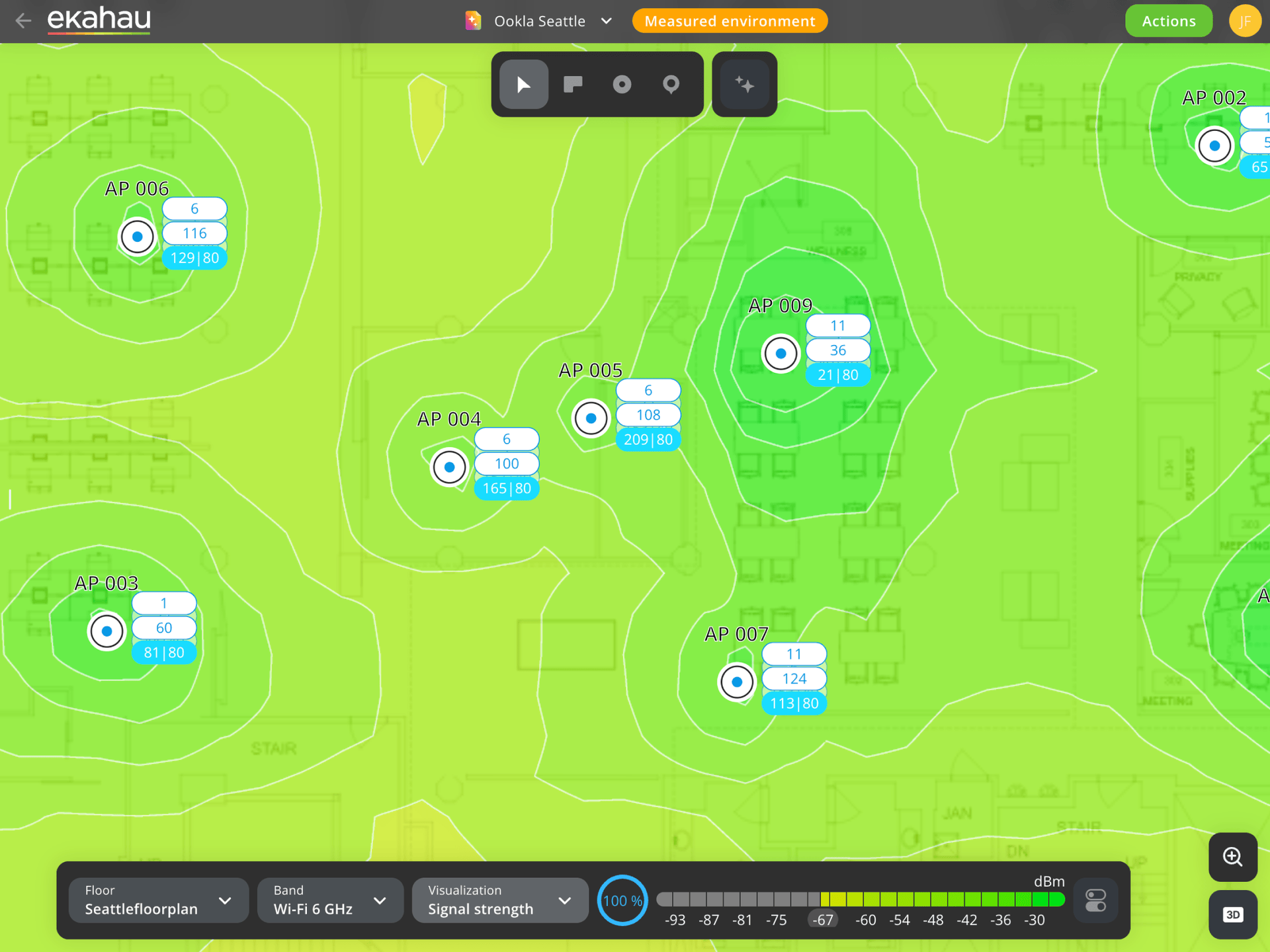
A San Diego wireless site survey from WiFi Hotshots starts with Ekahau predictive modeling and closes with post-install validation heatmaps — every engagement a fixed-fee SOW, not hourly billing.
We dispatch from Valencia HQ on a 2 to 2.5 hour drive to San Diego County, covering the full market from UCSD La Jolla and Scripps Green to downtown Gaslamp Quarter hotels, Sorrento Valley and Torrey Pines biotech campuses, Sharp Memorial and Sharp Grossmont, UCSD Jacobs Medical Center, Rady Children’s, Snapdragon Stadium and the downtown ballpark, SDSU, and the coastal hospitality corridor from Coronado through La Jolla. See the enterprise wireless services overview, the full enterprise network services portfolio, our engineering credentials and certifications, or send us your floor plans to start a scope call.
Why San Diego Wireless Survey Projects Fail Without an RF Baseline
San Diego building stock is not generic. The Torrey Pines Mesa and Sorrento Valley biotech corridor carries a dense inventory of GxP-validated laboratory and manufacturing environments where cleanroom framing, stainless steel casework, laminar-flow HEPA plenums, and copper vapor barriers behave nothing like a standard drywall-and-stud office. Cleanroom wall assemblies (stainless steel + aluminum stud + T-grid ceiling) attenuate 5 GHz signals by 20–30 dB through a single wall; 6 GHz attenuation is 5–8 dB higher still. Ultra-low temperature (−80°C) freezer farms and LN2 cryostorage rooms used for CAR-T and cell-therapy storage approximate Faraday cages — 30–40 dB attenuation through the door, effectively RF-dead inside.
Coastal exposure along Coronado, Point Loma, La Jolla, Mission Beach, and Imperial Beach subjects outdoor APs to salt-mist corrosion that IP67 alone does not address; NEMA 4X or IP67 combined with IEC 60068-2-11 Test Ka salt-mist qualification is the durable spec. Downtown Gaslamp Quarter hotel stock mixes 1880s–1920s brick-and-timber frame with modern steel-frame towers — two completely different RF environments on the same block.
Deploying APs without a measured RF baseline means your channel plan is built on assumptions, not data. When a Spectralink handset drops on a Scripps Memorial La Jolla patient floor or a Zebra scanner misses the back of a Sorrento Valley packaging line, the root cause is always the same: the pre-deployment work was skipped or compressed. Every San Diego wireless site survey we run begins by capturing these materials on the floor plan before any AP count is proposed.
An enterprise wireless site survey in San Diego is not optional for complex environments — it is the engineering step that separates a network that works from one that generates tickets. The design target for a general enterprise data environment is a minimum ‑67 dBm RSSI at cell edge with at least 25 dB SNR. For voice-grade networks at Scripps, Sharp, UCSD Health, Rady, and Kaiser Permanente San Diego — Vocera Smartbadge, Spectralink Versity, Ascom — those targets hold, and you add a 15–20% cell overlap requirement at the ‑67 dBm boundary to support 802.11r fast BSS transition.
For GxP-validated biotech shop floors at Illumina, Takeda, Pfizer La Jolla, Biogen, Genomics Institute, Salk, and Scripps Research, the post-install heatmap becomes part of the CAPA-documentation trail under ISPE GAMP 5 and 21 CFR Part 11 — not a nice-to-have. None of those thresholds can be confirmed by looking at a floor plan. They require measurement.
Ekahau Predictive Survey Methodology: Floor Plan Ingestion to AP Placement Map
Every WFHS engagement begins in Ekahau AI Pro, the design and analysis module within the Ekahau Connect platform. The workflow starts with floor plan import at measured scale — either CAD-exported PDF or a photographed as-built drawing re-scaled to a known distance. Wall types are assigned material attenuation values: glass, drywall, CMU, poured concrete, concrete with rebar, stainless-steel cleanroom framing, and copper-lined freezer walls each carry different dB-per-meter loss figures. For Sorrento Valley and Torrey Pines cleanroom assemblies, the model requires a stainless-steel-plus-stud attenuation assignment rather than a generic wall value because laminar-flow HEPA framing and equipment racking add measurable additional loss at 5 GHz and above.
For coastal commercial stock in La Jolla, Point Loma, Coronado, and downtown, the model accounts for marine-layer humidity contribution to outdoor propagation loss across open-courtyard and rooftop AP deployments. Once the floor plan is calibrated, the predictive engine runs AP placement simulations against the design requirement profile — coverage at ‑67 dBm RSSI, channel plan, and secondary-AP overlap for 802.11k neighbor list population. The output is an AP count per floor with placement coordinates and a draft bill of materials. This predictive phase of a San Diego wireless site survey typically completes within three business days of the scoping call of floor plan receipt.
For San Diego deployments, predictive design typically covers 1,200–2,000 sq ft per AP on 5 GHz and 6 GHz radios in open-plan office environments. High-density spaces — UCSD and SDSU lecture halls seating 200-plus, patient floors at Scripps Memorial La Jolla or UCSD Jacobs Medical Center, GxP wet labs at 1 AP per 1,500–2,000 sq ft, and cleanrooms at 1 AP per 1,200 sq ft — require tighter placement intervals driven by client count and MOS score targets rather than coverage radius alone.
Predictive survey is accurate for standard construction. On atypical San Diego materials — cleanroom stainless-steel framing, lead-lined imaging suites at Scripps Green and Sharp Memorial, ULT-freezer copper vapor barriers, IEEE 299-2006 shielded MRI enclosures at UCSD Jacobs and Rady, and historic Gaslamp Quarter timber-and-brick masonry — the predictive model flags uncertainty zones that require an AP-on-a-Stick validation pass before hardware procurement.
- AP count per floor with X/Y placement coordinates exportable to AutoCAD or PDF overlay
- Channel plan: 2.4 GHz channels 1/6/11 for coverage; 5 GHz 20/40/80 MHz assignments per zone; 6 GHz LPI channel selection for Wi-Fi 6E and Wi-Fi 7 APs (indoor LPI class, no AFC required per FCC Part 15 Subpart E)
- Per-band heatmap exports showing RSSI, SNR, secondary coverage (802.11k), and co-channel interference overlay
AP-on-a-Stick Validation for San Diego Venues: Biotech, Healthcare, Higher Ed, and Hospitality
AP-on-a-Stick (APoS) methodology mounts a production-model AP on a telescopic pole at the intended deployment height — typically 12–18 ft for ceiling-tile environments, 25–40 ft for high-bay cleanroom and convention-hall conditions. The Ekahau Sidekick 2 attaches to the survey laptop via USB-C and runs four tri-band radios scanning 2.4, 5, and 6 GHz simultaneously at 50 sweeps per second across the full 2,400–7,125 MHz range.
The surveyor walks the floor while the Sidekick 2’s nine custom 3D antennas record passive RF measurements at every point — RSSI, SNR, noise floor, and co-channel interference — across every visible AP. That measurement data overwrites the predictive model where they differ, producing a hybrid design that combines simulation efficiency with field accuracy.
Any San Diego wireless site survey covering a facility where drawings do not reflect reality requires AP-on-a-Stick rather than predictive-only. Biotech campuses across Torrey Pines Mesa, Sorrento Valley, and UTC — Illumina, Takeda, Pfizer La Jolla, Biogen, the Genomics Institute of the Novartis Research Foundation, Salk Institute, and Scripps Research — carry fume-hood VFD motor spectrum noise at 2.4 GHz that requires on-site Sidekick 2 spectrum capture before channel planning.
Clinical floors at Scripps Green, Scripps Memorial La Jolla, Scripps Mercy, Sharp Memorial, Sharp Grossmont, Rady Children’s, UCSD Health Hillcrest, and UCSD Jacobs Medical Center carry infection-control constraints on above-ceiling access; MRI and CT imaging suites boundary as RF-opaque zones per IEEE Std 299-2006 shielding-effectiveness requirements, typically 80–100 dB of isolation.
Higher-ed venues — UCSD’s 45,087-student campus (Fall 2025), SDSU’s 41,184-student campus, USD’s 9,714-student Alcala Park campus, and Point Loma Nazarene’s 4,757-student coastal cliffside campus — require seat-by-seat density confirmation in 200-plus-seat lecture halls and residence-hall roaming validation. Coastal hospitality venues — Gaslamp Quarter hotels, Coronado Island resorts, La Jolla cliffside properties, SeaWorld, and San Diego Zoo — operate outdoor APs under salt-mist exposure that requires NEMA 4X or IP67-plus-IEC-60068-2-11 Test Ka qualification, not bare IP67. These institutions are referenced as venue archetypes, not as claimed engagements.
- Biotech and life-sciences: Sidekick 2 spectrum capture for fume-hood VFD noise hunt; cleanroom stainless-steel attenuation measurement; ULT-freezer and LN2 cryostorage RF-void mapping; CAPA-documentation-ready heatmap output per ISPE GAMP 5 and 21 CFR Part 11
- Healthcare: infection-control ceiling-plenum constraints confirmed before cable pathways are routed; lead-lined imaging suite boundaries flagged as RF-opaque per IEEE 299-2006; VoWLAN handset roaming exercised on Spectralink Versity, Vocera Smartbadge, Ascom, and Stryker SmartCall form factors
- Higher education and dense campus: seat-by-seat density modeling in lecture halls; residence-hall roaming validation across wing transitions; outdoor quad coverage with outdoor-rated APs on 6 GHz standard power (AFC coordination per FCC DA-24-166)
- Coastal hospitality and attraction venues: NEMA 4X / IP67 + IEC 60068-2-11 Test Ka qualification for poolside and oceanfront APs; historic-structure cable-pathway planning in Gaslamp Quarter brick-and-timber masonry; convention-hall truss-mount planning for high-density event fills
Floor plans and device counts are all we need to scope the work — most San Diego engagements are quoted on a fixed-fee SOW within three business days of a 30–60 minute scoping call.
Passive and Active Validation: Throughput, Roaming, and Voice MOS Testing
A passive survey records every RF signal in the environment without associating to any SSID. The Ekahau Sidekick 2 listens — it measures what the air contains, not what a connected session reports. Passive surveys are used for pre-deployment environment assessment (neighbor AP inventory, noise floor, DFS radar event detection) and for post-install coverage confirmation. DFS event rates in San Diego are not generic.
San Diego International Airport (SAN, Lindbergh Field) ground-based ATC radar and the TDWR terminal Doppler weather radar serving SAN, plus Navy search radars at Naval Base San Diego, Naval Air Station North Island, MCAS Miramar, and Coast Guard Air Station Point Loma, are DFS-proximate to a meaningful footprint of commercial stock across downtown, Point Loma, Coronado, Mission Valley, Kearny Mesa, and Miramar-adjacent Mira Mesa.
UNII-2A and UNII-2C channels see measurably higher radar-event rates near these sites than in generic inland locations. Validate DFS exposure with field measurement before enabling DFS channels in production. The output is a heatmap for every band, every floor, at every survey waypoint — color-coded RSSI, SNR, and secondary coverage for 802.11k neighbor list validation.
Active validation associates to the production SSID and measures what the client actually experiences. iPerf3 bidirectional throughput runs confirm uplink and downlink capacity against the designed channel width. Roaming tests exercise 802.11r fast BSS transition — the protocol is designed to shorten roaming interruptions, and 50 ms or less is the accepted voice-grade handoff target that 802.11r was built to support. Active testing with a roaming test client confirms whether the deployed controller configuration actually achieves it or whether a misconfigured minimum RSSI threshold is stalling the handoff.
For voice-over-Wi-Fi migration engagements — Cisco Webex Calling, CUCM, or Teams Phone — the active test also captures a MOS (Mean Opinion Score) trace across the full walking route. A voice-grade network targeting MOS 4.0+ requires the ‑67 dBm RSSI and 25 dB SNR thresholds to hold at cell edge without exception. Any area that drops below those targets appears as a gap in the post-install validation report, with a remediation recommendation tied to a specific AP or configuration change. The independent post-install validation report is the deliverable your operations team, auditor, or next engineer can pick up without context.
San Diego Market Constraints: Coastal Salt Corrosion, Biotech Cleanroom RF, and AFC Exclusion Zones
Coastal Salt-Mist Corrosion and Outdoor Enclosure Selection
IP67 ingress protection and salt-mist corrosion resistance are two different specifications. IEC 60529 (the IP rating standard) tests dust and water ingress only — an AP rated IP67 is dust-tight and survives water immersion to 1 meter, but nothing in the IEC 60529 procedure addresses corrosion. IEC 60068-2-11 Test Ka (Edition 4.0, 2021) is the salt-mist corrosion test: a 5% NaCl atomized atmosphere at +35°C, pH 6.5–7.2, test durations from 24 hours to 1,000-plus hours depending on specification class.
The US equivalent is NEMA 4X, which combines water/dust ingress with corrosion resistance including salt atmosphere. An AP deployed on a Coronado, Point Loma, Mission Beach, La Jolla Shores, or Silver Strand outdoor mount needs NEMA 4X or IP67 plus IEC 60068-2-11 qualification — bare IP67 will corrode in the marine layer within 18–24 months. Marine-grade stainless 316L mounts, UV-stabilized radomes, and drip loops on cable entries are standard spec, not upgrades. Pole-mount lightning protection for oceanfront deployments follows NFPA 780 single-point-attachment guidance.
Biotech Cleanroom RF and GxP Validation Documentation
San Diego hosts the second-largest US biotech cluster: 2,153 life-science establishments (2023), 71,448 direct employees (2024), and $54.1B regional economic output concentrated on Torrey Pines Mesa, Sorrento Valley, and the UTC corridor. Cleanroom RF design is not a drywall problem.
Laminar-flow HEPA framing, stainless-steel casework, aluminum studs, and T-grid ceiling plenums approximate Low-E glass attenuation: 2.4 GHz loses 15–25 dB through a single cleanroom wall; 5 GHz loses 20–30 dB; 6 GHz loses 25–38 dB. Ultra-low-temperature (−80°C) freezer farms and LN2 cryostorage rooms used for cell-therapy and CAR-T workflows are effectively Faraday cages — stainless double-wall construction with copper vapor barrier attenuates 5/6 GHz by 30–40 dB through a single enclosure wall.
APs belong outside the freezer, not inside. Fume hoods with HEPA filtration introduce 2.4 GHz spectrum noise from variable-frequency-drive (VFD) blower motors — spectrum analysis with the Sidekick 2 is mandatory before channel plan finalization. Under 21 CFR Part 11 and ISPE GAMP 5, every wireless change in a GxP-validated environment must be auditable; the post-install Ekahau heatmap export becomes part of the CAPA documentation, not a nice-to-have. AAMI TIR18 provides the framework for wireless risk assessment on medical-device-adjacent infrastructure.
AFC Exclusion Zones, Airport Coordination, and Cross-Border Spectrum
Per FCC OET Public Notice DA-24-166, released February 23, 2024, seven AFC operators are approved for commercial management of the 6 GHz standard-power bands — Qualcomm, Federated Wireless, Sony Group, Comsearch, Wi-Fi Alliance Services Corporation, Wireless Broadband Alliance, and Broadcom. Approval covers U-NII-5 (5.925–6.425 GHz) and U-NII-7 (6.525–6.875 GHz) for standard-power APs and fixed client devices. Indoor-only low-power (LPI) operations do not require AFC coordination. San Diego’s coastal AFC footprint includes exclusion zones around FSS earth stations, NOAA satellite ground infrastructure, and shared-spectrum CBRS neighborhoods — outdoor 6 GHz standard-power deployments at coastal sites require AFC query coordination before channel assignment.
San Diego International Airport (SAN) handled 25.24 million passengers in 2024 (record high, beating the 2019 pre-COVID record of 25.18M); terminal-building Wi-Fi design coordinates with airport ATC radar exposure on DFS channels. Cross-border radio coordination across the San Ysidro / Otay Mesa border with Mexico requires FCC / IFT bilateral awareness for any licensed link near the border; the 2012 FCC-IFT Wi-Fi coordination framework governs current operating state below 6 GHz, with 6 GHz cross-border policy still evolving.
Cal Fire Fire Hazard Severity Zones across Ramona, Jamul, Alpine, Descanso, Julian, and East County affect outdoor AP enclosure selection (fire-rated cable pathways, non-combustible mounts, spark-arresting lightning protection) and construction-schedule access during red-flag days. Where the survey identifies below-ceiling pathway gaps or insufficient PoE capacity at the switch port, cabling infrastructure review is scoped as a parallel workstream in the same fixed-fee SOW.
Scope a San Diego Site Survey.
Send floor plans to sales@wifihotshots.com or call (844) 946-8746 — we return a fixed-fee SOW, not a multi-week proposal cycle.
Survey Deliverables: Heat Maps, BOM, Install Runbook, and Validation Report
At the close of every San Diego wireless site survey engagement, the client receives a complete document set — not a summary slide deck. The Ekahau project file (.esx) is included in every handoff so a future engineer can reopen the exact survey, adjust wall materials, or re-run the coverage model without starting from scratch.
The platform mix — Cisco Catalyst 9800 (IOS-XE 17.12.x recommended, 17.12.3+ for Wi-Fi 7), Cisco Meraki MR and CW (CW9166 Wi-Fi 6E, CW9178I Wi-Fi 7), HPE Aruba Central (AOS-10) with AP-635 / AP-655 / AP-744 / AP-754 / AP-584, Juniper Mist with Marvis AI, RUCKUS Networks (R770 Wi-Fi 7, R760 Wi-Fi 6E, T870 outdoor Wi-Fi 7), and ExtremeCloud IQ (AP5010/5020/5050 Wi-Fi 6E and Wi-Fi 7 AP4xxx) — does not change the deliverable set.
Every engagement ships with the same documentation regardless of vendor, because the documentation belongs to the client, not the vendor. Guest and BYOD onboarding — NAC and zero trust policy or cloud-native captive portal, certificate-based authentication, WPA3-Enterprise or WPA2-Enterprise with HIPAA-aligned segmentation — is scoped as a separate design workstream when the survey reveals that the existing SSID architecture does not segment guest traffic. AP refresh and controller migration planning for Catalyst 9800 (FIPS 140-3 mode available for federal-adjacent unclassified work), Meraki CW, HPE Aruba Central, Juniper Mist, RUCKUS One, and ExtremeCloud IQ is scoped separately where the survey identifies a controller version or capacity constraint.
- Ekahau project file (.esx) plus annotated heatmap exports per band (2.4, 5, 6 GHz) per floor: RSSI, SNR, secondary coverage (802.11k), and co-channel interference overlay
- Vendor-agnostic AP bill of materials with AP model, mount type, antenna selection, PoE class requirement (UPOE/802.3bt Class 6 required for CW9178 dual-6-GHz operation), and cabling length per drop
- Installation runbook: AP placement drawing, cable pathway map, switch port assignment, and VLAN/SSID configuration notes for the contractor
- Post-install validation report: passive heatmap confirmation, iPerf3 throughput results, 802.11r roaming handoff timing, and MOS trace data for voice-grade engagements
- GxP documentation (biotech only): CAPA-ready change log per ISPE GAMP 5 and 21 CFR Part 11, with before/after heatmap comparison suitable for validation-environment audit trail
- Design warranty: WFHS stands behind the AP count and placement — if coverage gaps appear at post-install validation that were not present in the design, we remediate the design at no additional cost
San Diego Wireless Site Survey Coverage and Service Map
WiFi Hotshots dispatches from Valencia (Santa Clarita Valley) to San Diego County on a 2 to 2.5 hour drive, with same-fee SOW structure for pre-scoped multi-day engagements to avoid mobilization surcharges.
Coverage runs the full San Diego County footprint: downtown Gaslamp Quarter and Little Italy; Mission Valley, Old Town, and Balboa Park; the La Jolla coastal arc from Scripps Green and UCSD Jacobs Medical Center to Torrey Pines Mesa biotech; the Sorrento Valley and UTC biotech corridor; Kearny Mesa, Mira Mesa, and Miramar; Coronado, Imperial Beach, and the South Bay border communities of Chula Vista, San Ysidro, and Otay Mesa; Point Loma and Ocean Beach; Pacific Beach and Mission Beach; Clairemont, Linda Vista, and Serra Mesa.
North County coverage extends to Poway, Escondido, Vista, Oceanside, Carlsbad, Encinitas, Rancho Santa Fe, and San Marcos. East County runs through El Cajon, La Mesa, Santee, Lakeside, Alpine, and Ramona.
Greenfield and brownfield engagements across the market include the UCSD La Jolla campus (45,087 students Fall 2025), SDSU Mission Valley (41,184 students), USD Alcala Park (9,714 students), Point Loma Nazarene (4,757 students), CSU San Marcos, and Mira Costa Community College. Healthcare engagements span Scripps Health’s 5 campuses, Sharp HealthCare’s 4 acute-care and 5 specialty hospitals with 2,700 physicians, UCSD Health’s 4 campuses (~1,101 combined licensed beds per HCAI), Rady Children’s (511 beds, top-10 US pediatric hospital), and Kaiser Permanente San Diego.
Hospitality and attractions include Gaslamp Quarter hotels, Coronado Island resorts, La Jolla cliffside properties, SeaWorld, San Diego Zoo and Safari Park, and the 615,701 sq ft San Diego Convention Center. Sports venues include the downtown ballpark (39,860 fixed seats) and Snapdragon Stadium (35,000-seat baseline, expandable to 55,000). K-12 engagements cover San Diego Unified, Sweetwater Union HSD, Chula Vista Elementary, Poway Unified, Grossmont Union HSD, Cajon Valley Union, Escondido Union, Vista Unified, Carlsbad Unified, and San Marcos Unified.
Multi-site San Diego engagements are coordinated from a single SOW and a single point of contact. For enterprise clients with facilities across multiple Southern California regions, we dispatch into adjacent service areas without a separate mobilization charge. The geo-family below shows the regional pages where market-specific survey details — LA metro density, SFV media corridor, Santa Clarita industrial, Antelope Valley aerospace, Inland Empire warehouse density, Orange County coastal, Palm Desert resort, and Bakersfield oil-and-ag — are documented for each sub-market.
Representative Engagement Profiles — San Diego Region
The profiles below summarize the engagement patterns a San Diego wireless site survey from WFHS is typically scoped against — biotech cleanroom and GxP-validated wet lab, multi-system hospital clinical-wireless migration, higher-education research-campus deployment, and unclassified federal-adjacent commercial-contractor office. Each maps to specific RF and documentation constraints that drive the SOW. None of the venues named are claimed WFHS engagements; they are identified as market archetypes so prospective clients can size their own scope against a known footprint.
Biotech cleanroom and GxP-validated wet-lab wireless refresh
The San Diego biotech archetype maps to a multi-building life-sciences campus on Torrey Pines Mesa, Sorrento Valley, or the UTC corridor with a mix of wet lab, dry lab/computational, cleanroom/GxP, and office space — the scale familiar to anyone who knows Illumina, Takeda, Pfizer La Jolla, Biogen, the Genomics Institute, Salk Institute, or Scripps Research. Typical scope covers 1 AP per 1,500–2,000 sq ft in wet lab, 1 AP per 2,500 sq ft in dry lab/computational, and 1 AP per 1,200 sq ft in cleanroom/GxP space, with Sidekick 2 spectrum capture to identify fume-hood VFD 2.4 GHz noise and Faraday-cage boundaries around ULT freezer farms and LN2 cryostorage.
CAPA-documentation-ready heatmap output per ISPE GAMP 5 and 21 CFR Part 11 is a standard deliverable, not a change order. AAMI TIR18 guidance applies to any segment carrying medical-device traffic. The deliverable set is formatted for review by the client’s Quality and IT governance committees. Illumina, Takeda, Pfizer La Jolla, Biogen, the Genomics Institute, Salk Institute, and Scripps Research are referenced here as venue archetypes, not as claimed engagements.
Multi-system hospital clinical-wireless network migration
The San Diego multi-system hospital archetype maps to an acute-care campus with med-surg floors, emergency department, OR suites, and ICU — the scale familiar to anyone who knows Scripps Green, Scripps Memorial La Jolla, Scripps Mercy, Sharp Memorial, Sharp Grossmont, UCSD Health Hillcrest, UCSD Jacobs Medical Center, or Rady Children’s (511 beds, top-10 US pediatric).
Typical scope covers a phased wireless migration with ‑65 dBm VoWLAN cell edges and ‑67 dBm data coverage at clinical depth, 25 dB SNR minimum for voice, 20% cell overlap at the voice threshold, and 802.11r fast BSS transition under 50 ms for Vocera Smartbadge, Spectralink Versity, Stryker SmartCall, and Ascom handsets. Patient-floor design targets ‑65 dBm at headwall and bedside (not at the door) for telemetry and nurse-call integration.
Emergency-department density runs 40–60 concurrent clients per 600 sq ft and requires 1 AP per 1,000–1,200 sq ft. OR suites often need both a corridor AP and an in-suite AP because OR booms block line-of-sight. MRI and CT imaging suites at Scripps Green, Sharp Memorial, UCSD Jacobs, and Rady present IEEE 299-2006 Faraday shielding of 80–100 dB — APs relocate to the control-room side, not inside the shield. WPA2/WPA3-Enterprise with HIPAA-aligned segmentation is a design input, not a compliance claim. HIMSS EMRAM Stage 6/7 validation implies voice-grade pervasive coverage. Scripps, Sharp, UCSD Health, Rady Children’s, and Kaiser San Diego are referenced here as venue archetypes, not as claimed engagements.
Higher-education research-campus dense-wireless deployment
The San Diego higher-ed archetype maps to a research university with 40,000-plus enrolled students across a 1,000-plus-acre main campus — the scale familiar to anyone who knows UC San Diego (45,087 students Fall 2025) or San Diego State (41,184 students Fall 2025).
Typical scope covers residence halls at 1 AP per 2–3 rooms with dense MIMO client fleets (laptop + phone + tablet + gaming console), 200-plus-seat lecture halls at 1 AP per 50–75 seats with 20 MHz channel widths for client-count capacity over throughput, libraries and study spaces at 1 AP per 2,000 sq ft with 80%-plus utilization, and research-building wireless matched to the vertical profile of each lab building (biotech-adjacent cleanroom RF per the biotech archetype above, healthcare-adjacent clinical floors per the hospital archetype).
Outdoor quad coverage requires outdoor-rated APs on 6 GHz standard power with AFC coordination per FCC DA-24-166; most large campuses still avoid outdoor 6 GHz pending AFC operator maturity and instead use 5 GHz outdoor with DFS mitigation. The deliverable set — per-floor heatmaps, vendor-agnostic AP BOM, CBC 2022 / ASCE 7-16 seismic mounting specifications for Zone D compliance, and post-install validation report — is formatted for review by campus IT governance. UCSD, SDSU, USD, Point Loma Nazarene, CSU San Marcos, and Mira Costa are referenced here as venue archetypes, not as claimed engagements.
Unclassified federal-adjacent commercial-contractor wireless scope
WiFi Hotshots does not claim, and does not provide, classified / SCIF / SAP / cleared-facility work. Unclassified scope only. Commercial contractor and research-partner facilities in the San Diego market — the scale familiar to anyone who knows Qualcomm in Sorrento Valley, SAIC, Northrop Grumman commercial offices, or General Atomics unclassified facilities — operate in an unclassified commercial posture. Typical scope covers commercial-contractor offices with 1 AP per 2,000–2,500 sq ft serving 25–35 concurrent authenticated devices, EAP-TLS or WPA3-Enterprise 192-bit (CNSA suite) authentication where CMMC Level 2+ alignment is a design input, and NIST SP 800-171 Rev 3 control 03.01.16 wireless access control posture on CUI-handling systems.
Platform selection leans toward DISA STIG-aligned posture or current DoDIN APL coverage (through FY2026 sunset per DISA July 2025 memo) — for example RUCKUS achieved DoDIN APL certification for Wi-Fi APs. FIPS 140-3 mode on Catalyst 9800 is available for federal-adjacent fabric. Classified-fabric wireless (SCIF-internal, TEMPEST-hardened, NIPR-only for commercial WLAN) is out of scope for WFHS and for any commercial VAR — we refer accordingly. Qualcomm, SAIC, Northrop Grumman, and General Atomics are referenced here as commercial-market archetypes, not as claimed engagements. WFHS unclassified scope in the San Diego commercial district is the operational boundary for this practice.
San Diego Site Survey FAQ
How long does a San Diego enterprise wireless site survey take?
Timeline depends on scope. A single-floor commercial space in downtown Gaslamp Quarter, La Jolla UTC, or a Sorrento Valley biotech building with complete as-built drawings can be predictively modeled and quoted within three business days of the scoping call. An AP-on-a-Stick field validation for that same floor takes one to two days on-site.
Multi-building campus engagements — UCSD-scale higher ed, Scripps- or Sharp-scale multi-system hospital rollouts, Torrey Pines biotech cluster campuses — typically run two to four weeks from floor plan receipt to final deliverable.
Every engagement is scoped and quoted as a fixed-fee SOW before work begins.
Our 2 to 2.5 hour dispatch from Valencia to San Diego County is absorbed in the same SOW for pre-scoped multi-day engagements, so there is no separate mobilization surcharge. We do not bill hourly against an open-ended estimate.
How do Navy coastal DFS radars and biotech-corridor RF affect predictive vs AP-on-a-Stick surveys in San Diego?
A predictive survey uses Ekahau AI Pro in the Ekahau Connect platform to model RF propagation through a calibrated floor plan. No physical measurement occurs — the software simulates signal paths through assigned wall materials and produces coverage heatmaps and an AP placement plan. It is fast and accurate for standard construction materials.
An AP-on-a-Stick survey mounts a production-model AP on a telescopic pole at the intended deployment height, and the Ekahau Sidekick 2 captures real measurements — actual RSSI, SNR, and noise floor — as the surveyor walks the floor.
For San Diego buildings with atypical attenuation (cleanroom stainless-steel framing, ULT-freezer copper vapor barriers, lead-lined imaging suites, IEEE 299-2006 Faraday-shielded MRI enclosures, Gaslamp Quarter historic brick-and-timber masonry, coastal-exposure outdoor mounts) or where as-built drawings are unreliable, the AP-on-a-Stick pass is required before procurement.
Most WFHS engagements include both: predictive for initial design and AP count, AP-on-a-Stick for validation before the BOM is finalized.
On a San Diego site survey, do you cover all of San Diego County, or just the downtown core?
All of San Diego County. Coverage runs the full footprint: downtown Gaslamp Quarter, Little Italy, Mission Valley, and Old Town; the La Jolla coastal arc; the Torrey Pines Mesa, Sorrento Valley, and UTC biotech corridor; Kearny Mesa, Mira Mesa, and Miramar; Coronado, Imperial Beach, Chula Vista, San Ysidro, and Otay Mesa in the South Bay;
Point Loma, Ocean Beach, Pacific Beach, and Mission Beach on the coast; North County including Poway, Escondido, Vista, Oceanside, Carlsbad, Encinitas, Rancho Santa Fe, and San Marcos; and East County through El Cajon, La Mesa, Santee, Lakeside, Alpine, and Ramona.
San Diego County coverage also includes National City, Lemon Grove, Solana Beach, and Del Mar.
We dispatch 2 to 2.5 hours from our Valencia HQ on a fixed-fee SOW structure that absorbs mobilization into the engagement price for pre-scoped multi-day work.
Cross-border coordination for engagements near San Ysidro or Otay Mesa factors FCC / IFT bilateral awareness into the design on any licensed link.
What does a wireless site survey cost in San Diego?
Every engagement is priced as a fixed-fee SOW — we do not bill hourly. Scope variables that drive cost: building square footage, number of floors, number of buildings, construction type (standard drywall vs. cleanroom stainless-steel framing vs. ULT-freezer Faraday cage vs. Gaslamp Quarter brick-and-timber vs. coastal-exposure outdoor), required survey type (predictive only, AP-on-a-Stick, or combined predictive-plus-validation), GxP documentation requirements for biotech environments, and whether post-install validation and a formal validation report are in scope.
We return a written SOW quote within three business days of the scoping call of receiving floor plans and a scope description.
Send floor plans to sales@wifihotshots.com or call (844) 946-8746.
No engagement begins without the client signing off on the fixed-fee price first.
What deliverables do we receive after a WFHS San Diego site survey?
Every engagement produces: the Ekahau project file (.esx) for future re-use; annotated heatmap exports per frequency band (2.4, 5, 6 GHz) per floor showing RSSI, SNR, secondary coverage (802.11k), and co-channel interference; a vendor-agnostic AP bill of materials with mount type, antenna, PoE class (UPOE/802.3bt Class 6 for Wi-Fi 7 dual-6-GHz operation), and cabling callouts;
an installation runbook for the contractor; and a post-install validation report with passive heatmap confirmation, iPerf3 throughput results, 802.11r handoff timing, and MOS trace data for voice-grade engagements.
Biotech and life-sciences engagements receive an additional CAPA-documentation-ready change log per ISPE GAMP 5 and 21 CFR Part 11 suitable for the client’s validation-environment audit trail.
The deliverable set is the same regardless of the AP vendor — Cisco Catalyst 9800, Cisco Meraki MR and CW, HPE Aruba Central, Juniper Mist, RUCKUS, or Extreme.
The documentation belongs to the client and is formatted for a 10-year shelf life.
Can WFHS survey in a live San Diego clinical or biotech environment without downtime?
Yes. Passive survey requires no network access and causes zero disruption to production traffic — the Ekahau Sidekick 2 listens passively and never associates to any SSID. Active throughput testing and roaming validation require a brief association to a production or test SSID, which does not affect other clients on the network.
Full iPerf3 load testing, which generates several hundred Mbps of synthetic traffic to stress the uplink, is scheduled during off-hours or in a maintenance window if the client requests it.
We have conducted passive surveys in live clinical patient floors, GxP-validated biotech wet labs, and operating cleanroom environments without interrupting production operations.
Biotech validation-environment surveys include a pre-survey coordination call with the Quality organization to identify access windows that do not conflict with active GxP production batches; the pre-survey coordination document we send before mobilization identifies which test phases, if any, require an off-hours window.
For MRI-suite adjacent work at Scripps Green, Sharp Memorial, UCSD Jacobs, or Rady, we coordinate with the imaging manager to schedule AP validation around clinical imaging hours.
On a San Diego site survey, how does WFHS handle coastal salt-mist corrosion on outdoor AP deployments?
IP67 alone is not enough on the San Diego coast. IEC 60529 (the IP rating standard) tests dust and water ingress only — it does not test corrosion. IEC 60068-2-11 Test Ka (Edition 4.0, 2021) is the salt-mist corrosion test, using a 5% NaCl atomized atmosphere at +35°C. NEMA 4X is the US equivalent combining ingress and corrosion resistance.
For oceanfront AP deployments across Coronado, Point Loma, La Jolla Shores, Mission Beach, and Silver Strand, we specify NEMA 4X or IP67 plus IEC 60068-2-11 qualification, marine-grade 316L stainless steel mounts, UV-stabilized radomes, and drip loops at cable entries.
Pole-mount lightning protection follows NFPA 780 single-point-attachment guidance.
Bare IP67 APs on coastal mounts corrode within 18–24 months; the specification gap is a common cause of post-installation failure that survey work identifies before procurement, not after.
Does WFHS work with San Diego defense contractors or classified facilities?
WiFi Hotshots does not claim, and does not provide, classified / SCIF / SAP / cleared-facility work. Unclassified scope only. We work with commercial-contractor and research-partner offices in the San Diego market under an unclassified commercial posture — for example the type of commercial office space operated by Qualcomm in Sorrento Valley, SAIC, Northrop Grumman commercial offices, or General Atomics unclassified facilities.
Typical design inputs include EAP-TLS or WPA3-Enterprise 192-bit (CNSA suite) authentication where CMMC Level 2+ alignment is in scope, NIST SP 800-171 Rev 3 control 03.01.16 wireless access posture on CUI-handling systems, and DISA STIG-aligned platform selection (or current DoDIN APL coverage through the FY2026 sunset per the DISA July 2025 memo).
FIPS 140-3 mode on Cisco Catalyst 9800 is available for federal-adjacent fabric.
Classified-fabric wireless (SCIF-internal, TEMPEST-hardened) is out of scope for any commercial VAR including WFHS, and we refer such work accordingly.
Qualcomm, SAIC, Northrop Grumman, and General Atomics are referenced as commercial-market archetypes, not as claimed engagements. See our NGFW and NAC design for full scope methodology and validation criteria.
How do you handle GxP and 21 CFR Part 11 documentation for biotech site surveys?
For biotech and life-sciences engagements across Torrey Pines Mesa, Sorrento Valley, and the UTC corridor, the survey deliverable is formatted to serve as part of the client’s CAPA documentation trail. Under 21 CFR Part 11 and ISPE GAMP 5, every wireless change in a GxP-validated environment must be auditable. We produce a before/after heatmap comparison showing the original design intent, the validated post-install state, and any remediation applied to close the gap.
The Ekahau project file (.esx) is part of the handoff so the Quality organization can reopen and re-validate the survey on a later audit without starting from scratch.
AAMI TIR18 guidance on electromagnetic compatibility of medical devices applies to any wireless segment carrying medical-device traffic — we identify co-existence boundaries with wireless-connected medical devices during survey and document any spectrum-coordination findings.
The CAPA-ready change log is part of the standard biotech deliverable, not a change order.
What happens if the San Diego survey identifies issues beyond the original scope?
The fixed-fee SOW covers the defined scope. If the survey uncovers something outside that scope — an ERRCS gap requiring a licensed BDA integrator at a Scripps, Sharp, or UCSD Health hospital campus; a structured cabling deficiency that needs remediation before APs can be installed in a Sorrento Valley biotech building;
a DAS antenna placement conflict in a Gaslamp Quarter hotel; or a Cal Fire FHSZ outdoor-enclosure requirement identified in Ramona, Jamul, or East County — we document the finding in the validation report with a clear description of the issue and its location.
We then issue a separate change-order estimate for any additional WFHS scope and, where the finding is outside wireless engineering (like ERRCS installation), we refer to the appropriate licensed contractor.
The client is never billed above the SOW total without a signed change order first.
That is the operational definition of a fixed-fee engagement.
How does FCC 6 GHz AFC affect outdoor Wi-Fi deployments in downtown San Diego?
Standard-power (SP) 6 GHz APs must register with an FCC-approved Automated Frequency Coordination (AFC) system before they can transmit on UNII-5 or UNII-7. The AFC service enforces dynamic exclusion zones around incumbent fixed microwave links — and downtown San Diego, Mission Valley, and the Sorrento Valley tech corridor all carry registered microwave paths that constrain outdoor SP channel selection.
Low Power Indoor (LPI) radios do not require AFC but are prohibited from outdoor mounting or weather-rated enclosures, which rules them out for rooftop, parking-structure, or courtyard coverage. Our San Diego wireless site survey models the incumbent exclusion footprint before we mount anything outdoors.
What is the difference between LPI and Standard Power 6 GHz APs for a San Diego indoor deployment?
LPI APs operate across UNII-5 / 6 / 7 / 8 at a Power Spectral Density ceiling of 5 dBm/MHz — 18 dBm EIRP on 20 MHz, 21 dBm on 40 MHz, 24 dBm on 80 MHz, 27 dBm on 160 MHz.
Standard Power APs may transmit up to 36 dBm EIRP (PSD 23 dBm/MHz) but require active AFC coordination on UNII-5 and UNII-7 only. LPI client devices must transmit at least 6 dB below their serving AP, which shrinks the usable uplink cell.
For most Sorrento Valley office, lab, and cleanroom buildouts, LPI is the correct power class — we size AP density during the wireless design phase so the reduced EIRP still delivers −67 dBm at the cell edge.
How many 6 GHz channels are available for a Sorrento Valley office deployment?
The FCC opened 1,200 MHz of contiguous spectrum from 5.925 GHz to 7.125 GHz, yielding 59 × 20 MHz channels, 29 × 40 MHz, 14 × 80 MHz, and 7 × 160 MHz channels.
A US-country-coded LPI AP can use all 59 channels without AFC, which is the reuse plan for nearly every Sorrento Valley and UTC office and lab we design.
Standard Power restricts operation to UNII-5 and UNII-7 but raises EIRP to 36 dBm — typically reserved for large indoor atria or outdoor venues where AFC registration is justified. Channel width selection is driven by density, not headline PHY rate; dense lab floors often stay at 80 MHz to keep a 14-channel reuse pool clean.
What coverage and SNR targets does WFHS measure on a San Diego healthcare survey?
Voice-grade healthcare coverage requires at minimum −67 dBm RSSI with a 25 dB SNR across the designed coverage footprint. For Wi-Fi location services — asset tags, patient-workflow dashboards, nurse-call correlation — the same −67 dBm / 25 dB threshold must be seen by at least three APs at every measurement point, so the worst-covered bathroom, stairwell, and supply closet still has triangulation geometry.
We validate both thresholds against Ekahau field captures, not predictive simulations, which is the distinction between a design and a verified deployment. Our San Diego healthcare site survey ships the post-install Ekahau heatmap plus a pass/fail grid of every measurement point against these two numbers.
How dense must AP placement be for asset-tracking at UCSD Medical Center or Scripps?
For Wi-Fi and BLE asset-location to work inside a hospital, the vendor-validated target is approximately one AP per 1,000 sq ft across the interior, with APs placed along the perimeter so every floor point has line-of-sight to at least four APs simultaneously.
A typical ward floor of 100 ft × 230 ft (23,000 sq ft) therefore requires more than 4× the AP count of a basic data-grade deployment — which is why hospitals that were designed for coverage alone cannot retrofit asset-tracking without an RF redesign. We model the four-AP visibility grid during predictive design and then verify it on-site with Ekahau Sidekick 2 during our San Diego hospital survey.
What accuracy can we expect from BLE asset tags vs Wi-Fi RTLS at a San Diego hospital?
With properly deployed Wi-Fi 6/6E APs and Cisco Spaces BLE, 50% of location samples fall within 2.2 m of actual position and 90% within 4.1 m — accuracy improves as more APs hear each tag. A standard RSSI-only Wi-Fi deployment targets roughly 10 m accuracy, which is adequate for zone-presence but not for room-level workflow.
Cisco Hyperlocation using Angle of Arrival with a 32-element antenna array delivers 1 m accuracy at the 50th percentile and 1-3 m on average. BLE tags must be heard by three or more APs to compute a position — which is why we enforce the three-AP visibility rule during the predictive design and validate it with the Sidekick 2 on-site.
How does WFHS design a Petco Park or Snapdragon Stadium high-density zone?
Channel widths are constrained to 20 MHz (VHT20) to preserve the largest pool of non-overlapping channels for a tight reuse plan across a stadium bowl. Per-radio client load is designed around 25 associations on the 5 GHz radio (50 per dual-radio AP), so AP count is the larger of aggregate-throughput-divided-by-per-device-throughput or concurrent-clients-divided-by-25.
Minimum SNR across the seating bowl must remain 25 dB or better, and per-client rate-limits typically start at 5 Mbps with Speed Burst enabled so the first packet burst doesn’t throttle. High-density San Diego stadium wireless design is survey-driven; we measure bowl-edge SNR and co-channel overlap before committing AP placement.
Why do San Diego coastal outdoor APs need salt-fog testing, and what certifications should we require?
Salt-laden marine air corrodes unprotected electronics and connector threads within months, not years. Vendor outdoor APs — Cisco Meraki CW9164I / CW9166D1 (current outdoor Wi-Fi 6E) and Cisco Catalyst IW9167E (industrial outdoor); legacy Meraki MR74/MR76/MR78/MR84/MR86 are end-of-sale — carry IP67 ratings and are vendor-tested for salt spray, vibration, shock, and dust.
The Cisco IW9167EH hazardous-location variant operates −50 °C to +75 °C; the base IW9167E Heavy Duty operates −40 °C to +70 °C. The authoritative salt-mist test standard is IEC 60068-2-11 (Test Ka), a continuous 5% NaCl fog at +35 °C with spray fall-out of 1.0–2.0 mL/80 cm²/hour for durations up to 1,000 hours.
For Port of San Diego, Coronado, or Shelter Island deployments, we specify IP67 enclosures plus corrosion-resistant mounting hardware on every San Diego outdoor wireless install.
Are there NEC grounding and lightning-arrestor requirements for outdoor APs at Port of San Diego or Coronado?
Yes. NEC Article 810 (Radio and Television Equipment) requires that every outdoor antenna lead-in have a listed antenna discharge unit (lightning arrestor) installed as close as practical to the point of building entry.
Bonding and earthing conductors must be copper, aluminum, copper-clad steel, or bronze — minimum #10 AWG copper or #8 AWG aluminum per §810.21. If the structure has an Intersystem Bonding Termination, the arrestor bond must terminate there.
We are RF engineers, not electrical contractors — the final grounding install is coordinated with the operator’s approved electrical contractor — but our wireless design deliverable specifies the NEC-compliant arrestor, entry location, and bond path so the electrician is working from a drawing.
How do 802.11r/k/v and Wi-Fi Alliance Voice-Enterprise certification support handoff at a Sharp or Scripps hospital?
The Wi-Fi Alliance Voice-Enterprise certification program layers selected capabilities from IEEE 802.11k (neighbor reports), 802.11r (Fast BSS Transition), and 802.11v (BSS Transition Management) on top of WMM and WPA2-Enterprise. 802.11r enables a client to complete re-association to a new AP target in under 50 ms, which keeps a voice codec from dropping packets mid-handoff.
Voice-Enterprise adds admission control that limits over-subscription on a given BSS — so a nurse call or physician consult does not get crowded out by bulk data on the same radio.
We validate that the WLAN, controller, and handset fleet all advertise and honor these amendments in the beacon and probe exchange during our San Diego hospital validation.
How does DFS and TDWR exclusion limit channel choice near San Diego International (SAN) and Miramar?
The FCC protects Terminal Doppler Weather Radar in the 5600-5650 MHz band, overlapping Wi-Fi channels 120, 124, and 128. APs operating in those channels implement Dynamic Frequency Selection and must cease transmission for at least 30 minutes when a radar burst is detected.
Current FCC DFS rules require radar-sensing across 100% of emission bandwidth (raised from the earlier 80%). Consumer and IoT clients still routinely refuse DFS channels, so the usable channel pool in Kearny Mesa, Mission Valley,
and anywhere near SAN or MCAS Miramar is narrower than the spec sheet suggests. During our San Diego wireless design, we inventory the client fleet and validate DFS support per model before committing a channel plan.
Do we need FAA Part 77 notice for rooftop APs or poles near SAN (Lindbergh Field)?
Possibly — it depends on the mount height and proximity to the runway. Under 14 CFR Part 77, a proponent must file Form 7460-1 (Notice of Proposed Construction or Alteration) with the FAA at least 45 days before construction for any structure exceeding 200 ft AGL, or which exceeds a lower imaginary-surface threshold based on proximity to a public-use or military airport.
Sites within 20,000 ft of a runway trigger additional criteria. Most rooftop and pole-mounted APs fall below the thresholds, but a tall rooftop stand or mast near Lindbergh Field, North Island, or Miramar may require filing. Our wireless design deliverable evaluates every exterior mount against §77.9 notice criteria and flags those requiring FAA filing.
What wireless-security controls does CMMC Level 2 require for Naval Base San Diego suppliers?
CMMC Level 2 incorporates all 110 controls of NIST SP 800-171. Two directly govern wireless: AC.L2-3.1.16 (authorize wireless access before allowing connections, establish usage restrictions and configuration requirements) and AC.L2-3.1.17 (protect wireless with authentication and encryption). SC.L2-3.13.11 additionally requires FIPS-validated cryptography when Controlled Unclassified Information traverses wireless or any link leaving the protected boundary.
For suppliers serving Naval Base San Diego, Naval Base Coronado, or NAS North Island, this translates to WPA3-Enterprise with FIPS-mode radios, documented wireless-use policy, and audit evidence keyed to the assessment control numbers. Our network security architecture deliverable maps each wireless control to a line item in the site survey evidence package.
What encryption must protect ePHI on a San Diego hospital WLAN (UCSD / Scripps / Sharp)?
The HIPAA Security Rule at 45 CFR 164.312(e)(1) requires technical safeguards against unauthorized access to ePHI in transit over an electronic network. Encryption is an addressable implementation specification — organizations must implement it when deemed appropriate after a risk analysis, and for ePHI on a shared WLAN the analysis almost always lands on yes.
At minimum this means WPA2-Enterprise (and preferably WPA3-Enterprise) with 802.1X/EAP; open or WEP SSIDs are non-compliant for ePHI. WPA3-Enterprise 192-bit mode uses AES-256-GCMP with HMAC-SHA-384 for key derivation and ECDH/ECDSA on 384-bit curves — a Wi-Fi Alliance-certified equivalent to NSA’s CNSA suite. We validate the in-use cipher and EAP method during our San Diego hospital wireless validation.
How does 21 CFR Part 11 affect wireless coverage validation in a Sorrento Valley biotech cleanroom?
21 CFR Part 11 sets the criteria under which FDA treats electronic records and electronic signatures as trustworthy and equivalent to paper. It applies to records created, modified, maintained, archived, retrieved, or transmitted under 21 CFR Part 210/211 (cGMP), Part 820 (QSR), or Part 58 (GLP).
Wireless transport of batch-record, environmental-monitoring, or LIMS data must preserve attributability (unique logins), audit trails, record integrity, and secure transmission. Our GxP deliverable for a Sorrento Valley cleanroom includes the signed Installation Qualification and Operational Qualification evidence — coverage screenshots, test-client captures, validation protocol tickets — that the quality function expects. Our San Diego biotech wireless survey ships this as a bound validation package.
What file formats do San Diego customers receive as survey deliverables?
Every engagement ships an Ekahau project file (.esx) — a ZIP container of JSON structures holding floor-plan imagery, AP inventory, survey paths, and heatmaps. Ekahau AI Pro supports passive, active, throughput, spectrum, and GPS-assisted outdoor collection in one walk, so the .esx is a single source-of-truth for every RF measurement on the property.
Customers also receive the PDF report (client-readable), CSV survey-point exports, AP placement drawings in AutoCAD or PDF, and any vendor-specific imports (Cisco Catalyst Center, Meraki Dashboard) requested. For GxP-regulated deployments, the deliverable additionally includes IQ/OQ validation protocols. Every San Diego engagement is a fixed-fee SOW, not hourly — the deliverable list is locked before the first walk.
For high-density San Diego venues, why 20 MHz channels instead of 80 or 160 MHz?
Wider channels reduce the number of non-overlapping channels available for spatial reuse. In a seating bowl, arena, convention hall, or ballroom, the binding constraint is airtime contention — not per-client headline rate.
Meraki’s high-density design guidance states the recommendation directly: configure 20 MHz (VHT20) widths, size the deployment around roughly 25 clients per 5 GHz radio, and enforce cell-edge RX-SOP thresholds (5 GHz: −76 dBm High / −78 Medium / −80 Low) to prevent sticky-client contention with a distant AP.
A Petco Park bowl or Snapdragon Stadium concourse running 80 MHz in dense seating cannot reuse channels without severe co-channel interference — 20 MHz is the only channel width that delivers a clean reuse pattern at scale during our San Diego high-density wireless design.
Should we deploy Wi-Fi 6E LPI or Wi-Fi 7 hardware for new Sorrento Valley buildouts?
For most Sorrento Valley office, lab, and biotech buildouts, current Wi-Fi 6E LPI hardware is sufficient today. Meraki MR57, CW9162, CW9164, CW9166I, and CW9166D1 deliver full tri-radio 2.4 / 5 / 6 GHz at 4×4 MIMO / 4 spatial streams — maximum PHY rates of 4,804 Mbps on 6 GHz, 2,402 Mbps on 5 GHz, 574 Mbps on 2.4 GHz, aggregate 7.78 Gbps on the MR57.
Wi-Fi 7 hardware (CW9172I/H, CW9176I/D1, CW9178I indoor; CW9179F outdoor; CW9163E outdoor 6E) adds 320 MHz channels on 6 GHz, 4K-QAM, and Multi-Link Operation. Wi-Fi 7 becomes the correct choice when MLO or 320 MHz is a design driver — otherwise LPI 6E at 80 MHz delivers the capacity. Our wireless design phase sizes both paths against the measured client fleet.
How does WFHS select outdoor antennas and lightning protection for marine-environment deployments at Coronado or Port of San Diego?
Outdoor antenna selection balances gain, pattern, polarity, and adjacent-channel exposure. Cisco Catalyst 9130E supports antennas up to 6 dBi via RP-TNC or up to 13 dBi via N-type connectors (the AP auto-sets maximum gain to 13 dBi when an N-adapter is detected).
Cisco’s deployment documentation requires a lightning arrestor and proper grounding on every outdoor installation — we specify an NEC §810.20(C)/§810.21-listed discharge unit at building entry plus a bonding path to the Intersystem Bonding Termination where present.
Salt-laden marine air shortens uncoated connector life, so we specify NEMA 4X or IP67 enclosures and corrosion-resistant hardware on every San Diego coastal outdoor wireless design.
What hazardous-location certifications are required for wireless in industrial zones around the Port of San Diego or bulk-fuel facilities?
For Class I Division 2, ATEX Zone 2/22, and IECEx-rated environments — including fuel handling and certain industrial processes adjacent to Port operations — we specify the Cisco Catalyst IW9167E Heavy Duty AP for Hazardous Location.
That radio carries Class I Div 2, ATEX Zone 2/22, and IECEx certifications in an IP67 enclosure tolerating −50 °C to +75 °C. It runs on Cisco Catalyst 9800 controllers, supports Wi-Fi 6 / WGB / URWB backhaul modes, and uses external antennas.
We are RF engineers, not hazloc electricians — the physical conduit, seal-off, and bonding install is coordinated with the operator’s approved contractor — but our San Diego industrial wireless survey specifies the certified hardware, mount location, and antenna selection.
WiFi Hotshots is a minority-owned, engineer-led wireless services firm with 25 years of enterprise networking leadership. Our San Diego wireless site survey practice runs on Ekahau Connect with Ekahau ECSE certified survey engineers and a multi-CCIE bench — every engagement a fixed-fee SOW, vendor-agnostic, and documented to a standard your operations team can reference for the life of the infrastructure.
For clinical wireless environments across the Scripps, Sharp, UCSD Health, Rady, and Kaiser San Diego campus footprints, or Wi-Fi 7 design work for biotech and research-campus greenfield builds across Torrey Pines Mesa and Sorrento Valley, the methodology and deliverable set are identical: measure first, design to data, validate before the invoice closes.
San Diego Site Survey — Further Reading
Adjacent disciplines that intersect with a San Diego County wireless engagement in any modern enterprise build. Each link below describes how the destination service line interacts specifically with biotech-corridor 21 CFR Part 11 records integrity, unclassified DoD-adjacent CMMC 2.0 / NIST SP 800-171 Rev 3 / ITAR-enclave handling, three-system HIPAA / DICOM hospital wireless, San Diego Unified and UCSD-scale K-12-and-higher-ed FERPA + E-rate, Convention Center / Petco Park / Snapdragon Stadium high-density event WLAN, and the FCC 6 GHz AFC exclusion zones the downtown microwave incumbents constrain — not the destination service line in the abstract.
- Enterprise wireless engineering — the parent practice this San Diego geo methodology runs on: WPA3-Enterprise per Wi-Fi Alliance WPA3 specification with EAP-TLS 1.3 supplicant certificates per IETF RFC 9190 and the IETF RFC 5216 baseline on every county SSID carrying ePHI / CUI / ITAR-controlled data; IEEE 802.11-2024 consolidated Wi-Fi base spec as the underlying RF substrate every voice / data / RTLS target rests on; FCC 6 GHz AFC operator coordination per FCC OET DA-24-166 for downtown / Mission Valley / Sorrento Valley registered-microwave-incumbent footprint; and the Ekahau-led predictive-and-validation methodology this geo inherits without modification — San-Diego-specific deltas (biotech GxP coordination, MCAS Miramar / NAS North Island / Naval Base San Diego DFS density, coastal salt-mist enclosure spec, cross-border San Ysidro / Otay Mesa FCC / IFT bilateral awareness) are the only adjustments to the parent practice.
- Campus LAN refresh — the wired access fabric that powers and trunks the San Diego AP layer plus the EHR-class and biotech-LIMS wired drops every clinical floor and GxP-validated lab requires: per-port 802.3bt Type 4 (90 W) PoE budget for Wi-Fi 7 medical-grade APs at Scripps / Sharp / UCSD Health / Rady bedside placement per IEEE 802.3bt-2018; dedicated wired VLAN drops for DICOM PACS imaging modalities (CT, MR, PET, mammography — never on Wi-Fi for C-STORE traffic per DICOM PS3.7 Message Exchange) at the seven San Diego hospital systems; multigig (2.5 / 5 / 10GBASE-T) per IEEE 802.3bz at Pfizer / Illumina / Genomatica biotech LIMS workstation drops; and the LLDP-MED voice-VLAN auto-assignment + DSCP trust-boundary at the access port that preserves EF (46) for clinical voice media and CS3 (24) for SIP signaling end-to-end per IETF RFC 4594.
- Data center fabric design — the EVPN-VXLAN overlay that hosts the application planes the San Diego WLAN delivers traffic to: Epic Hyperspace / Cerner Millennium / MEDITECH Expanse at the seven hospital systems, the Veeva / Benchling / IDBS GxP-validated LIMS / ELN at biotech sites, the Vocera and Spectralink call-server clusters, the CenTrak / AeroScout / AiRISTA RTLS application platform, the PACS archive ingesting C-STORE traffic, and the call-recording estate at the Qualcomm / ViaSat / SAIC / Northrop Grumman / Cubic Defense commercial offices — with VRF placement determining whether nurse-call / patient-monitoring telemetry (Rauland Responder 5, Hill-Rom NaviCare, Philips IntelliVue, GE CARESCAPE B450/B650/B850) and CUI-bearing flows traverse a tenant boundary or stay east-west on the leaf, and where the active-standby controller pair anchors for HIPAA-aligned data residency under HHS HIPAA Security Rule (45 CFR 164.312) and CMMC 2.0 Level 2 alignment per NIST SP 800-171 Rev 3.
- SD-WAN fabric design and migration — the transport layer multi-site San Diego organizations use to interconnect main, satellite, and branch operations: per-app SLA-class probing for Epic Care Everywhere and HL7 FHIR R4 RESTful API traffic per HL7 FHIR R4 RESTful API across the Scripps / Sharp / UCSD Health / Rady / Kaiser multi-campus footprints; BCP 195 TLS posture per IETF BCP 195 on every cross-site PHI / CUI / ITAR flow; IPsec / IKEv2 underlay per IETF RFC 7296 across dual-carrier transport for the San Diego Unified 200+ school-site district, the Sweetwater Union / Poway Unified estates, and the Qualcomm / ViaSat / Cubic Defense commercial-office portfolios; and the cross-border San Ysidro / Otay Mesa engagements that factor FCC / IFT bilateral coordination on any licensed link into the WAN underlay design before the SD-WAN edge LAN trunk handoff.
- Network security architecture — the firewall / NAC / segmentation / SIEM stack the HIPAA-aligned, CMMC-aligned, and ITAR-aligned San Diego WLAN integrates with: Cisco ISE 3.4, HPE Aruba ClearPass 6.12, Forescout 4D, or Juniper Mist Access Assurance for 802.1X EAP-TLS authorization at the clinical, biotech-validated, K-12 instructional, and federal-contractor-commercial-office SSIDs; east-west microsegmentation per NIST Cybersecurity Framework 2.0 isolating biomed VLAN / GxP-validated VLAN / CUI VLAN / staff VLAN / guest VLAN; NIST SP 800-171 Rev 3 control 03.01.16 wireless-access enforcement on CUI-handling systems for the federal-contractor commercial offices; SIEM ingest (Splunk, Microsoft Sentinel, IBM QRadar, Chronicle) with 6-year retention per 45 CFR 164.316(b)(2)(i) for hospital systems; and the OCR-defensible audit trail aligned to NIST SP 800-66 Rev 2 implementing the HIPAA Security Rule alongside CJIS-adjacent control sets where San Diego County and city law-enforcement adjacency applies.
- Unified communications migrations — the voice and contact-center plane that overlaps the San Diego clinical, biotech, K-12, and event WLAN: Spectralink Versity 96/97 and Vocera Smartbadge handsets at Scripps / Sharp / UCSD Health / Rady riding voice-grade RF (−65 dBm RSSI, 25 dB SNR, sub-50 ms 802.11r FT roam) on the medical SSID; nurse-call SIP-trunk integration with Rauland Responder 5 and Hill-Rom NaviCare; SIP-TLS signaling per IETF RFC 5630, SRTP media per IETF RFC 3711, and STIR/SHAKEN inbound-attestation per IETF RFC 8224 on Webex Calling and Teams Phone Direct Routing tenants for the Qualcomm / ViaSat / Cubic Defense / SAIC / Northrop Grumman commercial-office contact-center estate; and the high-density event-voice load profile at the San Diego Convention Center (Comic-Con, MLA, ESRI UC, BIO International), Petco Park, Snapdragon Stadium, and Hotel del Coronado conference floors where MOS preservation under 10k+ simultaneous client devices is the survey constraint.
- Structured cabling — the San Diego facility cable plant the wireless AP layer terminates on: dedicated Cat 6A horizontal drops to bedside / OR / ICU / ED / imaging-suite EN 60601-certified APs at the seven hospital systems sized to ANSI/TIA-1179 Healthcare Facility Telecommunications Infrastructure Standard; cleanroom / vivarium / vapor-barrier-aware low-voltage pathway at Pfizer / Illumina / Genomatica / Salk / Scripps Research / Sanford Burnham biotech sites with ANSI/TIA-568.2-E Cat 6A channel certification preserved through HEPA / laminar-flow framing penetrations; ERRCS / BDA donor-antenna pathway per NFPA 1221 + NFPA 72 at the Convention Center, Petco Park, Snapdragon Stadium, and the Gaslamp Quarter / Mission Valley hotel and convention floors; IEEE 802.3bt-2018 Type 4 (90 W) PoE budget verified at every drop; bundled-cable thermal de-rating per ANSI/TIA TSB-184-A in dense AP-and-camera bundles; and ANSI/TIA-606-D administration / labeling that survives the next clinical, biotech, or K-12 renovation cycle.
- Independent validation testing — post-install certification of the San Diego WLAN against a vertical-aware acceptance schema: voice-coverage heatmap at −65 dBm with 25 dB SNR per the Spectralink VIEW certification program on a live Spectralink Versity 96 or Vocera Smartbadge handset at Scripps / Sharp / UCSD Health / Rady; data-coverage at −67 dBm; RTLS three-AP visibility at −75 dBm for biotech specimen-tracking and hospital asset-tracking; MOS / R-factor per ITU-T G.107 E-model and one-way latency per ITU-T G.114; NetAlly AirCheck G3 Pro independent post-install validation across 2.4 / 5 / 6 GHz; the OCR-audit-defensible artifact set tied to NIST SP 800-66 Rev 2 45 CFR 164.312 control mapping for hospital systems; and the CAPA-ready before/after heatmap deliverable formatted to 21 CFR Part 11 + ISPE GAMP 5 audit standards for biotech sites — vendor-neutral, contrasted with a controller-vendor self-attested telemetry dashboard.
San Diego Site Survey Engineering References
Technical claims on this San Diego wireless site survey page are cited against the following primary sources. Coverage targets (‑67 dBm RSSI, 25 dB SNR) are per the Cisco Meraki Site Survey Guidance and Meraki RF Design Best Practices. 802.11r fast BSS transition roaming target (50 ms or less, voice-grade) is an industry-accepted deployment threshold; no single primary-source URL is cited for this value.
Ekahau Sidekick 2 hardware specifications per Ekahau Sidekick 2 product page. Wi-Fi 7 certification per Wi-Fi Alliance CERTIFIED 7 Resources; Wi-Fi 6 and 6E per Wi-Fi Alliance CERTIFIED 6 Resources. FCC 6 GHz device class definitions (LPI, Standard Power, VLP) per FCC Part 15 Subpart E; AFC operator approval per FCC OET Public Notice DA-24-166 (released February 23, 2024, approving Qualcomm, Federated Wireless, Sony Group, Comsearch, Wi-Fi Alliance Services Corporation, Wireless Broadband Alliance, and Broadcom).
IEC 60068-2-11 Test Ka salt-mist corrosion testing per IEC 60068-2-11:2021 Edition 4.0. 21 CFR Part 11 electronic records and signatures per eCFR Title 21 Part 11; GxP validation framework per ISPE GAMP 5 Second Edition (2022); medical-device electromagnetic compatibility per AAMI TIR18. IEEE Std 299-2006 shielding effectiveness methodology per IEEE Standards. NIST SP 800-171 Rev 3 control 03.01.16 wireless access control per NIST SP 800-171 Rev 3.
DoDD 8100.02 commercial wireless device policy per DoD Issuances. CWNP CWDP design methodology per CWNP CWDP certification page. California Title 24 Part 6 energy code per California Energy Commission. Cal Fire Fire Hazard Severity Zone viewer per California Office of the State Fire Marshal.
San Diego wireless site surveys from WiFi Hotshots run on Ekahau Connect predictive design and Ekahau Sidekick 2 field validation across Cisco Catalyst 9800, Cisco Meraki MR and CW, HPE Aruba Central, Juniper Mist, RUCKUS, and Extreme deployments. Wi-Fi standards references: Wi-Fi CERTIFIED 6 and 6E program (Wi-Fi Alliance) and Wi-Fi CERTIFIED 7 program (Wi-Fi Alliance). Validation instrument: NetAlly AirCheck G3 Pro for independent post-install validation across 2.4, 5, and 6 GHz. Design credential: CWNP Certified Wireless Design Professional (CWDP-305).