

Wireless Site Survey San Fernando Valley — Ekahau predictive, onsite, and validated
Ekahau ECSE certified engineers deliver every San Fernando Valley wireless site survey as a fixed-fee SOW — 15-minute dispatch from our Valencia HQ to Burbank, Van Nuys, and Northridge.
WiFi Hotshots is a vendor-agnostic enterprise network engineering firm serving enterprise customers, enterprise architects, infrastructure buyers, and network engineering teams across the San Fernando Valley and greater Southern California.
Ekahau ECSE — Certified Survey Engineer on every engagement
Multi-CCIE engineering bench
Fixed-fee SOW — no T&M surprises
25 years of enterprise networking leadership
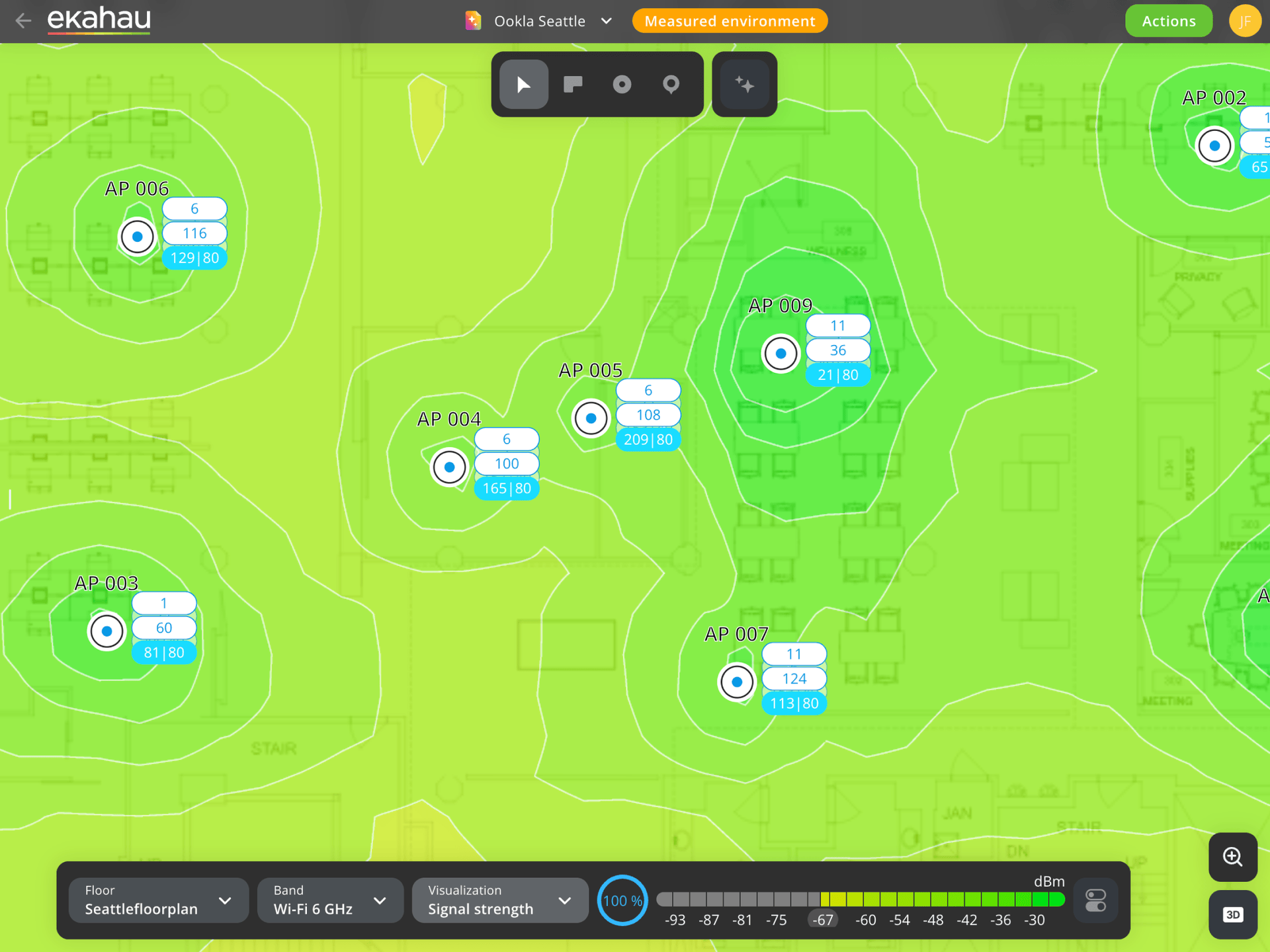
A San Fernando Valley wireless site survey from WiFi Hotshots starts with Ekahau predictive modeling and closes with post-install validation heatmaps — every engagement a fixed-fee SOW, not hourly billing.
We cover the full Valley from our Valencia HQ on a 15-minute dispatch to Burbank: CSUN lecture halls and residence halls, hospital floors at Providence Cedars-Sinai Tarzana, Providence Holy Cross in Mission Hills, and Northridge Hospital, LAUSD Local District Northwest CMU-block classroom buildings, Burbank and Studio City soundstages, Van Nuys and Chatsworth aerospace hangars, and greenfield Wi-Fi 7 opportunities at the Elevate BUR replacement terminal. See the enterprise wireless services overview, the full enterprise network services portfolio, our engineering credentials and certifications, or send us your floor plans to start a scope call.
Why SFV Wireless Survey Projects Fail Without an RF Baseline
San Fernando Valley building stock is not generic. The Ventura Boulevard commercial corridor from Studio City through Sherman Oaks, Encino, Tarzana, and Woodland Hills carries a dense inventory of 3–7 story mid-rises built between 1958 and 1978, with plaster-over-metal-lath interior partitions and stucco-over-wire-lath exterior walls — assemblies that modern predictive RF models tuned to drywall-and-stud office stock underestimate by a meaningful margin. The 1994 Northridge earthquake (M6.7) triggered LADBS seismic retrofit mandates across SFV commercial and school stock, and the standard retrofit strategy added poured concrete shear walls with rebar grids to the interior cores of 1960s and 1970s steel-frame buildings.
Aerospace hangar shells in Van Nuys and Chatsworth are welded steel frame with sheet-metal roof and walls — completely different RF behavior than the CMU-block classroom corridors of LAUSD Local District Northwest’s 127 schools. Burbank and Studio City soundstages are steel truss shells with internal sound-blanket insulation that raises the 5 GHz noise floor inside the stage independently of anything the WLAN controller is doing.
Deploying APs without a measured RF baseline means your channel plan is built on assumptions, not data. When a Spectralink handset drops on a Providence Tarzana patient floor or a Zebra scanner misses the back of a Chatsworth hangar bay, the root cause is always the same: the pre-deployment work was skipped or compressed.
An enterprise wireless site survey in the San Fernando Valley is not optional for complex environments — it is the engineering step that separates a network that works from one that generates tickets. The design target for a general enterprise data environment is a minimum ‑67 dBm RSSI at cell edge with at least 25 dB SNR. For voice-grade networks — Vocera Smartbadge, Spectralink, Ascom — those targets hold, and you add a 15–20% cell overlap requirement at the ‑67 dBm boundary to support fast BSS transition under 802.11r. None of those thresholds can be confirmed by looking at a floor plan. They require measurement.
Ekahau Predictive Survey Methodology: Floor Plan Ingestion to AP Placement Map
Every WFHS engagement begins in Ekahau AI Pro, the design and analysis module within the Ekahau Connect platform. The workflow starts with floor plan import at measured scale — either CAD-exported PDF or a photographed as-built drawing re-scaled to a known distance. Wall types are assigned material attenuation values: glass, drywall, CMU, poured concrete, concrete with rebar, and plaster-over-metal-lath each carry different dB-per-meter loss figures.
For post-Northridge seismic retrofit shear walls common across the Valley, the model requires a concrete-plus-rebar attenuation assignment rather than a generic concrete value, because the #5 and #6 rebar grid adds measurable additional loss at 5 GHz and above. For Ventura Boulevard mid-rises, the plaster-over-metal-lath interior partition is treated separately from modern drywall; the metal lath layer changes the 5 GHz attenuation profile materially.
Once the floor plan is calibrated, the predictive engine runs AP placement simulations against the design requirement profile — coverage at ‑67 dBm RSSI, channel plan, and secondary-AP overlap for 802.11k neighbor list population. The output is an AP count per floor with placement coordinates and a draft bill of materials.
For San Fernando Valley deployments, predictive design typically covers 1,200–2,000 sq ft per AP on 5 GHz and 6 GHz radios in open-plan office environments. High-density spaces — CSUN lecture halls seating 200-plus, hospital patient floors at Providence Tarzana or Northridge Hospital, LAUSD classrooms at 2 APs per room — require tighter placement intervals driven by client count and MOS score targets rather than coverage radius alone.
Predictive survey is accurate for standard construction. On atypical SFV materials — plaster-over-metal-lath, concrete-plus-rebar shear walls, sheet-metal hangar shells, steel-truss soundstage envelopes, lead-lined imaging suites at Providence and Northridge Hospital — the predictive model flags uncertainty zones that require an AP-on-a-Stick validation pass before hardware procurement.
- AP count per floor with X/Y placement coordinates exportable to AutoCAD or PDF overlay
- Channel plan: 2.4 GHz channels 1/6/11 for coverage; 5 GHz 20/40/80 MHz assignments per zone; 6 GHz LPI channel selection for Wi-Fi 6E and Wi-Fi 7 APs (indoor LPI class, no AFC required per FCC Part 15 Subpart E)
- Per-band heatmap exports showing RSSI, SNR, secondary coverage (802.11k), and co-channel interference overlay
AP-on-a-Stick Validation for SFV Venues: Healthcare, Higher Ed, and Media Production
AP-on-a-Stick (APoS) methodology mounts a production-model AP on a telescopic pole at the intended deployment height — typically 12–18 ft for ceiling-tile environments, 25–40 ft for soundstage grid-iron and aerospace hangar conditions. The Ekahau Sidekick 2 attaches to the survey laptop via USB-C and runs four tri-band radios scanning 2.4, 5, and 6 GHz simultaneously at 50 sweeps per second across the full 2,400–7,125 MHz range.
The surveyor walks the floor while the Sidekick 2’s nine custom 3D antennas record passive RF measurements at every point — RSSI, SNR, noise floor, and co-channel interference — across every visible AP. That measurement data overwrites the predictive model where they differ, producing a hybrid design that combines simulation efficiency with field accuracy.
SFV venues that mandate APoS rather than predictive-only include any facility where drawings do not reflect reality. Clinical floors at Providence Cedars-Sinai Tarzana, Providence Holy Cross in Mission Hills, and Northridge Hospital Medical Center carry infection-control constraints on above-ceiling access that require cable routing to be confirmed before the first AP is mounted; lead-lined imaging suites boundary as RF-opaque zones on the heat map. CSUN’s 234,712 sq ft University Library creates multipath and line-of-sight challenges across stack zones that a flat-floor predictive model cannot resolve; 200-plus-seat lecture halls in Chaparral Hall and across the 356-acre campus require seat-by-seat density confirmation.
LAUSD Local District Northwest school buildings, many constructed with CMU-block exterior walls and central corridor layouts, need room-by-room passive validation to confirm that a hallway-only AP plan holds signal at the back of a 30-seat classroom — it rarely does. Burbank and Studio City soundstages (Warner Bros., Walt Disney Studios, NBCU, CBS Studio Center) use welded steel truss shells with internal sound-blanket insulation; the shielding is incidental to acoustic design but it raises the 5 GHz noise floor inside the stage materially. These institutions are referenced as venue archetypes, not as claimed engagements.
- Higher education and dense campus: seat-by-seat density modeling in lecture halls; residence-hall roaming validation across wing transitions; outdoor quad coverage with Juniper AP63-class or equivalent outdoor-rated APs on 6 GHz (standard-power outdoor requires AFC)
- Healthcare: infection-control ceiling-plenum constraints confirmed before cable pathways are routed; lead-lined imaging suite boundaries flagged as RF-opaque zones requiring AP relocation; VoWLAN handset roaming exercised on Spectralink, Vocera, and Ascom form factors
- Media production: steel-shell soundstage noise-floor measurement; production vs. office WLAN segmentation; temporary stage coverage planning; spectrum coordination with 5 GHz production lighting control and 2.4 GHz walkie-talkie systems
Floor plans and device counts are all we need to scope the work — most San Fernando Valley engagements are quoted on a fixed-fee SOW within three business days of a 30–60 minute scoping call.
Passive and Active Validation: Throughput, Roaming, and Voice MOS Testing
A passive survey records every RF signal in the environment without associating to any SSID. The Ekahau Sidekick 2 listens — it measures what the air contains, not what a connected session reports. Passive surveys are used for pre-deployment environment assessment (neighbor AP inventory, noise floor, DFS radar event detection) and for post-install coverage confirmation. DFS event rates in the SFV are not generic.
Van Nuys Airport (VNY) and Hollywood Burbank Airport (BUR) ground-based ATC radar is DFS-proximate to hangars and ramps in Van Nuys, Chatsworth, and Burbank; UNII-2A and UNII-2C channels see measurably higher radar-event rates near these sites than in generic LA metro locations. Validate DFS exposure with field measurement before enabling DFS channels in production. The output is a heatmap for every band, every floor, at every survey waypoint — color-coded RSSI, SNR, and secondary coverage for 802.11k neighbor list validation.
Active validation associates to the production SSID and measures what the client actually experiences. iPerf3 bidirectional throughput runs confirm uplink and downlink capacity against the designed channel width. Roaming tests exercise 802.11r fast BSS transition — the protocol is designed to shorten roaming interruptions, and 50 ms or less is the accepted voice-grade handoff target that 802.11r was built to support. Active testing with a roaming test client confirms whether the deployed controller configuration actually achieves it or whether a misconfigured minimum RSSI threshold is stalling the handoff.
For voice-over-Wi-Fi migration engagements — Cisco Webex Calling, CUCM, or Teams Phone — the active test also captures a MOS (Mean Opinion Score) trace across the full walking route. A voice-grade network targeting MOS 4.0+ requires the ‑67 dBm RSSI and 25 dB SNR thresholds to hold at cell edge without exception. Any area that drops below those targets appears as a gap in the post-install validation report, with a remediation recommendation tied to a specific AP or configuration change. The independent post-install validation report is the deliverable your operations team, auditor, or next engineer can pick up without context.
San Fernando Valley Market Constraints: Aerospace Sheet-Metal, Title 24, and Burbank Airport Coordination
Aerospace Sheet-Metal Hangar Shadowing in Van Nuys and Chatsworth
The SFV aerospace and defense corridor includes Northrop Grumman’s Woodland Hills campus on Canoga Avenue (the former Litton Guidance & Control facility), the Aerojet Rocketdyne campus on De Soto Avenue in Chatsworth, and general aviation hangars lining Van Nuys Airport. Hangar shells are welded steel frame with sheet-metal roof and walls. Sheet-metal creates 20-plus-dB shadow zones; outdoor-to-indoor signal propagation is severely attenuated, which means an outdoor AP reaching in from a pole mount does not cover the hangar floor — dedicated indoor APs at deployment height are required.
Large open-bay hangars with 30–50 ft ceilings and moving overhead crane bridges add another layer: AP mounting has to clear crane travel height or the crane itself blocks the signal when it moves. Outdoor apron and ramp coverage is a separate design with outdoor-rated APs. Secure-facility portions of Northrop Grumman and Aerojet Rocketdyne campuses have separate scoping from enterprise WLAN; CJIS-adjacent and controlled-environment work is out of scope for a standard site survey and is referred accordingly.
California Title 24 Part 6 Ceiling Penetration Coordination
California Title 24 Part 6 (the California Energy Code) sets prescriptive requirements for building envelope thermal performance that affect ceiling and wall penetration approvals in energy-efficient occupancies — particularly in buildings targeting LEED certification or CEC compliance. In new SFV construction and major renovations (new LAUSD builds, CSUN new buildings, the Elevate BUR replacement terminal, Providence expansion projects), the AP cable pathway from the IDF closet to the ceiling grid plenum must be routed through approved penetrations coordinated with the general contractor and the Authority Having Jurisdiction (AHJ).
On a WFHS survey engagement, the deliverable includes a cable pathway recommendation with flagged penetration points — so the contractor has the routing map before they start cutting, not after. Where the survey identifies below-ceiling pathway gaps or insufficient PoE capacity at the switch port, cabling infrastructure review is scoped as a parallel workstream in the same fixed-fee SOW.
Public-Safety DAS Overlay, BUR Greenfield, and Clinical-Campus ERRCS Coordination
LA County fire code (referencing NFPA 72 and NFPA 1221) requires Emergency Responder Radio Coverage Systems (ERRCS) in any building that exceeds three stories above grade, has 50,000 sq ft or more of total floor area, has a basement area of 10,000 sq ft or more, or has any basement two or more stories below grade. ERRCS mandates 99% signal coverage in critical areas (command centers, elevator lobbies, exit stairs) and 90% in remaining areas throughout the building.
Providence Cedars-Sinai Tarzana (approximately 204 licensed beds), Providence Holy Cross in Mission Hills (approximately 378 licensed beds), and Northridge Hospital Medical Center (approximately 394 licensed beds) all exceed the 50,000 sq ft and three-story thresholds; the 355,000 sq ft Elevate BUR replacement terminal opening October 2026 triggers ERRCS from day one; CSUN’s 90,000 sq ft, four-story Chaparral Hall triggers ERRCS; Ventura Boulevard mid-rises at three stories and above frequently trigger ERRCS.
The ERRCS BDA (bi-directional amplifier) donor antennas and remote units share plenum space with enterprise Wi-Fi APs. On a WFHS site survey, we identify existing ERRCS infrastructure in the ceiling plenum and route AP cable pathways to avoid conflict with BDA cabling. WFHS is not an ERRCS integrator — if the survey reveals an ERRCS coverage gap or a BDA installation that does not satisfy the NFPA 1221 signal level requirements, the correct next step is a licensed ERRCS contractor, not a Wi-Fi vendor.
We flag the gap, document the location, and coordinate referral. Hospital campuses represent the most complex ERRCS coordination scenario in the SFV market; our approach to clinical wireless environments covers both the survey methodology and the post-construction validation sequence. Note: the Hollywood Burbank Airport Part 161 voluntary nighttime curfew (10 p.m. – 7 a.m.) does not directly affect wireless design but commonly affects construction access windows for outdoor AP mounting near flight paths.
Scope an SFV Site Survey.
Send floor plans to sales@wifihotshots.com or call (844) 946-8746 — we return a fixed-fee SOW, not a multi-week proposal cycle.
Survey Deliverables: Heat Maps, BOM, Install Runbook, and Validation Report
At the close of every San Fernando Valley wireless site survey engagement, the client receives a complete document set — not a summary slide deck. The Ekahau project file (.esx) is included in every handoff so a future engineer can reopen the exact survey, adjust wall materials, or re-run the coverage model without starting from scratch. The platform mix — Cisco Catalyst 9800, Cisco Meraki MR, HPE Aruba Central (AOS-10), Juniper Mist, RUCKUS One, ExtremeCloud IQ — does not change the deliverable set.
Every engagement ships with the same documentation regardless of vendor, because the documentation belongs to the client, not the vendor. Guest and BYOD onboarding — NAC and zero trust policy or cloud-native captive portal, certificate-based authentication — is scoped as a separate design workstream when the survey reveals that the existing SSID architecture does not segment guest traffic. AP refresh and controller migration planning for Cisco Catalyst 9800 (IOS-XE 17.15+ for Wi-Fi 7), Meraki MR, HPE Aruba Central, Juniper Mist, RUCKUS One, and ExtremeCloud IQ is scoped separately where the survey identifies a controller version or capacity constraint.
- Ekahau project file (.esx) plus annotated heatmap exports per band (2.4, 5, 6 GHz) per floor: RSSI, SNR, secondary coverage (802.11k), and co-channel interference overlay
- Vendor-agnostic AP bill of materials with AP model, mount type, antenna selection, PoE class requirement, and cabling length per drop
- Installation runbook: AP placement drawing, cable pathway map, switch port assignment, and VLAN/SSID configuration notes for the contractor
- Post-install validation report: passive heatmap confirmation, iPerf3 throughput results, 802.11r roaming handoff timing, and MOS trace data for voice-grade engagements
- Design warranty: WFHS stands behind the AP count and placement — if coverage gaps appear at post-install validation that were not present in the design, we remediate the design at no additional cost
San Fernando Valley Site Survey Coverage and Wireless Service Map
WiFi Hotshots dispatches from Valencia (Santa Clarita Valley) to the full San Fernando Valley on a 15-minute drive time to Burbank — the single largest geo-differentiator for SFV engagements. Coverage runs east-to-west from Burbank, Glendale, Studio City, and North Hollywood through Sherman Oaks, Van Nuys, Valley Glen, Panorama City, Van Nuys Airport, Sun Valley, and Encino, and continues west through Tarzana, Reseda, Winnetka, Canoga Park, Woodland Hills, West Hills, and Chatsworth. The north-Valley coverage band — Mission Hills, Granada Hills, Porter Ranch, Northridge — is served on the same dispatch. The SFV/Santa Clarita border includes Six Flags Magic Mountain in Valencia, which sits inside our home dispatch window.
Greenfield and brownfield engagements across the Valley include the Elevate BUR $1.298 billion replacement passenger terminal (355,000 sq ft, 14 gates, October 2026 opening), CSUN’s 356-acre main campus, Providence Cedars-Sinai Tarzana, Providence Holy Cross, Northridge Hospital Medical Center, and the LAUSD Local District Northwest’s 127 schools covering 70,000-plus students. Warner Bros. Burbank’s 31 certified soundstages, Walt Disney Studios Burbank, NBCU Universal City, and CBS Studio Center Studio City define the Burbank/Glendale/Studio City media corridor; Northrop Grumman Woodland Hills and Aerojet Rocketdyne Chatsworth define the aerospace and defense corridor.
Multi-site San Fernando Valley engagements are coordinated from a single SOW and a single point of contact. For enterprise clients with facilities across multiple Southern California regions, we dispatch into adjacent service areas without a separate mobilization charge. The geo-family below shows the regional pages where market-specific survey details — LA metro density, Santa Clarita industrial corridor, Antelope Valley aerospace, Inland Empire warehouse density, coastal constraints — are documented for each sub-market.
Representative Engagement Profiles — San Fernando Valley Region
Multi-campus higher-education dense-wireless refresh
The SFV higher-education archetype maps to a large public university on a 350-plus-acre main campus with 35,000-plus enrolled students — the scale familiar to anyone who knows Cal State Northridge. Typical scope covers lecture halls seating 200-plus, a 200,000-plus sq ft library with dense stack zones where predictive-only modeling is inadequate, residence halls operating at 1:1 to 1:3 device density (laptop + phone + tablet + gaming console), and outdoor quad coverage that requires outdoor-rated APs on 6 GHz standard power with AFC coordination.
High-density lecture halls use 20 MHz channels for client-count capacity rather than wider channels for throughput. The deliverable set — per-floor heatmaps, vendor-agnostic AP BOM, and post-install validation report — is formatted for review by campus IT governance. CSUN is referenced here as a venue archetype, not as a claimed engagement.
Regional-hospital clinical-wireless network migration
The SFV regional-hospital archetype maps to a 200- to 400-licensed-bed acute-care facility with med-surg floors, ED bays, OR suites, and ICU — the scale familiar to anyone who knows Providence Cedars-Sinai Tarzana, Providence Holy Cross in Mission Hills, or Northridge Hospital Medical Center. Typical scope covers a phased wireless migration with ‑67 dBm cell edges at clinical depth, VoWLAN-grade roaming for Spectralink, Vocera, and Ascom handsets, EHR bedside workflow coverage, RTLS overlay for patient location services on a parallel RF scheme (active-RFID or BLE), and ERRCS ceiling-plenum conflict identification across buildings meeting the LA County 50,000 sq ft / three-story threshold.
WPA3-Enterprise or WPA2-Enterprise encryption with HIPAA-aligned network segmentation is a design input, not a compliance claim. The deliverable set is formatted for review by the health system’s IT governance committee. Providence and Northridge Hospital are referenced here as venue archetypes, not as claimed engagements.
Large-scale K-12 district deployment across the SFV
The SFV K-12 archetype maps to a large urban public district with 100-plus schools and 70,000-plus students — the scale familiar to anyone who knows LAUSD Local District Northwest, covering Van Nuys, Northridge, Granada Hills, Mission Hills, Porter Ranch, Reseda, Chatsworth, Winnetka, Canoga Park, and Woodland Hills.
Typical scope covers 2 APs per classroom design (LAUSD specifies a 2:1 AP-to-classroom ratio — not the 1:1 ratio common in other districts) across CMU-block construction from the 1950s–1970s, 1:1 Chromebook density, voice-quality targets for district-standardized Wi-Fi calling, post-Northridge (1994) seismic shear-wall attenuation modeling, asbestos-containing ceiling tiles that constrain above-ceiling cable routing, and E-rate FY2026–2030 Category 2 documentation requirements with a $201.57 per-student budget floor. The filing window for FY2026 closes April 1, 2026. The K-12 campus wireless design methodology covers the full survey and E-rate documentation workflow. LAUSD is referenced here as a venue archetype, not as a claimed engagement.
Media-campus backstage-wireless production network
The SFV media archetype maps to a Burbank, Glendale, or Studio City soundstage campus with 20-plus certified stages ranging 10,000–32,000 sq ft each — the scale familiar to anyone who knows Warner Bros., Walt Disney Studios, NBCU Universal City, or CBS Studio Center. Typical scope covers steel-truss soundstage shells with internal sound-blanket insulation that raises the 5 GHz noise floor inside the stage, production vs. office WLAN segmentation (production SSID isolated from corporate network), temporary stage coverage for location shoots with teleasing APs on tripods, and spectrum coordination with 5 GHz production lighting control and 2.4 GHz walkie-talkie systems.
Stage-to-stage roaming for production walkies is a coexistence planning issue with WLAN, not a WLAN design issue per se. The deliverable includes AP mounting specifications, antenna type and polarization recommendations, and a channel-reuse plan that accounts for production-schedule access windows. Warner Bros., Disney, NBCU, and CBS Studio Center are referenced here as venue archetypes, not as claimed engagements.
San Fernando Valley Wireless Site Survey FAQs
How long does a San Fernando Valley enterprise wireless site survey take?
Timeline depends on scope. A single-floor commercial space on Ventura Boulevard or in the Burbank media corridor with complete as-built drawings can be predictively modeled and quoted within three business days of the scoping call. An AP-on-a-Stick field validation for that same floor takes one to two days on-site.
Multi-building campus engagements — CSUN-scale higher ed, Providence or Northridge Hospital-scale clinical campuses, or LAUSD Local District Northwest-scale multi-school rollouts — typically run two to four weeks from floor plan receipt to final deliverable.
Every engagement is scoped and quoted as a fixed-fee SOW before work begins.
Our 15-minute dispatch from Valencia to Burbank means mobilization is fast, and the timeline, scope, and deliverables are defined in writing. We do not bill hourly against an open-ended estimate.
What’s the difference between a predictive survey and an AP-on-a-Stick validation survey?
A predictive survey uses Ekahau Connect to model RF propagation through a calibrated floor plan. No physical measurement occurs — the software simulates signal paths through assigned wall materials and produces coverage heatmaps and an AP placement plan. It is fast and accurate for standard construction materials.
An AP-on-a-Stick survey mounts a production-model AP on a telescopic pole at the intended deployment height, and the Ekahau Sidekick 2 captures real measurements — actual RSSI, SNR, and noise floor — as the surveyor walks the floor.
For buildings with atypical attenuation (plaster-over-metal-lath, concrete-plus-rebar shear walls, sheet-metal hangar shells, steel-truss soundstage envelopes, lead-lined imaging suites, CMU block) or where as-built drawings are unreliable, the AP-on-a-Stick pass is required before procurement.
Most WFHS engagements include both: predictive for initial design and AP count, AP-on-a-Stick for validation before the BOM is finalized.
On a San Fernando Valley site survey, do you cover all of the San Fernando Valley, or just Burbank/Glendale?
All of the San Fernando Valley — and the 15-minute Valencia-to-Burbank dispatch is the primary geo-differentiator. Coverage runs the full east-to-west SFV footprint: Burbank, Glendale, Studio City, North Hollywood, Sherman Oaks, Van Nuys, Encino, Tarzana, Reseda, Winnetka, Canoga Park, Woodland Hills, West Hills, Chatsworth, Mission Hills, Granada Hills, Porter Ranch, and Northridge. SFV coverage also extends to Arleta, Pacoima, Sylmar, Lake Balboa, Valley Village, Toluca Lake, Calabasas, and Hidden Hills.
The SFV/Santa Clarita border (Six Flags Magic Mountain in Valencia) is inside the same dispatch.
We also dispatch into adjacent service areas — LA metro, Santa Clarita, Antelope Valley, Ventura County, Inland Empire, Orange County — under the same fixed-fee SOW structure.
Van Nuys Airport and Hollywood Burbank Airport engagements are quoted with airport-access credentialing and Part 161 coordination factored in.
What does a wireless site survey cost in San Fernando Valley?
Every engagement is priced as a fixed-fee SOW — we do not bill hourly. Scope variables that drive cost: building square footage, number of floors, number of buildings, construction type (standard drywall vs. CMU block vs. plaster-over-metal-lath vs. concrete-plus-rebar shear wall vs. steel-truss soundstage vs. sheet-metal hangar), required survey type (predictive only, AP-on-a-Stick, or combined predictive-plus-validation), and whether post-install validation and a formal validation report are in scope.
We return a written SOW quote within three business days of the scoping call of receiving floor plans and a scope description.
Send floor plans to sales@wifihotshots.com or call (844) 946-8746. No engagement begins without the client signing off on the fixed-fee price first.
On a San Fernando Valley site survey, what deliverables do we receive after a WFHS site survey?
Every engagement produces: the Ekahau project file (.esx) for future re-use; annotated heatmap exports per frequency band (2.4, 5, 6 GHz) per floor showing RSSI, SNR, secondary coverage (802.11k), and co-channel interference; a vendor-agnostic AP bill of materials with mount type, antenna, PoE class,
and cabling callouts; an installation runbook for the contractor; and a post-install validation report with passive heatmap confirmation, iPerf3 throughput results, 802.11r handoff timing, and MOS trace data for voice-grade engagements.
The deliverable set is the same regardless of the AP vendor — Cisco, Meraki, HPE Aruba, Juniper Mist, RUCKUS, or Extreme.
The documentation belongs to the client and is formatted for a 10-year shelf life.
Can WFHS survey in a live San Fernando Valley production environment without downtime?
Yes. Passive survey requires no network access and causes zero disruption to production traffic — the Ekahau Sidekick 2 listens passively and never associates to any SSID. Active throughput testing and roaming validation require a brief association to a production or test SSID, which does not affect other clients on the network.
Full iPerf3 load testing, which generates several hundred Mbps of synthetic traffic to stress the uplink, is scheduled during off-hours or in a maintenance window if the client requests it.
We have conducted passive surveys in live Burbank soundstage production environments, clinical patient floors, and operating aerospace hangars without interrupting production operations.
Studio production schedules typically drive a pre-survey coordination call with the stage manager to identify access windows that do not conflict with active shoots.
The pre-survey coordination document we send before mobilization identifies which test phases, if any, require an off-hours window.
Do you survey CSUN and LAUSD Northwest campuses differently than corporate offices?
The survey instruments are the same; the design targets differ. CSUN-scale higher education and LAUSD-scale K-12 are designed for 1:1 client device density per classroom or lecture hall seat, not the lower density of a corporate open-plan floor.
That changes the AP placement interval — LAUSD Local District Northwest specifies 2 APs per classroom (a 2:1 AP-to-classroom ratio, not the 1:1 ratio common in other districts), which drives tighter AP-to-AP spacing — the channel width selection (20 MHz standard in high-density zones), and the roaming design.
LAUSD Local District Northwest engagements are typically scheduled during summer recess to allow room-by-room passive walkthroughs in CMU-block buildings where hallway-only AP plans fail under classroom load.
E-rate procurement requirements mean the deliverable set must include documentation compatible with the district’s Category 2 equipment and installation submission for the FY2026–2030 funding cycle.
For CSUN-scale higher education, outdoor coverage across the 356-acre main campus — quads, pathways, and residence halls — requires outdoor-rated APs on 6 GHz standard power with AFC coordination, and ADA-accessible AP mounting locations are a hard constraint.
CSUN and LAUSD are referenced here as venue archetypes, not as claimed engagements.
How does a San Fernando Valley site survey handle Valley-specific RF surprises not in the original scope?
The fixed-fee SOW covers the defined scope. If the survey uncovers something outside that scope — an ERRCS gap requiring a licensed BDA integrator at a Providence or Northridge Hospital campus, a structured cabling deficiency that needs remediation before APs can be installed in a Ventura Boulevard mid-rise, or a DAS antenna placement conflict inside a Burbank soundstage grid-iron — we document the finding in the validation report with a clear description of the issue and its location.
We then issue a separate change-order estimate for any additional WFHS scope and, where the finding is outside wireless engineering (like ERRCS installation), we refer to the appropriate licensed contractor.
The client is never billed above the SOW total without a signed change order first.
That is the operational definition of a fixed-fee engagement.
How does WFHS handle wireless design inside an LED volume or virtual production stage where the LED wall raises the RF noise floor?
Virtual production LED walls emit broadband digital switching noise that raises the 2.4 GHz and 5 GHz noise floor across a sound stage envelope. On Burbank, Lake Balboa,
and Sherman Oaks virtual production stages, WFHS baselines the noise floor under live video playback using the Ekahau Sidekick 2 spectrum analyzer (2,400-2,495 MHz and 5,000-7,125 MHz coverage), then designs channel plans that avoid the most polluted 5 GHz segments and prioritize 6 GHz Wi-Fi 6E/Wi-Fi 7 on Arista C-360 or Arista C-460 platforms where the LED wall’s broadband emissions attenuate more quickly with frequency.
Wi-Fi 7 preamble puncturing (mandatory in 802.11be) lets wide channels stay usable when narrowband segments are compromised.
See our wireless engineering services for sound-stage survey scope.
Does WFHS coordinate FAA Part 77 obstruction evaluation for rooftop APs or mast-mounted outdoor access points near Van Nuys Airport?
Yes. Any proposed construction or alteration within navigable airspace requires an FAA Form 7460-1 Notice of Proposed Construction or Alteration under 14 CFR Part 77. Notification must be submitted 45 days prior to construction, and structures exceeding 200 feet above ground level (or lower near airports) trigger mandatory filing.
For Van Nuys Airport-adjacent Lake Balboa, Sherman Oaks, and North Hollywood rooftop omnidirectional or sector antenna deployments, WFHS prepares the Part 77 filing ahead of mast height approval and coordinates with the FAA Obstruction Evaluation / Airport Airspace Analysis (OE/AAA) portal.
Penalties for non-filing reach $1,000 per day under 49 U.S.C.
Section 46301(a). Send us the site coordinates and proposed mast height to begin the filing workflow via our project inquiry form.
How does the Terminal Doppler Weather Radar at Hollywood Burbank Airport affect DFS channel availability in the San Fernando Valley?
TDWR operates in the 5.600-5.650 GHz band, which sits inside the UNII-2C extended band (5.470-5.725 GHz). The FCC requires wireless operators within 35 km of a TDWR to avoid frequencies within 30 MHz (center-to-center) of the TDWR operating frequency,
and access points farther than 35 km must comply if their clients roam within the 35 km radius. That zone encompasses the entire San Fernando Valley from the Burbank Airport TDWR.
The FCC reopened channels 120, 124, and 128 with enhanced protection (radar sensing across 100% of emission bandwidth rather than the prior 80%), but the 5600-5650 MHz TDWR overlap remains restricted.
WFHS channel plans around TDWR-affected UNII-2C channels for Valley deployments, commonly routing primary 5 GHz coverage into UNII-1 and UNII-3.
Can WFHS deploy standard-power 6 GHz Wi-Fi 7 access points in the San Fernando Valley given airport proximity?
Yes, with AFC (Automated Frequency Coordination) enabled. Standard-power access points are limited to UNII-5 (5.925-6.425 GHz) and UNII-7 (6.525-6.875 GHz) portions of the 6 GHz band and must operate under an approved AFC system at a maximum EIRP of 36 dBm per 47 CFR 15.407.
The FCC OET approved seven AFC system operators on February 23, 2024: Qualcomm, Federated Wireless, Sony, Comsearch (a CommScope company), the Wi-Fi Alliance Services Corporation, the Wireless Broadband Alliance, and Broadcom.
AFC dynamically allocates channels that avoid incumbent microwave backhaul and other licensed services.
Arista C-460, Cisco Catalyst 9176, HPE Aruba 730 Series, and RUCKUS R770 access points all support AFC-managed standard-power operation on a San Fernando Valley site survey engagement.
How does California Title 24 Part 6 impact ceiling AP placement and cable penetration in San Fernando Valley commercial buildings?
Title 24 Part 6 (California Energy Code, 2022 edition) governs building envelope thermal performance. Noninsulated duct penetrations into unconditioned space must be draft-stopped and air-sealed to the construction materials penetrated, and ceiling-plane air sealing between attic and conditioned space is required in Climate Zones 2, 4, and 8-16. The same discipline applies to any AP drop that penetrates the ceiling plane.
WFHS coordinates AP above-ceiling mounting with the mechanical and fire-protection trades during design so Title 24-compliant thermal barriers are maintained and NFPA 13 sprinkler obstruction clearances (nothing in the 18-inch zone below sprinkler heads) are preserved.
For Glendale and Sherman Oaks Class A towers subject to LADBS plan check, WFHS mounting details feed into the permit set.
Does WFHS support Arista wireless platforms for San Fernando Valley enterprise deployments?
Yes. Arista is a first-class WFHS survey and deployment platform alongside Cisco Catalyst 9800, HPE Aruba AOS-10, Juniper Mist, RUCKUS One, and Extreme ExtremeCloud IQ.
The current Arista portfolio includes the Wi-Fi 7 C-460 (4×4 all bands, 11.5 Gbps peak 6 GHz, dual 10 GbE PoE++ MACsec-capable), the C-430 Wi-Fi 7 (2×2 all bands, dual 5 GbE PoE+), the C-400 entry Wi-Fi 7 AP, and the O-435 outdoor Wi-Fi 7 AP.
The Wi-Fi 6E C-360 features a multi-function tri-band scan radio for integrated WIPS, security, and AI/ML troubleshooting.
All Arista APs are managed by CloudVision CUE (Cognitive Unified Edge), Arista’s cloud-native wireless management plane with AI/ML-driven App Quality of Experience engine and Marker Packet WIPS. CloudVision CUE scales from dozens to hundreds of thousands of APs. Review our vendor partnerships for the full platform list.
What is Multi-Link Operation (MLO) and does it help Glendale post-production and render-farm-adjacent wireless?
MLO is a mandatory Wi-Fi 7 feature enabling a multi-link device to simultaneously associate and exchange traffic across 2.4 GHz, 5 GHz, and 6 GHz bands. Traffic distribution across multiple bands raises throughput, reduces latency, and improves reliability; if one band experiences interference, traffic shifts to other links. Cisco Meraki documents three MLO modes: MLMR-STR (simultaneous transmit/receive across radios), EMLSR (enhanced single-radio dynamic switching), and MLSR (sequential single-radio switching).
For Glendale post-production floors where large animation and VFX campuses run 300-plus-AP indoor and outdoor deployments, MLO-capable APs including Arista C-460, Cisco Catalyst 9176, HPE Aruba AP-735, and RUCKUS R770 deliver band-level resilience against interference events.
Does WFHS design to Wi-Fi 7 marketing throughput numbers or to realistic SNR-bounded rates?
Realistic. 4K-QAM (4096-QAM) is an optional Wi-Fi 7 feature that encodes 12 bits per subcarrier versus 10 bits in Wi-Fi 6’s 1024-QAM. Per Cisco Meraki’s Wi-Fi 7 technical guide, 4K-QAM requires an SNR close to 42 dB — compared with 25 dB for 802.11ac 256-QAM and 31 dB for 802.11ax 1K-QAM.
In Cisco’s VoWLAN design reference, enterprise surveys validate cell-edge coverage at -67 dBm RSSI with a minimum 25 dB SNR (voice-grade), which supports lower modulation orders but not 4K-QAM. 4K-QAM rates only appear within a few meters of the AP in clean spectrum.
For vendor datasheet maxima to become real throughput, clients must be in 4K-QAM-capable range with negligible contention.
WFHS validates with Ekahau survey data, not marketing peaks.
How does preamble puncturing help in contested San Fernando Valley spectrum environments like Studio City mid-rise office campuses?
Preamble puncturing lets an AP carve out an interfered 20 MHz sub-block within a wide channel and keep the rest of the channel usable — if one 20 MHz segment of a 320 MHz Wi-Fi 7 channel is polluted by an adjacent-tenant source, the remaining width is preserved rather than lost. Wi-Fi 6 made puncturing optional for multi-user transmissions only.
Wi-Fi 7 makes puncturing mandatory and extends it to single-user transmissions, significantly enhancing spectrum efficiency in environments with wireless interference.
On Studio City, Sherman Oaks, and Glendale mid-rise stacks where adjacent-tenant RF leakage is endemic, Arista C-460, Cisco Catalyst 9176, HPE Aruba AP-735, and RUCKUS R770 Wi-Fi 7 APs retain wide-channel efficiency that Wi-Fi 6 deployments would lose.
Does WFHS implement WPA3-Enterprise 192-bit mode for Tarzana and Mission Hills clinical deployments?
Yes, when the clinical program requires CNSA-grade encryption. WPA3-Enterprise 192-bit mode uses AES-256-GCMP encryption with HMAC-SHA-384 authentication under the CNSA (Commercial National Security Algorithm) suite, which NSA published in 2018 at minimum 192-bit security strength to replace Suite B. Technical ciphers per Cisco Meraki: AES-256-GCMP pairwise, GCMP-256 group data, BIP-GMAC-256 group management, and EAP-TLS mutual-certificate authentication is the only permitted EAP method (username/password is not supported).
Permitted EAP ciphers are TLS_ECDHE_ECDSA_WITH_AES_256_GCM_SHA384, TLS_ECDHE_RSA_WITH_AES_256_GCM_SHA384, or TLS_DHE_RSA_WITH_AES_256_GCM_SHA384.
Arista, Cisco Catalyst 9800, HPE Aruba AOS-10, Juniper Mist, and RUCKUS One all support WPA3-Enterprise 192-bit on current-generation APs.
What roaming parameters does WFHS configure for Spectralink Versity voice-over-Wi-Fi handsets on SFV hospital floors?
Versity 92/95/96 handsets require voice-enterprise-grade roaming: 802.11r Fast BSS Transition, 802.11k Neighbor Reports, and 802.11v BSS Transition Management enabled; DTIM period aligned to the handset’s power-save intervals; voice-class WMM queues; and per Cisco VoWLAN design a minimum -67 dBm RSSI at cell edge with 25 dB SNR (noise floor no higher than -92 dBm).
Per Cisco Meraki documentation, 802.11r stores encryption keys on all APs so re-authentication with the backend is skipped at roam, and 802.11k provides neighbor AP and channel information so the handset does not need to scan before roaming.
Cell overlap target is 15-20% for 5 GHz and 20% for 2.4 GHz per Cisco.
Note: 802.11r is not supported concurrently with WPA3-Enterprise 192-bit mode per Cisco Meraki, so voice and high-security SSIDs are segregated on separate WLANs.
Does WFHS coordinate ERRCS / ERCES and NFPA 1225 public-safety radio coverage during clinical-campus wireless surveys?
Yes. NFPA 1225 (Standard for Emergency Services Communications, 2022 edition) consolidated NFPA 1221 and NFPA 1061 and governs in-building public-safety DAS / ERCES design. Chapter 18 requires minimum inbound and outbound signal strength of -95 dBm with coverage in 99% of critical areas (stairwells, fire command centers, fire pump rooms, elevator lobbies, exit passageways) and 90% of general building areas.
Backup power must support the ERCES system and re-validation is required annually.
On Tarzana, Mission Hills, Northridge, and Van Nuys clinical campuses, WFHS coordinates Wi-Fi AP mounting and penetrations with the in-building public-safety BDA / DAS design so donor-antenna backhaul, 700/800 MHz public-safety coverage, and Wi-Fi coverage do not interfere. Review scope via our wireless engineering services page.
How does WFHS design around aerospace hangar sheet-metal shadowing in Van Nuys and Chatsworth?
Sheet-metal envelopes impose substantial shadow attenuation — metal wall attenuation is commonly the largest single loss in RF link budgets, which is why predictive models without calibrated site measurements routinely miss shadow zones in hangars.
WFHS addresses this with a two-stage workflow: AP-on-a-Stick (APoS) validation pre-design to measure actual RF behavior inside the hangar envelope with the Ekahau Sidekick 2 (4 enterprise-grade tri-band Wi-Fi 6E radios, 9 custom 3D antennas, and a spectrum analyzer covering 2,400-2,495 MHz and 5,000-7,125 MHz at 50 sweeps per second), and Ekahau AI Pro predictive modeling with wall-attenuation values calibrated against the APoS measurements.
The APoS-calibrated predictive model then guides placement of Arista C-460, Cisco Catalyst 9176, HPE Aruba AP-735, or RUCKUS R770 APs along the hangar perimeter and catwalk structures.
What airtime-utilization thresholds does WFHS design to for CSUN high-density lecture halls and Pierce College classrooms?
For higher-education classrooms and lecture halls that mix voice, video, and data, WFHS designs to a conservative airtime utilization ceiling: overall Channel Utilization less than 50% per Cisco’s VoWLAN design reference, retransmissions under 20%, packet loss under 1%, and jitter under 100 ms.
Airtime consumed by voice and video WMM queues tightens the effective ceiling because contention windows are smaller than best-effort, so collisions above the threshold cascade into latency spikes.
CSUN operates eduroam campus-wide as a WPA2-Enterprise encrypted network requiring campus-credential login, and WFHS surveys validate airtime headroom across lecture halls at peak class-change periods using Ekahau Sidekick 2 passive and active capture.
Request a fixed-fee SOW for a CSUN or Pierce classroom-density assessment.
How does WFHS size AP density for LAUSD Local District Northwest schools with 1:1 Chromebook programs?
WFHS sizes to a one-AP-per-classroom pattern for districts running 1:1 Chromebook fleets. Qualcomm reported that LAUSD deployed more than 100,000 Chromebooks powered by Snapdragon 7c compute platforms with integrated 4G/LTE for students without home Wi-Fi — roughly 25% of LAUSD’s student population. That density translates to 30-35 clients per classroom plus IoT overhead.
Per Cisco VoWLAN design, -67 dBm at cell edge with 25 dB SNR is the voice-grade target, and hallway-only deployments fail under this load because concrete-block interior walls attenuate substantially.
The one-AP-per-classroom pattern supports voice-grade SNR at every desk with headroom. WFHS validates with active Ekahau Sidekick 2 survey at simulated class-change load.
Does WFHS validate Wi-Fi design against Zebra MC9400 and TC58 scanner fleets for Valley 3PL and retail operations?
Yes. The Zebra MC9400/MC9450 is a current-generation rugged mobile computer supporting IEEE 802.11 a/b/g/n/ac/ax/d/h/i/r/k/v/w/mc standards with 2×2 MU-MIMO tri-band (2.4, 5, 6 GHz) Wi-Fi 6E, paired with the SE58 Extended Range Scan Engine (IntelliFocus, 100+ foot scan range) or SE4770 1D/2D scan engine. The Zebra TC53/TC58 adds 5G (TC58) and CBRS to Wi-Fi 6E with SE4720 (standard) or SE55 Advanced Range (40+ foot) scan engines.
WFHS builds handset-class roaming policies on surveyed Valley 3PL, retail back-of-house, and cold-chain environments: dedicated SSID, 802.11r Fast Transition, 802.11k Neighbor Reports, 802.11v BSS Transition Management, minimum -67 dBm RSSI at cell edge, 25 dB SNR, 15-20% overlap.
Arista C-260/C-360/C-460, Cisco Catalyst 9166/9176, HPE Aruba AP-635/AP-735, and RUCKUS R770 interoperate with Zebra fleets under voice-enterprise certification.
Does WFHS deploy Juniper Mist Marvis Virtual Network Assistant for Valley multi-campus operations?
Yes, where the operational model benefits from AI-driven assurance. Per Juniper documentation, Mist RRM is a cloud-based system using the dedicated scanning radio in every Mist AP to continuously gather RF data. RRM uses reinforcement learning and analyzes 30 days of historical site data to make nightly adjustments to channel, transmit power, channel width, band steering, and radio state.
Marvis is Juniper’s Virtual Network Assistant — a conversational interface using NLP/NLU where an operator can ask “troubleshoot Teams” and receive near-real-time natural-language responses with actionable insights.
Marvis Client is a software agent on client devices collecting client-side parameters. For SFV customers with multiple sites (Valencia HQ plus Valley branches), Marvis reduces mean-time-to-resolution on wireless tickets.
How does WFHS decide between Arista C-260 (Wi-Fi 6), C-360 (Wi-Fi 6E), and C-460 (Wi-Fi 7) for SFV office and clinical refresh projects?
Per Arista’s Wi-Fi 7 Series product page and C-460 datasheet, the C-460 is a quad-radio Wi-Fi 7 AP with 4×4 on 6 GHz, 5 GHz, and 2.4 GHz plus a 2×2 tri-band scan radio, delivering 11.5 Gbps peak data rate at 6 GHz, connecting via dual 10 GbE PoE++ ports that are MACsec-capable and support 100M/1G/2.5G/5G/10G Ethernet.
The C-360 is Arista’s Wi-Fi 6E AP with concurrent 6 GHz, 5 GHz, and 2.4 GHz 4-stream 802.11ax operation and a multi-function tri-band scan radio for security, assurance, and AI/ML troubleshooting.
The C-260 is an enterprise Wi-Fi 6 AP without 6 GHz — a cost-optimized refresh target.
WFHS selects C-260 for cost-optimized corporate refreshes with mixed Wi-Fi 5/6 clients, and C-360 or C-460 for greenfield clinical, higher-ed, and premium-office deployments where 6 GHz headroom matters. All are managed by CloudVision CUE.
Can WFHS capture passive, active, and spectrum data in a single Valley site walk?
Yes. The Ekahau Sidekick 2, paired with Ekahau AI Pro, simultaneously captures passive survey data (RSSI, channel utilization, noise, co-channel interference), active throughput and roaming data, and spectrum analyzer data in a single walk-through.
The Sidekick 2 uses 4 enterprise-grade tri-band Wi-Fi radios (2.4/5/6 GHz) plus a spectrum analyzer sweeping 2,400-2,495 MHz and 5,000-7,125 MHz at 50 sweeps per second, with 9 custom 3D integrated antennas for omnidirectional measurement consistency.
The largest-allowed commercial-airline battery and a USB-C fast charging port (one-hour charge for four additional hours of active use) let WFHS complete large Valley hospital, higher-ed, and corporate surveys on a single charge.
Is WFHS platform-agnostic or locked to one wireless OEM for San Fernando Valley surveys?
Platform-agnostic. WFHS delivers validated designs on Cisco Catalyst 9800 wireless controllers with Catalyst 9166/9176 access points; Cisco Meraki MR/CW series (CW9166, CW9172, CW9176) cloud-managed APs; HPE Aruba Central with AOS-10 managing AP-635/AP-735/AP-770 class hardware; Juniper Mist with Marvis AI assurance; RUCKUS One cloud managing R550/R760/R770; Arista CloudVision CUE managing C-260/C-360/C-400/C-430/C-460/O-435; and Extreme ExtremeCloud IQ managing AP4000/AP5010 universal hardware.
Each survey deliverable — AP BOM, install runbook, validation report — is generated against the customer’s chosen platform.
For mixed-fleet enterprises (Valencia HQ Cisco 9800 + Valley branch Meraki + clinical-wing Aruba), WFHS validates interoperability at roaming boundaries and SSID-policy alignment.
WiFi Hotshots is a minority-owned, engineer-led wireless services firm with 25 years of enterprise networking leadership. Our San Fernando Valley wireless site survey practice runs on Ekahau Connect with Ekahau ECSE certified survey engineers and a multi-CCIE bench — every engagement a fixed-fee SOW, vendor-agnostic, and documented to a standard your operations team can reference for the life of the infrastructure. For clinical wireless environments across the SFV’s Providence and Dignity Health campuses or Wi-Fi 7 design work for a greenfield build like the Elevate BUR replacement terminal, the methodology and deliverable set are identical: measure first, design to data, validate before the invoice closes. Adjacent SoCal coverage: the Ekahau survey methodology page documents the predictive-to-validated workflow end-to-end, the Los Angeles site survey page covers DTLA tower and seismic-retrofit methodology, the Santa Clarita Valley site survey page covers Valencia industrial corridor and Magic Mountain coverage, and the enterprise wireless services overview covers the methodology hub end-to-end.
San Fernando Valley Site Survey — Further Reading
Adjacent disciplines that intersect with a San Fernando Valley wireless site survey in any modern enterprise build — from Burbank and Universal City entertainment HQ campuses with live-broadcast UDP multicast and on-set IP, through Van Nuys and Chatsworth aerospace and industrial production-floor wireless, to Northridge clinical campuses, CSUN dormitories and lecture halls, and the Ventura Boulevard professional-services corridor in Sherman Oaks and Encino. Each link below describes how the destination service line interacts specifically with SFV-cohort survey work — not the destination service line in the abstract.
- Campus LAN refresh — the wired access fabric that powers and trunks SFV access points across Burbank and Universal City entertainment campuses, Northridge clinical floors, and CSUN residence halls: per-AP IEEE 802.3bt Type 4 (90 W) per IEEE 802.3bt-2018 for tri-radio Wi-Fi 7 and pan-tilt-zoom stage cameras, multigig 2.5/5/10GBASE-T per IEEE 802.3bz for the AP downlink at Catalyst 9300X / Aruba CX 6300M / EX4400-48MP / Arista 720XP closets, and DSCP trust-boundary enforcement at the access port honoring EF (46) for Wi-Fi calling and AF41 (34) for live-stage video per IETF RFC 4594 — the SFV variant where 1980s-vintage CSUN buildings, 1960s Burbank stages, and modern Northridge clinical wings all converge on the same access-switch decision.
- Data center fabric design — the spine-leaf core that hosts the Cisco Catalyst 9800 / Aruba Mobility Conductor / Mist Edge controller pair anchoring SFV sound-stage and aerospace-hangar deployments, the campus-DCI seam to Burbank and Universal City studio MDFs that carries low-latency UDP multicast for live broadcast, and the EVPN-VXLAN overlay per IETF RFC 7348 and IETF RFC 7432 that segregates production media, post-production rendering, and corporate IT VRFs at Disney, Warner Bros Discovery, NBCUniversal, and Cartoon Network estates — the leaf-port the SFV WLAN controller hardware actually plugs into determines whether SSID-tenant separation survives the trip to the data-center perimeter.
- SD-WAN fabric design and migration — the branch-edge and multi-site fabric that connects SFV satellite locations — Sherman Oaks and Encino professional-services offices, distributed Northridge clinical buildings, Van Nuys and Chatsworth fabrication sites, secondary CSUN administrative buildings — back to the studio MDF, the Northridge Hospital data center, or the cloud SaaS plane: per-app SLA path selection for Wi-Fi calling and on-set IP traffic, IPsec / IKEv2 underlay per IETF RFC 7296, and DSCP-marking preservation across MPLS-replacement internet underlays so the access port that trusts the AP-marked QoS still honors it after the WAN handoff to a Versa, Viptela, or Fortinet edge.
- Network security architecture — the WPA3-Enterprise + EAP-TLS + per-SSID dynamic VLAN policy plane that turns the SFV access-point edge into a NAC-decision rather than a flat VLAN: WPA3 supplicant authentication per Wi-Fi Alliance WPA3 with EAP-TLS certificate handling per IETF RFC 5216 and the modern IETF RFC 9190 (EAP-TLS 1.3) tightening, dynamic VLAN landing on Cisco ISE / Aruba ClearPass / Juniper Mist Access Assurance for separate Burbank-stage production / Northridge clinical / CSUN Eduroam student / SFV professional-services tenants on the same physical AP, and stage-floor and clinical-area microsegmentation that prevents a guest SSID from reaching a production-asset or biomed VLAN through the AP egress.
- Unified communications migrations — the Wi-Fi calling and DECT-IP handset plane the SFV wireless survey actually has to validate: voice-grade coverage at −67 dBm RSSI and 25 dB SNR with 20-25% cell overlap so handset roams stay under 50 ms via IEEE 802.11r Fast BSS Transition, MOS ≥ 4.0 per ITU-T P.800.1 measured against the one-way delay budget per ITU-T G.114, and Wi-Fi Voice-Enterprise certification per Wi-Fi Alliance Voice-Enterprise — survey targets that hold for Spectralink and Cisco 8821 handsets in Northridge Hospital corridors and Providence Holy Cross med-surg floors, Vocera badges in Northridge Medical Center clinical workflows, and Webex / Teams softphones across Burbank entertainment-HQ headset users.
- Structured cabling — the Cat 6A horizontal cable plant the SFV access-switch port actually terminates into and the SFV access point actually rides on: per ANSI/TIA-568.2-E Cat 6A 100 m channel certification at every AP drop, bundled-cable thermal de-rating per ANSI/TIA TSB-184-A protecting 802.3bt Type 4 PoE budgets in dense AP-and-camera bundles above Burbank stages and Northridge clinical corridors, and per ANSI/TIA-606-D labeling so every AP map coordinate in the Ekahau heatmap deliverable resolves cleanly to a named station outlet, named patch-panel port, named closet, and named building — the discipline that makes the post-install validation report actually usable by an operations team across CSUN, Northridge Hospital, and Universal City stages.
- Healthcare network design — the SFV clinical wireless cohort: Northridge Hospital Medical Center (Dignity Health), Providence Holy Cross Medical Center in Mission Hills, and Providence Cedars-Sinai Tarzana — with HIPAA segmentation per OCR guidance, biomed-device SSID isolation, Vocera and Spectralink VoWLAN handset roaming, Cerner / Epic clinical-workflow latency budgets, and clinical-area Wi-Fi surveys built around bedside RFID asset tracking and pyxis-cabinet medication-dispensing patterns rather than corporate-floor user densities. The SFV variant of the methodology accounts for the specific construction profiles (1970s-1990s steel-and-concrete clinical wings vs. modern outpatient additions) that drive AP placement at Northridge Hospital and Providence Holy Cross.
- K-12 and higher-education classroom wireless — the SFV academic cohort: LAUSD Local District Northwest CMU-block classroom buildings, CSUN Cal State Northridge residence halls and lecture buildings (Oviatt Library, Sierra Tower, Manzanita Hall), and the FERPA + Eduroam EAP-TLS RADIUS federation per IETF RFC 5216 and IETF RFC 9190 that spans inter-institution roaming for visiting researchers and credentialed faculty — with 1:1 device density at LAUSD elementary and secondary classrooms, dorm-room per-room AP density planning at CSUN residence halls, lecture-hall capacity targets at CSUN Sierra Hall and Oviatt Library, and CMU-block attenuation methodology that drives the SFV academic AP count higher than a glass-and-steel corporate refresh of the same square footage.
San Fernando Valley Site Survey Engineering References
Technical claims on this page are cited against the following primary sources. Coverage targets (‑67 dBm RSSI, 25 dB SNR) are per the Cisco Meraki Site Survey Guidance and Meraki RF Design Best Practices. 802.11r fast BSS transition roaming target (50 ms or less, voice-grade) is an industry-accepted deployment threshold; no single primary-source URL is cited for this value.
Ekahau Sidekick 2 hardware specifications per Ekahau Sidekick 2 product page. Wi-Fi 7 certification per Wi-Fi Alliance CERTIFIED 7 Resources; Wi-Fi 6 and 6E per Wi-Fi Alliance CERTIFIED 6 Resources. FCC 6 GHz device class definitions (LPI, Standard Power, VLP) per FCC Part 15 Subpart E and FCC DOC-407628A1 (November 2024).
ERRCS applicability thresholds (building height, floor area, basement criteria) and coverage percentages (99% critical areas / 90% remaining) per BOMA LAFD ERRCS article citing LA County fire code (NFPA 72 / NFPA 1221). Signal level minimums are specified in NFPA 1221, Standard for the Installation, Maintenance, and Use of Emergency Services Communications Systems, and International Fire Code Section 510.
CWNP CWDP design methodology per CWNP CWDP certification page. NetAlly AirCheck G3 Pro for independent post-install validation across 2.4, 5, and 6 GHz. California Title 24 Part 6 energy code per California Energy Commission. Elevate BUR replacement passenger terminal scope and schedule per elevatebur.com (Burbank-Glendale-Pasadena Airport Authority primary source).