

Wireless Site Survey Santa Clarita: Ekahau Predictive Design and Post-Install Validation Across the SCV
Every Santa Clarita site survey from WiFi Hotshots is delivered by Ekahau ECSE certified engineers and a multi-CCIE bench as a fixed-fee SOW — Ekahau AI Pro predictive design, AP-on-a-Stick validation across SCV buildings, and no travel markup from the Valencia office at 23890 Copper Hill Drive.
WiFi Hotshots is a vendor-agnostic enterprise network engineering firm serving enterprise customers, enterprise architects, infrastructure buyers, and network engineering teams across Santa Clarita, the San Fernando Valley, and greater Southern California.
Ekahau ECSE — Certified Survey Engineer on every engagement
Multi-CCIE engineering bench
Fixed-fee SOW — no T&M surprises
25 years of enterprise networking leadership
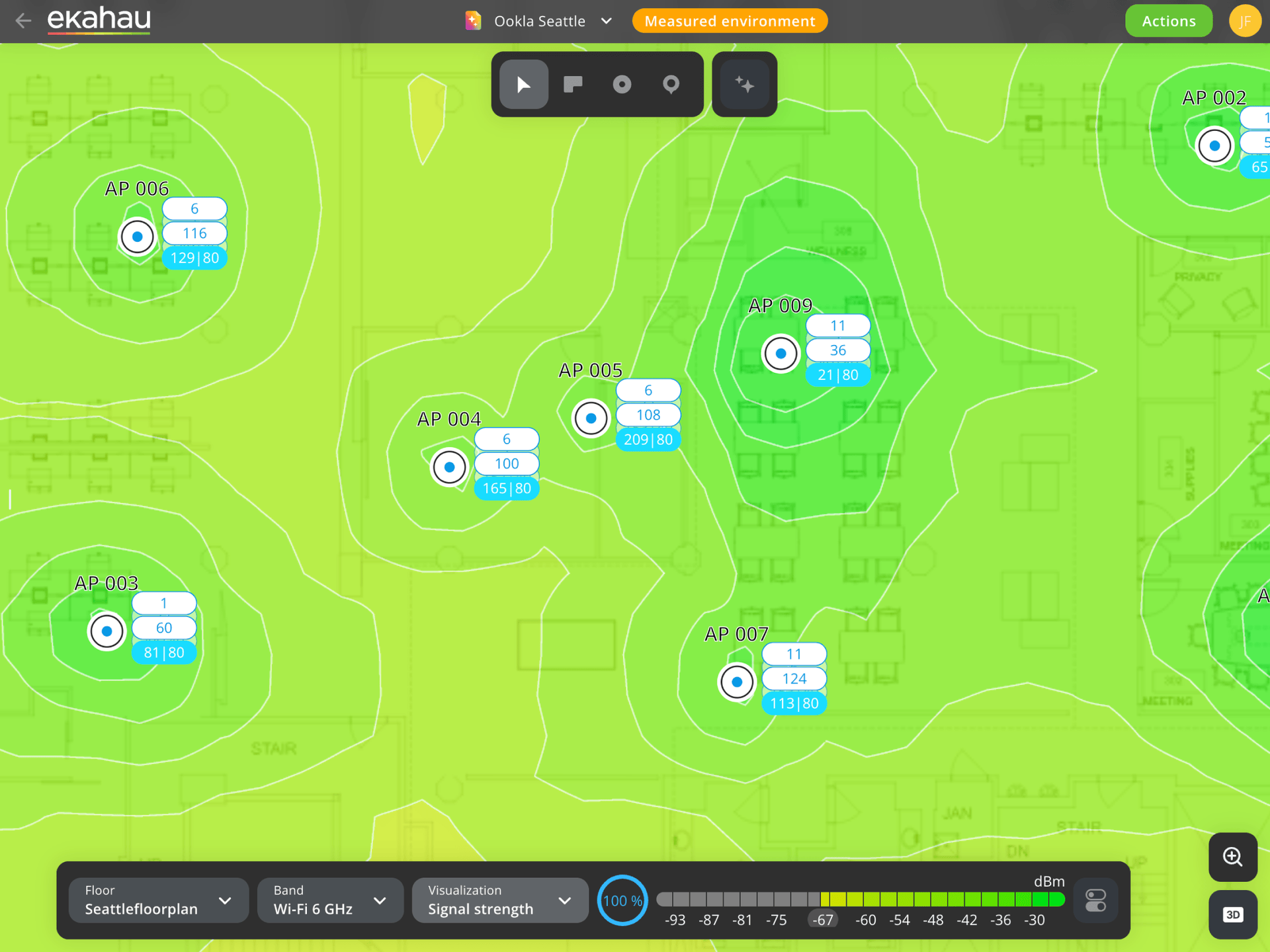
A Santa Clarita site survey from WiFi Hotshots starts with Ekahau AI Pro predictive modeling and closes with post-install validation heatmaps — every engagement a fixed-fee SOW, not hourly billing. We cover the full Santa Clarita Valley: Henry Mayo Newhall Hospital and clinic network, the Valencia Industrial Center corridor tilt-up warehouse corridor, Six Flags Magic Mountain park operations and back-of-house, Princess Cruises corporate headquarters in Santa Clarita, College of the Canyons and CalArts Valencia, and the Hart/Saugus/Castaic/Newhall/Sulphur Springs K-12 districts across Stevenson Ranch, Valencia, Newhall, and Canyon Country.
See the enterprise wireless services overview, the full enterprise network services portfolio, our engineering credentials and certifications, or send us your floor plans to start a scope call. Our Valencia headquarters means zero travel markup inside SCV.
Why a Santa Clarita Site Survey Is Required Before You Commit to an AP Count
Santa Clarita Valley building stock is not generic, which is why a measured Santa Clarita site survey outperforms any catalog-grade design. The Valencia Industrial Center corridor is dense with tilt-up concrete warehouse shells — 7-inch and 9-inch wall panels poured on-site and stood vertical, with embedded rebar grids that behave nothing like interior drywall. Predictive RF models tuned to standard office partition values routinely underestimate attenuation by 6–12 dB per panel at 5 GHz and above, which is the difference between full coverage in simulation and a ‑82 dBm signal at the back of the rack aisle.
Henry Mayo Newhall Hospital and the surrounding clinical footprint mix 1970s masonry wings with modern steel-framed expansions and lead-lined imaging suites where above-ceiling access is gated by infection control. Six Flags Magic Mountain operates roller-coaster spans, steel-frame service buildings, and outdoor guest-services zones on the same 209-acre gated park — three completely different RF environments sharing a controller architecture.
Deploying APs without a measured RF baseline means your channel plan is built on assumptions, not data. When a Zebra TC26 scanner drops association at the edge of a Valencia distribution aisle or a Spectralink Versity handset holds to a ‑82 dBm AP three treatment rooms away, the root cause is always the same: the pre-deployment work was skipped or compressed.
An enterprise Santa Clarita site survey is not optional for complex environments — it is the engineering step that separates a network that works from one that generates tickets. The design target for a general enterprise data environment is a minimum ‑67 dBm RSSI at cell edge with at least 25 dB SNR. For voice-grade networks — Vocera Smartbadge at Henry Mayo, Spectralink Versity on a clinic floor, Ascom i63 in long-term care — those targets tighten to ‑65 dBm RSSI and you add a 20–25% cell overlap requirement at the ‑67 dBm boundary to support fast BSS transition under 802.11r.
None of those thresholds can be confirmed by looking at a floor plan. They require measurement against the actual tilt-up concrete, the actual lead-lined barrier, and the actual steel racking in place on the day the survey happens.
Ekahau AI Pro Predictive Survey Methodology: Floor Plan to AP Placement Map
Every WFHS Santa Clarita site survey begins in Ekahau AI Pro, the design and analysis module within the Ekahau Connect platform. The workflow starts with floor plan import at measured scale — either CAD-exported PDF from the SCV property owner or a photographed as-built drawing rescaled against a known reference distance. Wall types are assigned material attenuation values aligned to IEEE 802.11-2020 propagation modeling: glass, drywall, CMU, poured concrete, and concrete with rebar each carry different dB-per-meter loss figures.
For Valencia Industrial Center tilt-up warehouses, the model requires a tilt-up-concrete-plus-rebar attenuation assignment, not the generic concrete value the default library ships with, because the rebar grid adds measurable additional loss at 5 GHz and substantially more at 6 GHz. Once the floor plan is calibrated, Ekahau AI Pro runs AP placement simulations against the design requirement profile — coverage at ‑67 dBm RSSI, 25 dB SNR, channel plan, and secondary-AP overlap at ‑75 dBm for 802.11k neighbor list population. The output is an AP count per floor with X/Y placement coordinates and a draft bill of materials against vendor-neutral part numbers.
For SCV deployments, predictive design typically covers 1,200–2,000 sq ft per AP on 5 GHz and 6 GHz radios in open-plan office environments such as the Princess Cruises Valencia corporate HQ or a Stevenson Ranch master-planned retail pad. High-density spaces — College of the Canyons 200-seat lecture halls, Henry Mayo patient floors, Six Flags ride-queue scanning zones, Hart district classroom clusters under 1:1 Chromebook load — require tighter placement intervals driven by client count and voice MOS targets rather than coverage radius alone.
Predictive survey is accurate for standard construction. On atypical SCV materials — tilt-up concrete with embedded #5 rebar at 12-inch spacing, lead-lined imaging suites at Henry Mayo, CalArts soundstage walls with acoustic treatment layers — the predictive model flags uncertainty zones that require an AP-on-a-Stick validation pass before hardware procurement. A production-grade Santa Clarita site survey reconciles the predictive output against measured data before any bill of materials is locked.
- AP count per floor with X/Y placement coordinates exportable to AutoCAD or PDF overlay at 1:100 or 1:200 plan scale
- Channel plan: 2.4 GHz channels 1/6/11 for coverage (radios disabled on a majority of APs in dense SCV deployments to control CCI); 5 GHz 20/40/80 MHz assignments per zone; 6 GHz LPI channel selection for Wi-Fi 6E and Wi-Fi 7 APs (indoor LPI class, no AFC required per FCC Part 15 Subpart E)
- Per-band heatmap exports showing RSSI, SNR, secondary coverage (802.11k), and co-channel interference overlay against the ‑85 dBm CCI threshold
- Vendor-neutral hardware call-outs: Cisco Meraki MR57, Catalyst 9166I, Aruba AP-655, Juniper Mist AP45 — the RF design targets do not change with the vendor, only the part numbers
AP-on-a-Stick Validation for SCV Buildings: Hospitals, Soundstages, and Warehouses
AP-on-a-Stick (APoS) methodology mounts a production-model AP on a telescopic pole at the intended deployment height — typically 12–18 ft for ceiling-tile environments inside Princess Cruises Valencia corporate, 25–40 ft for a Valencia Industrial Center high-bay warehouse, and up to 45 ft for a Six Flags back-of-house service bay. The Ekahau Sidekick 2 attaches to the survey laptop via USB-C and runs four tri-band radios scanning 2.4, 5, and 6 GHz simultaneously at 50 sweeps per second across the full 2,400–7,125 MHz range, with a measurement floor of ‑20 to ‑92 dBm.
The surveyor walks the floor while the Sidekick 2’s nine custom 3D antennas record passive RF measurements at every point — RSSI, SNR, noise floor, and co-channel interference — across every visible AP. That measurement data overwrites the predictive model where they differ, producing a hybrid design that combines Ekahau AI Pro simulation efficiency with field accuracy.
SCV venues that mandate APoS rather than predictive-only include any facility where drawings do not reflect reality. High-bay distribution warehouses in the Valencia Industrial Center corridor routinely run 40-ft and 45-ft clear heights with tall steel-rack storage systems that create shadow zones invisible to a flat-floor predictive model. Henry Mayo Newhall Hospital and surrounding clinic environments carry infection-control constraints on above-ceiling access that require cable routing to be confirmed before the first AP is mounted, plus lead-lined imaging suites that create hard RF-opaque boundaries.
CalArts Valencia soundstage and performance spaces include acoustically treated walls, black-box theater enclosures, and long unobstructed spans where polarization and reflection modeling need a measured baseline. Hart UHSD and Saugus USD classrooms, many built with CMU-block exterior walls and central-corridor layouts across Castaic, Canyon Country, Newhall, and Valencia campuses, need room-by-room passive validation to confirm that a hallway-only AP plan holds signal at the back of a 32-seat classroom under 1:1 Chromebook load. These institutions are referenced as venue archetypes, not as claimed engagements.
- High-ceiling industrial: aisle-by-aisle attenuation capture through steel racking at Valencia Industrial Center corridor tilt-up shells; directional antenna modeling for above-rack coverage zones in 40+ ft clear-height distribution buildings
- Healthcare: infection-control ceiling-plenum constraints confirmed before cable pathways are routed; lead-lined imaging suite boundaries at Henry Mayo-class campuses flagged as RF-opaque zones requiring AP relocation; ‑65 dBm voice-grade coverage mapped for Vocera Smartbadge and Spectralink Versity clinical handsets
- Education: 1:1 device density planning per classroom across Hart UHSD, Saugus USD, Castaic USD, Newhall SD, and Sulphur Springs USD; roaming validation across wing transitions and portable-classroom clusters where hallway-only APs fail at the back of a 32-seat room; per-campus heat-map exports formatted for E-rate documentation
- Higher education: College of the Canyons lecture hall density for approximately 21,300 students across Valencia and Canyon Country campuses, CalArts Valencia soundstage and performance-space acoustic-wall modeling, outdoor-AP coverage across COC Valencia and Canyon Country campus quads
Scope Your Santa Clarita Site Survey
Floor plans and device counts are all we need to scope the work — most SCV engagements are quoted on a fixed-fee SOW within three business days of a 30–60 minute scoping call. Send them to Contact Us with a one-paragraph scope description.
Passive and Active Validation: Throughput, Roaming, and Voice MOS Testing
A passive survey records every RF signal in the environment without associating to any SSID. The Ekahau Sidekick 2 listens — it measures what the air contains, not what a connected session reports. Passive surveys are used for pre-deployment environment assessment (neighbor AP inventory, noise floor, DFS radar event detection against UNII-2A/UNII-2C channels) and for post-install coverage confirmation. The output is a heatmap for every band, every floor, at every survey waypoint — color-coded RSSI, SNR, and secondary coverage for 802.11k neighbor list validation.
Active validation associates to the production SSID and measures what the client actually experiences. iPerf3 bidirectional throughput runs confirm uplink and downlink capacity against the designed channel width. Roaming tests exercise 802.11r fast BSS transition and 802.11k/v neighbor reporting — the protocol stack is designed to shorten roaming interruptions, and 50 ms or less is the accepted voice-grade handoff target that 802.11r was built to support. Active testing with a roaming test client confirms whether the deployed controller configuration actually achieves it or whether a misconfigured minimum RSSI threshold is stalling the handoff.
For voice-over-Wi-Fi migration engagements — Cisco Webex Calling, CUCM, Zoom Phone, or Teams Phone rollouts across a Henry Mayo-class clinical footprint — the active test also captures a MOS (Mean Opinion Score) trace across the full walking route. A voice-grade network targeting MOS 4.0+ requires the ‑65 dBm RSSI and 25 dB SNR thresholds to hold at cell edge without exception.
Any area that drops below those targets appears as a gap in the post-install validation report, with a remediation recommendation tied to a specific AP or configuration change. Active testing closes the loop on every Santa Clarita site survey deliverable — the independent post-install validation report is the artifact your operations team, auditor, or next engineer can pick up without context.
Santa Clarita Market Constraints: Thermal Derating, Wildland-Urban Interface, and Tilt-Up Concrete
Tilt-Up Concrete Warehouses: RF Attenuation in the Valencia Industrial Center
The Valencia Industrial Center corridor drives the SCV industrial economy with a building stock dominated by tilt-up concrete warehouse shells, and a Santa Clarita site survey inside that corridor must account for materials most default libraries get wrong. These are not the masonry-plus-drywall mix of older DTLA stock — tilt-up construction uses 7-inch and 9-inch concrete panels poured on-site at the slab and stood vertical with an embedded rebar grid, typically #5 bar at 12-inch spacing vertical and horizontal. Generic predictive models treat interior and exterior walls as either drywall, light partition, or generic concrete.
A tilt-up panel with a rebar grid attenuates a 5 GHz signal substantially more per panel than the 3–4 dB a single drywall partition produces, and the attenuation scales up further at 6 GHz. A 200,000 sq ft warehouse with multiple interior tilt-up demising walls may show full coverage in a default predictive simulation and deliver ‑82 dBm at the back of the rack aisle. Accurate predictive modeling for these buildings requires material-specific attenuation input, and that input comes from an initial passive scan, not from a vendor’s default material library.
SCV Thermal Derating: Direct Sun on Rooftop and Exterior-Mount APs
Santa Clarita summers push outdoor ambient air temperatures into the 105–115 °F range, and direct-sun ambient on a black polycarbonate AP housing regularly lands above 130 °F. Most enclosed enterprise APs carry an operating temperature ceiling around 55 °C (131 °F) for indoor models. Outdoor APs with IP67 ratings and extended thermal envelopes — Cisco Catalyst IW9167E, Aruba AP-577, Juniper Mist AP63 — are required for rooftop and exterior-wall mount locations at Six Flags Magic Mountain parking areas, Valencia Industrial Center truck courts, and Stevenson Ranch retail-pad perimeter coverage.
On a WFHS Santa Clarita site survey engagement, the deliverable flags thermal-sensitive mount locations and specifies IP67-rated outdoor models for any AP mounted outside conditioned space or in direct-sun attic conditions. The survey output also identifies any AP mount location where the ambient-plus-solar-gain condition would push an indoor-class AP above its spec sheet and moves it to an outdoor-class model before procurement.
Santa Clarita Site Survey at the Wildland-Urban Interface: Castaic and Canyon Country Outdoor Coverage
Castaic and Canyon Country sit along the wildland-urban interface (WUI) with periodic Red Flag Warning days and post-fire terrain exposure. Outdoor wireless coverage for SCV school district buildings, master-planned community amenity centers in Newhall Ranch, and industrial perimeter security cameras must account for seasonal dust loading on exterior antennas, summer-afternoon thermal ducting that distorts long-haul bridge paths, and smoke-event attenuation in the visible and near-IR bands that also depresses 60 GHz unlicensed links.
Where a WFHS Santa Clarita site survey identifies outdoor P2P or MP microwave backhaul as a candidate link across the SCV terrain — a Castaic warehouse to a Valencia corporate node, for example — we specify the link with seasonal fade margin beyond the clear-air LOS minimum, not the theoretical value. Where the survey identifies below-ceiling pathway gaps or insufficient PoE+ (IEEE 802.3bt Type 3) capacity at the switch port, cabling infrastructure review is scoped as a parallel workstream in the same fixed-fee SOW.
Public-Safety DAS Overlay and Enterprise Wi-Fi Coexistence
Los Angeles County fire code (referencing NFPA 72 and NFPA 1221) applies inside Santa Clarita city limits and across the surrounding unincorporated LA County footprint. The code requires Emergency Responder Radio Coverage Systems (ERRCS) in any building that exceeds three stories above grade, has 50,000 sq ft or more of total floor area, has a basement area of 10,000 sq ft or more, or has any basement two or more stories below grade. ERRCS mandates 99% signal coverage in critical areas (command centers, elevator lobbies, exit stairs) and 90% in remaining areas throughout the building.
Henry Mayo Newhall Hospital, Six Flags service buildings, and the larger tilt-up warehouse footprints inside Valencia Industrial Center all cross the 50,000 sq ft threshold and carry ERRCS obligations. The ERRCS BDA (bi-directional amplifier) donor antennas and remote units share plenum space with enterprise Wi-Fi APs.
On a WFHS Santa Clarita site survey, we identify existing ERRCS infrastructure in the ceiling plenum and route AP cable pathways to avoid conflict with BDA cabling. WFHS is not an ERRCS integrator — if the survey reveals an ERRCS coverage gap or a BDA installation that does not satisfy the NFPA 1221 signal level requirements, the correct next step is a licensed ERRCS contractor, not a Wi-Fi vendor. We flag the gap, document the location, and coordinate referral.
Scope a Santa Clarita Site Survey: Pricing, Timeline, and Disclosure
Every Santa Clarita site survey engagement is priced as a fixed-fee SOW before mobilization. No hourly billing, no open-ended estimate, no mileage charge inside the SCV metro. We headquarter in Valencia, which means dispatch to Henry Mayo Newhall Hospital, College of the Canyons, any Valencia Industrial Center address, Stevenson Ranch retail, Six Flags Magic Mountain, or a Hart UHSD or Saugus USD campus involves zero travel markup. Scope variables that drive cost: total building square footage, number of floors, number of buildings, construction type (standard office drywall vs. tilt-up concrete vs.
CMU block vs. soundstage atypical materials), required survey type (predictive-only, AP-on-a-Stick, or combined predictive-plus-validation), and whether post-install validation and a formal independent validation report are in scope. Typical turnaround on a written SOW quote is three business days of the scoping call from floor plan receipt. Standard single-floor predictive-plus-validation engagements complete in one to two weeks on site; Henry Mayo-scale multi-building clinical engagements run two to four weeks with a formal validation report.
Scope boundary disclosure: WiFi Hotshots does not claim, and does not provide, classified / SCIF / SAP / cleared-facility work. The Santa Clarita Valley Sheriff’s Station at 23740 Magic Mountain Parkway sits inside our unclassified, public-facing scope — facility admin floors, non-secure training rooms, public-lobby guest coverage. Any classified or SCIF-rated space inside SCV or any cleared-facility contract falls outside our engagement envelope and is handled by a cleared-facility integrator.
We are an engineer-led commercial wireless services firm; our credential stack (Ekahau ECSE, multi-CCIE bench, CWNP reference methodology) is aligned to enterprise commercial and institutional work, not Title 32 or Title 50 cleared spaces. If your project has a classified overlay, flag it during the scope call so the unclassified envelope is the only thing inside our Santa Clarita site survey SOW.
Santa Clarita Site Survey Deliverables: Heat Maps, BOM, Install Runbook, and Validation Report
At the close of every Santa Clarita site survey engagement, the client receives a complete document set — not a summary slide deck. The Ekahau project file (.esx) is included in every handoff so a future engineer can reopen the exact survey, adjust wall materials, or re-run the coverage model without starting from scratch. The platform mix — Cisco Catalyst 9800, Cisco Meraki MR (including MR57 Wi-Fi 6E and MR56 Wi-Fi 6 models), Catalyst 9166I indoor Wi-Fi 6E, Aruba Central (CX 8100 and AP-655), Juniper Mist AI with the AP45 and AP63 families, Ruckus, Extreme — does not change the deliverable set.
Every engagement ships with the same documentation regardless of vendor, because the documentation belongs to the client, not the vendor. Cabling call-outs follow ANSI/TIA-568.2-E for balanced twisted-pair and the current ANSI/TIA-569 pathway standard for plenum runs. Guest and BYOD onboarding — NAC and zero trust policy or cloud-native captive portal with certificate-based authentication — is scoped as a separate design workstream when the survey reveals that the existing SSID architecture does not segment guest traffic. AP refresh and controller migration planning for Cisco Catalyst 9800, Meraki, Aruba Central, Juniper Mist, Ruckus, and Extreme is scoped separately where the survey identifies a controller version or capacity constraint.
- Ekahau project file (.esx) plus annotated heatmap exports per band (2.4, 5, 6 GHz) per floor: RSSI, SNR, secondary coverage (802.11k), and co-channel interference overlay against the ‑85 dBm CCI threshold
- Vendor-agnostic AP bill of materials with AP model, mount type, antenna selection, PoE class requirement (IEEE 802.3af, 802.3at, or 802.3bt), and cabling length per drop referenced to ANSI/TIA-568.2-E
- Installation runbook: AP placement drawing in AutoCAD or PDF overlay, cable pathway map against ANSI/TIA-569, switch port assignment, and VLAN/SSID configuration notes for the contractor
- Post-install validation report: passive heatmap confirmation, iPerf3 throughput results, 802.11r roaming handoff timing (50 ms target), and MOS trace data for voice-grade engagements
- Design warranty: WFHS stands behind the AP count and placement — if coverage gaps appear at post-install validation that were not present in the design, we remediate the design at no additional cost
Santa Clarita Site Survey Coverage and Service Map
Every Santa Clarita site survey dispatches from our Valencia office at 23890 Copper Hill Drive and covers the full Santa Clarita Valley footprint without a mileage charge: the city of Santa Clarita proper (Valencia, Saugus, Newhall, Canyon Country), Stevenson Ranch, Castaic, Val Verde, Agua Dulce, and the unincorporated SCV communities.
Named institutional coverage includes Henry Mayo Newhall Hospital at 23845 McBean Parkway, College of the Canyons at 26455 Rockwell Canyon Road and the Canyon Country campus at 17200 Sierra Highway, CalArts Valencia at 24700 McBean Parkway, Princess Cruises corporate headquarters in Santa Clarita, Six Flags Magic Mountain at 26101 Magic Mountain Parkway, and the Valencia Industrial Center corridor tilt-up warehouse corridor west of I-5.
School district coverage spans Hart Union High School District, Saugus Union School District, Castaic Union School District, Newhall School District, and Sulphur Springs Union School District. Newhall Ranch master-planned community build-out — currently the largest active California master-planned project by approved-unit count — is in our active coverage footprint as new retail, amenity, and campus pads come online.
Multi-site engagements spanning SCV and adjacent regions are coordinated from a single SOW and a single point of contact. For enterprise clients with facilities across multiple Southern California regions, we dispatch into adjacent service areas without a separate mobilization charge. The sibling pages below document the regional survey details — DTLA seismic stock, San Fernando Valley media corridor, Antelope Valley aerospace footprint, Palm Desert hospitality and gaming — for each sub-market, paired with the Santa Clarita site survey methodology when a client operation crosses jurisdiction lines.
Representative Santa Clarita Site Survey Engagement Profiles
Single-hospital VoWLAN refresh at a Henry Mayo-class campus
A Henry Mayo Newhall Hospital-class single-hospital clinical footprint — the 357-bed kind of acute-care facility anchoring SCV clinical coverage adjacent to Joint Commission accreditation cycles — operates with Vocera Smartbadge and Spectralink Versity handsets, EHR bedside workflows via Epic Rover or Cerner CareAware, RTLS-tagged biomedical device tracking, and an IT governance committee that gates all RF change windows.
Typical Santa Clarita site survey scope covers a phased clinical wireless refresh with ‑65 dBm voice-grade cell edges at patient-room depth, 20–25% cell overlap at the ‑67 dBm contour for fast BSS transition, 802.11r roaming validation across nursing-station transitions, RTLS coexistence modeling with at least 3 APs visible at ‑75 dBm for trilateration-grade accuracy, and ERRCS ceiling-plenum conflict identification across the main tower and surrounding clinic buildings that cross the 50,000 sq ft threshold. HIPAA-aligned network segmentation is a design input, not a compliance claim. The deliverable set is formatted for review by the health system’s IT governance committee and archived against a 10-year infrastructure shelf life.
Outdoor high-density event venue — Six Flags Magic Mountain-class theme park
A Six Flags Magic Mountain-class theme park Santa Clarita site survey covers a 209-acre gated park with roller-coaster spans, outdoor queue zones, guest-services structures, F&B concessions, and ticketing scanning stations — an environment that operates with tens of thousands of guest devices plus point-of-sale scanners, pass-reader terminals, and staff handsets concentrated into ride-queue and midway corridors during peak hours.
Predictive outdoor modeling is combined with AP-on-a-Stick validation at ground level to confirm that ride-structure reflections, steel-frame service-building shadows, and terrain elevation changes from the hilltop entry plaza down into Magic Mountain Parkway are captured before outdoor AP mounting locations are finalized. Wi-Fi 6E APs operating as LPI indoor-class devices on 6 GHz are specified for covered queue structures and pavilions; IP67-rated outdoor APs (Cisco Catalyst IW9167E, Aruba AP-577, Juniper Mist AP63) with full thermal envelope are scoped for open-ground zones and rooftop ride structures.
Corporate HQ and media-adjacent campus — Princess Cruises Valencia profile
Valencia corporate HQ campuses — the Princess Cruises corporate-HQ-class footprint in Santa Clarita, Disney Studios Ranch in Valencia, and the CalArts Valencia academic campus — mix open-plan office floors, executive conference rooms, video-conferencing and production studios, and soundstage-style performance spaces on the same campus. A Santa Clarita site survey engagement of this type must account for three distinct RF environments: office 1,200–2,000 sq ft per AP for general data, conference-room high-density placement driven by 30+ seat video-call density, and soundstage or production-studio acoustic-treated walls where reflection modeling requires measured baseline.
Fast BSS transition under 802.11r plus 802.11k/v neighbor reporting is specified for any mobile-device roaming path across the campus. Output includes a per-building AP count, a channel plan that de-conflicts across contiguous buildings, and a structured-cabling review against ANSI/TIA-568.2-E where the existing infrastructure is older than Category 6A at PoE++ loading.
Multi-site K-12 district refresh — William S. Hart UHSD and feeder districts
SCV K-12 districts — William S. Hart UHSD (6 comprehensive high schools (Hart, Canyon, Valencia, Saugus, Golden Valley, Castaic) within a 16-school district grades 7–12 serving approximately 22,000 students), Saugus USD (K-6), Castaic USD, Newhall SD, and Sulphur Springs USD — require a Santa Clarita site survey that accounts for 1 AP per classroom density, voice-quality targets for district-standardized Wi-Fi calling, and E-rate Category 2 aligned deliverable packages.
Survey methodology must address CMU-block exterior wall attenuation, 1:1 Chromebook client density at 32 students per classroom, and roaming validation across wing-to-wing transitions where hallway-AP-only designs consistently fail under active classroom load. Typical scope covers multi-site phased deployment with per-campus heat-map validation before go-live, scheduled across summer recess to allow room-by-room passive walkthroughs without bell-schedule disruption. The K-12 campus wireless design methodology covers the full survey and E-rate documentation workflow against USAC submission requirements.
Higher-education lecture hall and soundstage — College of the Canyons and CalArts Valencia
A College of the Canyons Santa Clarita site survey — approximately 21,300 students across Valencia and Canyon Country campuses with CalArts Valencia a short drive away on McBean Parkway — covers two ends of the higher-education RF spectrum. COC combines large lecture halls (150–250 seats) with labs, a library, and outdoor-quad coverage where predictive 5 GHz and 6 GHz modeling must be reconciled against real student-device density during class-change transitions.
CalArts Valencia operates soundstages, black-box theaters, recording and broadcast studios, and performance halls with acoustic-treated walls, suspended lighting grids, and long unobstructed spans where reflection modeling benefits from measured AP-on-a-Stick data rather than predictive alone. Both deliverables package per-campus heatmaps, iPerf3 throughput validation, and MOS traces where Wi-Fi calling is in scope.
SCV industrial logistics warehouse — Valencia Industrial Center tilt-up shells
A Valencia Industrial Center Santa Clarita site survey across tilt-up concrete warehouses — 200,000 sq ft to 600,000 sq ft clear-span distribution buildings — handles 40-ft to 45-ft clear heights with tall steel-rack storage systems, Zebra TC26 and MC33 scanner fleets, VoWLAN forklift-mounted handsets, and increasing robotics density.
Typical scope covers high-bay predictive design with directional antenna modeling for above-rack aisle coverage, AP-on-a-Stick validation at actual rack height through loaded steel racking (not unloaded), ‑67 dBm cell-edge targets at pick-face depth, and roaming validation for forklift-mounted VoWLAN handsets across cross-aisle transitions. Outdoor truck-court and yard coverage is specified with IP67-rated outdoor APs and thermal-derated mount recommendations against SCV summer ambient conditions. Structured cabling recommendations reference ANSI/TIA-568.2-E against PoE++ budgets at the switch.
Scope a Santa Clarita Site Survey Engagement
Send floor plans to sales@wifihotshots.com or call (844) 946-8746 — we return a fixed-fee SOW, not a multi-week proposal cycle. Or go straight to Contact Us.
Santa Clarita Wireless Site Survey FAQs
How long does a Santa Clarita enterprise wireless site survey take?
Timeline depends on scope. A single-floor commercial space with complete as-built drawings — a Stevenson Ranch retail pad or a Valencia office floor — can be predictively modeled in Ekahau AI Pro and quoted within three business days of the scoping call. An AP-on-a-Stick field validation for that same floor takes one to two days on-site.
Multi-building campus engagements like a Henry Mayo-scale clinical footprint or a College of the Canyons multi-campus refresh typically run two to four weeks from floor plan receipt to final deliverable, including voice-grade validation and the independent validation report.
A Valencia Industrial Center tilt-up warehouse with 400,000+ sq ft and full racking typically runs three to ten business days on site depending on clear-height.
Every engagement is scoped and quoted as a fixed-fee SOW before work begins — the timeline, scope, and deliverables are defined in writing.
We do not bill hourly against an open-ended estimate.
What is the difference between a predictive survey and AP-on-a-Stick validation?
A predictive survey uses Ekahau AI Pro to model RF propagation through a calibrated floor plan. No physical measurement occurs — the software simulates signal paths through assigned wall materials and produces coverage heatmaps and an AP placement plan. It is fast and accurate for standard construction materials.
An AP-on-a-Stick survey mounts a production-model AP on a telescopic pole at the intended deployment height, and the Ekahau Sidekick 2 captures real measurements — actual RSSI, SNR, and noise floor from ‑20 to ‑92 dBm — as the surveyor walks the floor.
For SCV buildings with atypical attenuation (Valencia Industrial Center tilt-up concrete panels with embedded rebar, Henry Mayo lead-lined imaging suites, CalArts soundstage walls with acoustic treatment layers, 40-ft warehouse steel racking, CMU-block K-12 classrooms) or where as-built drawings are unreliable, the AP-on-a-Stick pass is required before procurement.
Most WFHS engagements include both: Ekahau AI Pro predictive for initial design and AP count, AP-on-a-Stick for validation before the bill of materials is finalized.
Do you cover all of the Santa Clarita Valley, or just the city of Santa Clarita?
All of the Santa Clarita Valley — no mileage charge inside the SCV footprint. That covers the city of Santa Clarita (Valencia, Saugus, Newhall, Canyon Country), Stevenson Ranch, Castaic, Val Verde, Agua Dulce, and the unincorporated LA County SCV communities.
Named institutional coverage includes Henry Mayo Newhall Hospital, College of the Canyons (Valencia + Canyon Country), CalArts Valencia, Princess Cruises corporate headquarters in Santa Clarita, Six Flags Magic Mountain, and the Valencia Industrial Center corridor tilt-up warehouse corridor.
We also dispatch into adjacent service areas — the San Fernando Valley over Newhall Pass, the Antelope Valley over Vasquez Canyon, west to Ventura County, and south into LA County — under the same fixed-fee SOW structure.
Our Valencia HQ at 23890 Copper Hill Drive means zero travel markup inside SCV and same-day mobilization where needed.
What does a wireless site survey cost in Santa Clarita?
Every engagement is priced as a fixed-fee SOW — we do not bill hourly. Scope variables that drive cost: total building square footage, number of floors, number of buildings, construction type (standard office drywall vs. Valencia Industrial Center tilt-up concrete vs. CMU-block school vs. CalArts soundstage atypical materials), required survey type (predictive-only in Ekahau AI Pro, AP-on-a-Stick, or combined predictive-plus-validation), and whether post-install validation and a formal validation report are in scope.
We return a written SOW quote within three business days of the scoping call of receiving floor plans and a scope description.
Send floor plans to sales@wifihotshots.com or call (844) 946-8746.
No engagement begins without the client signing off on the fixed-fee price first, and no hidden change orders appear against the signed SOW number without a separate signed change order.
What deliverables do we receive after a WFHS Santa Clarita site survey?
Every engagement produces: the Ekahau AI Pro project file (.esx) for future re-use; annotated heatmap exports per frequency band (2.4, 5, 6 GHz) per floor showing RSSI, SNR, secondary coverage (802.11k), and co-channel interference against a ‑85 dBm CCI threshold;
a vendor-agnostic AP bill of materials with mount type, antenna, PoE class (802.3af/at/bt), and cabling callouts referenced to ANSI/TIA-568.2-E; an installation runbook for the contractor with AP placement drawing and ANSI/TIA-569 cable pathway map; and a post-install validation report with passive heatmap confirmation, iPerf3 throughput results, 802.11r handoff timing, and MOS trace data for voice-grade engagements.
The deliverable set is the same regardless of the AP vendor — Cisco Catalyst 9166I, Meraki MR57, Aruba AP-655, Juniper Mist AP45, Ruckus, or Extreme.
The documentation belongs to the client and is formatted for a 10-year shelf life.
Can WFHS survey in a live Henry Mayo or Valencia Industrial Center environment without downtime?
Yes. Passive survey requires no network access and causes zero disruption to production traffic — the Ekahau Sidekick 2 listens passively and never associates to any SSID, so clinical telemetry at Henry Mayo-class campuses and VoWLAN forklift handsets in Valencia Industrial Center warehouses continue operating without interference.
Active throughput testing and roaming validation require a brief association to a production or test SSID, which does not affect other clients on the network.
Full iPerf3 load testing, which generates several hundred Mbps of synthetic traffic to stress the uplink, is scheduled during off-hours or in a maintenance window if the client requests it.
We have conducted passive surveys in live healthcare clinical environments, active corporate headquarters operations, and operating distribution centers without interrupting production.
The pre-survey coordination document we send before mobilization identifies which test phases, if any, require an off-hours or maintenance window.
Do you survey Hart UHSD, Saugus USD, and COC campuses differently than corporate offices?
The survey instruments are the same; the design targets differ. SCV K-12 — Hart UHSD (6 comprehensive high schools (Hart, Canyon, Valencia, Saugus, Golden Valley, Castaic) within a 16-school district grades 7–12), Saugus USD, Castaic USD, Newhall SD, Sulphur Springs USD — is designed for 1:1 Chromebook client density at 32 students per classroom plus teacher device, not the lower density of a corporate open-plan floor.
That changes the AP placement interval, the channel width selection (20 MHz standard in high-density zones to control CCI), and the roaming design across wing and portable-classroom transitions.
Hart and Saugus survey engagements are typically scheduled during summer recess to allow room-by-room passive walkthroughs without bell-schedule disruption.
E-rate Category 2 procurement requirements mean the deliverable set must include documentation compatible with the district’s USAC submission.
For College of the Canyons and CalArts Valencia, ADA-accessible AP mounting locations and outdoor coverage for the Canyon Country hillside campus add a field-validation requirement that a flat-floor predictive model cannot resolve.
Lecture halls at 150–250 seat density drive tighter AP placement than a typical corporate conference room.
What happens if the Santa Clarita survey identifies issues beyond the original scope?
The fixed-fee SOW covers the defined scope. If the survey uncovers something outside that scope — an ERRCS gap at a Henry Mayo clinical building that crosses the 50,000 sq ft threshold requiring a licensed BDA integrator, a structured cabling deficiency in a Valencia Industrial Center tilt-up warehouse that needs remediation before APs can be installed, a DAS antenna placement conflict at a Six Flags service building, or a classified overlay that falls outside our unclassified commercial envelope — we document the finding in the validation report with a clear description of the issue and its location.
We then issue a separate change-order estimate for any additional WFHS scope and, where the finding is outside wireless engineering (like ERRCS installation or cleared-facility work), we refer to the appropriate licensed contractor.
The client is never billed above the SOW total without a signed change order first.
WiFi Hotshots does not claim, and does not provide, classified / SCIF / SAP / cleared-facility work — classified overlays inside SCV go to a cleared integrator, not WFHS.
That is the operational definition of a fixed-fee engagement.
What RSSI and SNR targets should a Santa Clarita enterprise survey design to, and how does that change for VoWLAN in a Henry Mayo-class hospital?
A Santa Clarita enterprise site survey designs data coverage to -67 dBm at cell edge. Voice clients — Spectralink, Vocera, and Ascom handsets typical of a Henry Mayo-class campus — require the same -67 dBm RSSI floor plus a consistent SNR of 25 dB or better, with a minimum of three APs visible above -67 dBm to enable location services and survivable roaming under sustained load.
The tightened voice floor is -65 dBm, and RTLS asset-tracking scopes push to -63 dBm.
These thresholds are baked into the predictive model before any AP-on-a-Stick validation begins, and they govern the per-room validation table in the deliverable.
See the Santa Clarita wireless design practice for the full methodology.
How does tilt-up concrete construction in the Valencia Industrial Center change AP count versus a drywall office?
Tilt-up concrete exterior and core panels typical of Valencia Industrial Center warehouses attenuate 2.4 GHz signal by roughly 12-15 dB per panel and 5/6 GHz signal by 18-25 dB per panel. An Ekahau AI Pro predictive model must import SCV-specific wall types — reinforced concrete tilt-up, metal racking, HVAC ducting — rather than default office drywall, or the simulated AP count will under-deploy by 20-40%.
The correct sequence is a material-specific predictive survey followed by AP-on-a-Stick validation at deployment height (28-36 ft for racked warehouses).
Panel thickness, rebar density, and moisture content all shift attenuation, which is why the designer curates the material library per building rather than accepting tool defaults.
Why does a 28-36 ft warehouse AP mounting height in Valencia require different APs than a 10-ft office ceiling?
At 28-36 ft mounting heights common to Valencia Industrial Center tilt-up shells, omnidirectional internal APs cast coverage at a downward angle that leaves signal shadows in aisle floors. The correct design uses directional antennas to shape a narrower vertical beam, or APs with external antenna connectors purpose-built for high-mount deployment.
The Cisco Catalyst CW9166I ships with internal 4×4 MIMO radios optimized for standard enterprise ceilings.
For high-bay warehouses the engineering choice is the external-antenna CW9166D1 family or a Catalyst IW industrial AP, not the CW9166I.
That decision is made at predictive design, not at install. See wireless engineering services for the full vendor matrix.
What AP density should a predictive Ekahau design use for a COC lecture hall versus a Valencia tilt-up warehouse versus a Princess Cruises-class office floor?
Meraki’s Enterprise RF Design reference specifies 1,200-2,000 sq ft per AP for 5/6 GHz radio coverage in general office space. High-density classrooms and lecture halls at College of the Canyons typically land at 1 AP per 1,000 sq ft, or 1 AP per 25-30 concurrent clients, whichever is tighter. Office floor plans follow the 1,200-2,000 sq ft band.
Warehouses with tall racking cannot be modeled by square-footage alone.
AP count is driven by aisle geometry, racking reflectivity, and required coverage at floor level.
In all three cases, predictive design is confirmed with AP-on-a-Stick at actual deployment height before the BOM freezes.
What predictive wireless design tool does WFHS run on Santa Clarita surveys, and why does it matter for a Valencia warehouse or Hart UHSD campus?
WFHS runs Ekahau AI Pro on Santa Clarita engagements. Juniper Mist documentation names Ekahau AI Pro as one of the third-party tools used to measure RSSI at an AP placement location,
and explicitly supports importing Ekahau predictive project files (.esx) into Mist for AP provisioning — x,y coordinates, height, orientation, AP name. Cisco Meraki documentation likewise lists Ekahau Site Survey as a recommended tool whose predictive mode has Cisco AP coverage patterns built in.
For a Valencia Industrial Center tilt-up warehouse or a Hart UHSD multi-building refresh, the predictive model controls AP count, rack-aisle coverage simulation, and the importable output the installation team drops into the controller.
Tool output feeds directly into Mist or Catalyst Center without re-keying.
What does an on-site WFHS Santa Clarita survey actually involve — predictive design plus on-site measurement?
A WFHS Santa Clarita survey combines two phases. First, a predictive model built in Ekahau AI Pro using the building floor plan, wall materials, and target SSID and client mix. Second, on-site AP-on-a-Stick validation — a physical access point relocated through the survey area while signal strength, throughput, interference, and packet loss are measured, then re-imported into the predictive tool for reconciliation.
Juniper Mist documents this exact pattern in its AP Survey Mode guide, with AP configuration persistence enabled and uplink monitoring disabled so the AP operates without cloud connectivity during the walk.
Cisco Meraki confirms predictive surveys use floor plans, building-material estimates, and algorithms to forecast AP count, location, and configuration before hardware is deployed.
Both phases are required on Valencia Industrial Center tilt-up shells or Henry Mayo-class patient towers.
Does Wi-Fi 7 change the survey methodology for a Valencia HQ or Henry Mayo building compared to Wi-Fi 6 or 6E?
Wi-Fi 7 (IEEE 802.11be, ratified 2024) preserves the same RF survey methodology — passive, active, predictive, AP-on-a-Stick — but adds three design inputs the surveyor must account for. First, 320 MHz channel width (restricted to 1 standard-power channel in the US). Second, 4K-QAM requiring roughly 42 dB SNR for top MCS, versus 25 dB for 256-QAM. Third, Multi-Link Operation (MLO) which aggregates multiple bands per client session.
These shift the SNR bar higher: a -67 dBm cell edge that delivered 256-QAM under Wi-Fi 6 will no longer hit top Wi-Fi 7 PHY rates.
The SCV Santa Clarita site survey adjusts AP spacing for the tighter SNR floor and validates MLO link-up on real client hardware during the active phase.
Will DFS channels work in the SCV, and do I need them enabled at the Valencia Industrial Center?
DFS (Dynamic Frequency Selection, IEEE 802.11h) is mandatory in the US on UNII-2A (ch 52-64) and UNII-2C (ch 100-144) — a combined 16 additional 5 GHz channels that effectively double usable 5 GHz spectrum. In the SCV they operate normally, but client-fleet compatibility varies. Some industrial barcode scanners, older VoIP handsets, and consumer-grade IoT devices silently refuse to associate to DFS channels.
The Santa Clarita site survey includes a DFS compatibility test against the actual client fleet before channel plan commits.
Channel Availability Check (CAC) delays AP boot by 60 seconds on non-TDWR channels, longer on weather-radar-adjacent channels — a hard gate for rolling warehouse reboots during cutover.
What PoE budget should my switches deliver to support Wi-Fi 7 APs in a Santa Clarita refresh, and what happens at 802.3at only?
Current-generation Wi-Fi 7 APs require 802.3bt (Type 3 at 60 W class or Type 4 at 90 W class at PSE) for full functionality. On 802.3at (PoE+, 25.5 W at PD), the AP operates with reduced functionality — dropping radios, disabling secondary radios, or throttling spatial streams.
Juniper Mist documents this explicitly: an AP47 on 802.3at runs at 2×2:2 on its data radios; an AP45 on 802.3af (15.4 W) connects to cloud only to request more power.
The Cisco CW9166I supports full 4×4 on either 802.3bt or 802.3at, but Wi-Fi 7 Catalyst APs escalate the requirement.
Audit the installed switch PoE budget before scoping AP count on any Santa Clarita refresh — a forgotten PoE ceiling turns a fresh AP refresh into a mid-project switch swap.
How does WFHS address direct-sun thermal derating on outdoor APs at Six Flags, Castaic, or rooftop campus deployments?
SCV outdoor AP deployments — Six Flags-class theme parks, Castaic and Canyon Country WUI coverage, rooftop enterprise backhaul — must specify IP67-rated enclosures and operating-temperature ranges that survive direct summer sun on a dark enclosure. Outdoor-rated APs from Cisco Catalyst IW, HPE Aruba outdoor series, and Juniper AP63 publish operating-temperature ranges and IP ingress ratings per model datasheet.
The Santa Clarita survey deliverable specifies the required enclosure class, bracket load rating, and cable strain relief, not just the AP model.
The designer selects an AP whose vendor-published operating temperature range covers anticipated rooftop heat-soak, and confirms bracket ratings against the manufacturer’s installation guide before the rooftop crew is scheduled.
What channel plan does WFHS recommend for a high-density SCV venue like Six Flags or a COC lecture hall?
For high-density outdoor venues like Six Flags or packed College of the Canyons lecture halls, drop channel width to 20 MHz in 2.4 GHz (channels 1, 6, 11 only — never 13 in FCC regions, and never 40 MHz in 2.4). Use 20 MHz or 40 MHz channels in 5 GHz.
In 6 GHz (Wi-Fi 6E and Wi-Fi 7), the US allocates 59 × 20 MHz, 29 × 40 MHz, 14 × 80 MHz, and 7 × 160 MHz channels, plus up to 3 × 320 MHz for Wi-Fi 7 Low-Power Indoor and 1 × 320 MHz for Standard Power.
For density, 20-40 MHz widths in 6 GHz give more reusable channels and lower airtime contention than 160 MHz or 320 MHz wide channels ever will.
Does WFHS validate 802.11r, 802.11k, and 802.11v fast-roaming behavior on the SCV survey?
Yes. The active-survey phase validates fast-roaming behavior for voice clients and mobile devices. 802.11r (Fast BSS Transition) targets sub-50 ms re-association; 802.11k (Neighbor Reports) is client-driven; 802.11v (BSS Transition Management) is AP-steered. All three amendments are defined in the IEEE 802.11 standard series and are supported natively on current Windows, iOS, and Android device classes.
On a Henry Mayo-class VoWLAN floor, handsets like Spectralink Versity or Vocera Smartbadge require consistent 802.11r plus minimum-RSSI policy tuning to prevent sticky-client dropouts.
WFHS tests roaming against the actual handset fleet on site — lab-only validation misses fleet-specific issues that only surface when the handset walks a real corridor under load.
What wireless controller platform does WFHS recommend for a multi-site Santa Clarita enterprise — Cisco Catalyst 9800 options sized by AP count?
For a single Santa Clarita enterprise under ~1,000 APs, the Cisco Catalyst 9800-L handles up to 250 APs (500 with the LIC-C9800L-PERF Performance License). For a multi-site SCV deployment up to 2,000 APs — HQ plus satellite offices plus warehouse — the 9800-40 supports up to 2,000 APs and 32,000 clients. For larger campus-wide deployments approaching 6,000 APs, the 9800-80 or 9800-CL virtual controller are the sizing targets.
For Wi-Fi 7 AP support, the minimum IOS-XE version is 17.15.x per Cisco TAC; 17.12.x remains current LT-stable for non-Wi-Fi-7 deployments.
Code-train selection is part of the deliverable, not an afterthought — picking the wrong train locks you out of the APs on your BOM.
How does WFHS scope AP count for a K-12 classroom in a Hart UHSD, Saugus USD, or Newhall school district refresh?
The durable K-12 classroom design pattern is one AP per classroom. Hallway-only deployments fail under 30-plus-device classrooms — typical class size plus Chromebook, IoT, teacher laptop, document camera, and AV overhead. A classroom-level AP placed inside the room, not in the hall, delivers predictable -67 dBm at student-desk height and sufficient airtime for standardized testing and live video instruction.
A district-wide Santa Clarita site survey uses the California Department of Education’s official School Directory enrollment figures to size AP count and controller capacity per building across Hart UHSD, Saugus USD, Newhall SD, Castaic Union SD, and Sulphur Springs SD.
Meraki’s 1,200-2,000 sq ft per AP band confirms one AP per ~800-900 sq ft classroom falls inside the recommended density envelope.
E-Rate eligibility is built into the deliverable timing.
What does HIPAA require of wireless at a Henry Mayo-class hospital, and how does a site survey deliver to it?
HIPAA 45 CFR 164.312(e) — Technical Safeguards, Transmission Security — requires a mechanism to encrypt ePHI (electronic protected health information) whenever deemed appropriate in transit. For wireless that touches clinical systems this means WPA3-Enterprise or WPA2-Enterprise with strong EAP methods, plus VLAN and SSID segmentation between clinical, guest, medical-device, and vendor-access networks.
A Henry Mayo-class Santa Clarita site survey deliverable identifies current encryption and segmentation posture, flags legacy pre-shared-key networks touching clinical systems, and documents the recommended WPA3-Enterprise plus segmentation architecture.
WFHS supplies the wireless engineering inputs; the hospital’s existing HIPAA compliance program consumes them.
See network security architecture for the full scope.
How does WFHS coordinate wireless with public-safety DAS and ERRCS requirements in a large SCV building?
NFPA 1225 (the 2022 NFPA consolidation of NFPA 1221 and related emergency-communication standards) and NFPA 72 are the primary national standards defining Emergency Responder Communication Coverage requirements. Coverage thresholds for critical areas and general coverage, UPS runtime, and signal levels are specified in NFPA 1225 Chapter 18 and NFPA 72 Chapter 24.
Building-size thresholds that trigger ERRCS are set by the local Authority Having Jurisdiction — in the SCV that is LACoFD and LAFD where applicable.
WFHS does not design or install ERRCS.
The Santa Clarita site survey identifies interference and coexistence issues between the enterprise Wi-Fi infrastructure and the ERRCS donor or BDA system, and refers the ERRCS design to a licensed integrator operating under the AHJ.
What active validation metrics beyond RSSI does WFHS record on a Santa Clarita post-install survey?
The active-phase Santa Clarita site survey measures, at minimum: TCP and UDP throughput per AP and SSID per band (iPerf3 against a server on the same LAN), roaming latency across cell edges (timed re-association under load), voice MOS R-factor via synthetic RTP stream per ITU-T G.107, packet loss, jitter, ping RTT, airtime utilization per BSS, and retry rate.
For Wi-Fi 7 deployments, MLO link-up verification and 4K-QAM achievement at the design point (42 dB SNR per Meraki’s Wi-Fi 7 technical guide) are added.
Results populate a per-room validation table in the deliverable runbook — the document the operator uses six months later when a ticket hits and the question is “did this room ever pass?”
Does WFHS provide multi-vendor options for a SCV survey — Cisco, Meraki, HPE Aruba, Juniper Mist, Ruckus, Extreme — and what drives the choice?
Yes. WFHS designs to the buyer’s platform preference and supplies BOMs for multiple vendors when the SCV buyer is still evaluating. Drivers include existing installed base and operational familiarity; cloud versus on-prem controller preference (Meraki, Juniper Mist, HPE Aruba Central, Ruckus One versus Cisco 9800 IOS-XE or Extreme ExtremeCloud IQ hybrid);
Wi-Fi 7 AP availability and PoE budget compatibility; AI and automation requirements (Juniper Marvis for NLP troubleshooting, Meraki AI Operations); and integration with the existing security stack.
Current Wi-Fi 7 options on a SCV BOM include HPE Aruba AP-735 (3 × 2×2 radios, 9.3 Gbps max tri-band), Juniper Mist AP45 and AP47, Ruckus R770 (12.22 Gbps combined max PHY, 1024 concurrent users, 1/2.5/5/10 GbE uplink), Extreme AP5020 (three 4×4:4 radios up to 20 Gbps aggregate), and Fortinet FortiAP 441K for Fortinet-SD-WAN sites.
How fast can WFHS dispatch to a Santa Clarita site for an emergency survey, and what does same-city dispatch mean?
WFHS dispatches from a Valencia-based operations footprint inside the Santa Clarita Valley. For in-SCV engagements, unplanned dispatch is a same-city response model — no cross-basin LA Metro drive from an East LA, South Bay, or Orange County hub, and no I-5 corridor or SR-14 interchange delay beyond the route already in the SCV.
For scheduled engagements, WFHS staffs site-specific engineer teams with Ekahau ECSE credentials and wireless depth on the Cisco CCIE bench.
The practical effect on a Valencia Industrial Center outage or a Henry Mayo-class post-upgrade issue is that an engineer is walking the building the same business day — not the next morning from a cross-county hub. Start a project to scope dispatch windows against your maintenance calendar.
What security and compliance frameworks does WFHS align the Santa Clarita survey deliverable to — NIST CSF 2.0, PCI DSS, E-Rate?
The Santa Clarita site survey deliverable cross-references three primary frameworks. NIST Cybersecurity Framework 2.0 — published February 26, 2024, adding Govern as the sixth core function alongside Identify, Protect, Detect, Respond,
and Recover. PCI DSS v4.0 — for retail and POS environments such as Westfield Valencia Town Center tenant buyers. E-Rate program eligibility — for K-12 districts including Hart UHSD, Saugus USD, Newhall SD, Castaic Union SD, and Sulphur Springs SD.
For healthcare (Henry Mayo-class) deployments, HIPAA 45 CFR 164.312(e) is the primary regulatory anchor.
WFHS is the wireless engineering input to the buyer’s compliance program, not the HIPAA, PCI, or NIST attestation vendor.
The deliverable packages cleanly into the auditor’s evidence file without re-keying.
WiFi Hotshots is a minority-owned, engineer-led wireless services firm headquartered at 23890 Copper Hill Drive in Valencia, California, with 25 years of enterprise networking leadership. Our Santa Clarita site survey practice runs on Ekahau Connect and Ekahau AI Pro with Ekahau ECSE certified survey engineers and a multi-CCIE bench — every engagement a fixed-fee SOW, vendor-agnostic, and documented to a standard your operations team can reference for the life of the infrastructure.
For warehouse and distribution center survey work across the Valencia Industrial Center corridor or Wi-Fi 7 design work for a new-build SCV campus or Newhall Ranch master-planned community rollout, the methodology and deliverable set are identical: measure first, design to data, validate before the invoice closes. A well-scoped Santa Clarita site survey is the single best insurance policy against the post-install ticket queue.
Santa Clarita Site Survey — Further Reading
Adjacent disciplines that intersect with a Santa Clarita Valley wireless engagement in any modern enterprise build — the Valencia Industrial Center logistics and 3PL footprint, the Princess Cruises / Boston Scientific / Sunkist tech-corridor enterprise stack, the Disney Studio Ranch and Six Flags soundstage and theme-park overlay, the Henry Mayo Newhall Hospital clinical environment, and the Hart UHSD / Saugus USD / College of the Canyons / CalArts education footprint. Each link below describes how the destination service line interacts specifically with a SCV site survey — the wired access port the AP backhaul lands on, the WAN edge that carries Webex Calling and Wi-Fi calling traffic, the security policy that rides the SSID, the cable plant the wall-mount AP terminates against, the AI inference fabric the next-generation contact center anchors to, the post-install validation pass that closes the SOW — not the destination service line in the abstract.
- Campus LAN refresh — the wired access fabric that powers and trunks the SCV AP fleet: Cisco Catalyst 9300X-48HX, HPE Aruba CX 6300M, Juniper EX4400-48MP, and Arista 720XP-48ZC2 access switches at Princess Cruises HQ and Boston Scientific Neuromodulation delivering IEEE 802.3bt Type 4 (90 W) PoE per IEEE 802.3bt-2018 to Wi-Fi 7 high-mount APs at 28-36 ft Valencia Industrial Center tilt-up clear-height, multigig 2.5/5/10GBASE-T per IEEE 802.3bz sized for tri-radio MLO throughput, and dynamic VLAN assignment from ISE / ClearPass / Mist Access Assurance lighting up the AP-trunk port post-EAP-TLS authentication per IETF RFC 5216 across the Henry Mayo clinical floor and the Hart UHSD classroom edge.
- Data center fabric design — the EVPN-VXLAN core that anchors the Santa Clarita controller estate per IETF RFC 7348 and IETF RFC 7432: Cisco Catalyst 9800-L / 9800-40 / 9800-80 / 9800-CL controllers, Aruba Mobility Conductor, Juniper Mist Edge, and Ruckus SmartZone 144 hosted on the Valencia HQ data-center fabric, with VRF placement deciding whether tunnel termination from satellite SCV sites lands on a clinical, guest, OT, classroom, or production-back-office tenant boundary, and where the active-standby controller HA pair anchors for Henry Mayo-class clinical continuity and Princess Cruises corporate uptime windows.
- SD-WAN fabric design and migration — the SCV branch and satellite-site transport layer carrying voice, video, and Wi-Fi calling traffic between Valencia HQ, Stevenson Ranch retail pads, Castaic distribution overflow, and Newhall and Canyon Country COC campuses: per-app SLA-class probing for jitter and packet-loss thresholds, DSCP-marking preservation across MPLS-replacement internet underlay through Newhall Pass and Vasquez Canyon to the SFV and AV, IPsec / IKEv2 underlay per IETF RFC 7296 against carrier diversity to AT&T, Spectrum, Frontier, Verizon, and the Valencia 23890 Copper Hill demarc, and trunk handoff between the SD-WAN edge LAN-side port and the Catalyst 9800 access-fabric uplink that has to match VLAN, MTU, and BFD timers exactly across SSID-to-VLAN mappings.
- Network security architecture — the WPA3-Enterprise + EAP-TLS posture per the Wi-Fi Alliance WPA3 specification and IETF RFC 5216 that rides every Santa Clarita SSID, including the HIPAA 45 CFR 164.312(e) clinical-encryption requirement at Henry Mayo Newhall Hospital, the FERPA student-data segmentation requirement across Hart UHSD and Saugus USD, the soundstage media-production guest segregation at Disney Studio Ranch and Six Flags, and the NIST SP 800-207 zero-trust architecture posture per NIST SP 800-207 that lands on Cisco ISE 3.4, HPE Aruba ClearPass 6.12, Forescout 4D, or Juniper Mist Access Assurance for the dynamic-VLAN policy decision.
- Unified communications migrations — the Wi-Fi calling and DECT-IP handset overlay at Henry Mayo (Spectralink Versity, Vocera Smartbadge, Cisco 8821), Princess Cruises corporate (Webex Calling), Sunkist back-office (Teams Phone Direct Routing), and Six Flags operations (Zoom Phone) that the Santa Clarita site survey designs voice-grade RF for: −65 dBm RSSI floor with 25 dB SNR cell overlap supporting IEEE 802.11r-2008 Fast BSS Transition under 50 ms handover latency, DSCP EF (per IETF RFC 4594) for SIP-TLS / SRTP voice (per IETF RFC 5630 and IETF RFC 3711), and one-way latency budget per ITU-T G.114 on the Webex / CUCM / Teams / Zoom platform.
- Structured cabling — the Cat 6A horizontal cable plant the SCV AP fleet terminates against: per ANSI/TIA-568.2-E Cat 6A category certification at the 100 m channel from MDF / IDF to the Princess Cruises wall-mount AP and the Henry Mayo above-ceiling pendant; per ANSI/TIA TSB-184-A bundled-cable thermal de-rating that protects 802.3bt Type 4 PoE budgets in dense AP-and-camera bundles inside Valencia Industrial Center tilt-up shells; pathway and space coordination per ANSI/TIA-569-D through CMU-block Hart UHSD classroom walls; and labeling and administration per ANSI/TIA-606-D so the as-built drop sheet matches the AP-deployment plan handed to the contractor.
- AI-ready infrastructure — the GPU and inference cluster anchoring next-generation SCV applications: contact-center agent-assist and voicebots at Princess Cruises and Six Flags reservations, real-time call transcription and voice biometrics at Henry Mayo MyChart and tele-stroke workflows, autonomous-MHE telemetry inference for Valencia Industrial Center 3PL warehouse-management systems, and CalArts soundstage real-time AV processing — with the sub-200 ms voicebot turn-around budget requiring inference-network placement on a lossless RoCEv2 fabric per IBTA RoCEv2 Annex A17 with PFC and ECN sized for the Wi-Fi 7 RTLS and 4K-broadcast multicast volume, not behind a regional-firewall hop that adds 80-120 ms and pushes round-trip past the human conversational threshold.
- Independent validation testing — the post-cutover deliverable that closes every Santa Clarita fixed-fee SOW: passive heatmap confirmation per band per floor against the −67 dBm data / −65 dBm voice / 25 dB SNR / −85 dBm CCI design targets, iPerf3 bidirectional throughput against the designed Wi-Fi 7 320 MHz / Wi-Fi 6E 160 MHz channel width, 802.11r / 802.11k / 802.11v fast-roaming validation against the actual Spectralink / Vocera / Cisco 8821 handset fleet at Henry Mayo and the Princess Cruises corporate softphone fleet, MOS and R-factor measurement per ITU-T P.800.1 and ITU-T G.107, Cat 6A drop certification per ANSI/TIA-568.2-E, and a vendor-neutral acceptance report rather than a screenshot of the controller dashboard.
Santa Clarita Site Survey Engineering References
Technical claims on this page are cited against the following primary sources. Coverage targets (‑67 dBm data RSSI, ‑65 dBm voice RSSI, 25 dB SNR, ‑85 dBm CCI threshold) are per the Cisco Meraki Site Survey Guidance and Meraki RF Design Best Practices, plus CWNP CWDP community consensus. 802.11r fast BSS transition roaming target (50 ms or less, voice-grade) is an industry-accepted deployment threshold. 802.11-2020 governs the consolidated MAC/PHY baseline for all current-generation enterprise APs. Ekahau Sidekick 2 hardware specifications (9 antennas, 4 tri-band radios, 50 sweeps/sec, ‑20 to ‑92 dBm measurement range) per Ekahau Sidekick 2 product page.
Wi-Fi 7 certification per Wi-Fi Alliance CERTIFIED 7 Resources. FCC 6 GHz device class definitions (LPI, Standard Power, VLP) per FCC Part 15 Subpart E and FCC DOC-407628A1 (November 2024). ERRCS applicability thresholds (three stories, 50,000 sq ft total, 10,000 sq ft basement, two-stories-below-grade basement) and coverage percentages (99% critical / 90% remaining) per BOMA LAFD ERRCS article citing LA County fire code (NFPA 72 / NFPA 1221).
Signal level minimums are specified in NFPA 1221, Standard for the Installation, Maintenance, and Use of Emergency Services Communications Systems, and International Fire Code Section 510. Structured cabling references ANSI/TIA-568.2-E (balanced twisted-pair) and ANSI/TIA-569 (pathways and spaces). CWNP CWDP design methodology per CWNP CWDP certification page. NetAlly AirCheck G3 Pro for independent post-install validation across 2.4, 5, and 6 GHz.