

Wireless Site Survey Inland Empire: Ekahau Predictive Design Across Riverside and San Bernardino Counties
A Inland Empire site survey from WiFi Hotshots — delivered fixed-fee with Ekahau AI Pro and ECSE-certified engineers — is the same engagement as a Inland Empire wireless site survey, with the wireless scope made explicit in the SOW. Ekahau ECSE certified engineers deliver every Inland Empire wireless site survey as a fixed-fee SOW — tilt-up distribution centers, clinical campuses, and 35,000-plus-student public universities across Riverside and San Bernardino counties.
WiFi Hotshots is a vendor-agnostic enterprise network engineering firm serving enterprise customers, enterprise architects, infrastructure buyers, and network engineering teams across the Inland Empire and greater Southern California.
Ekahau ECSE — Certified Survey Engineer on every engagement
Multi-CCIE engineering bench
Fixed-fee SOW — no T&M surprises
25 years of enterprise networking leadership
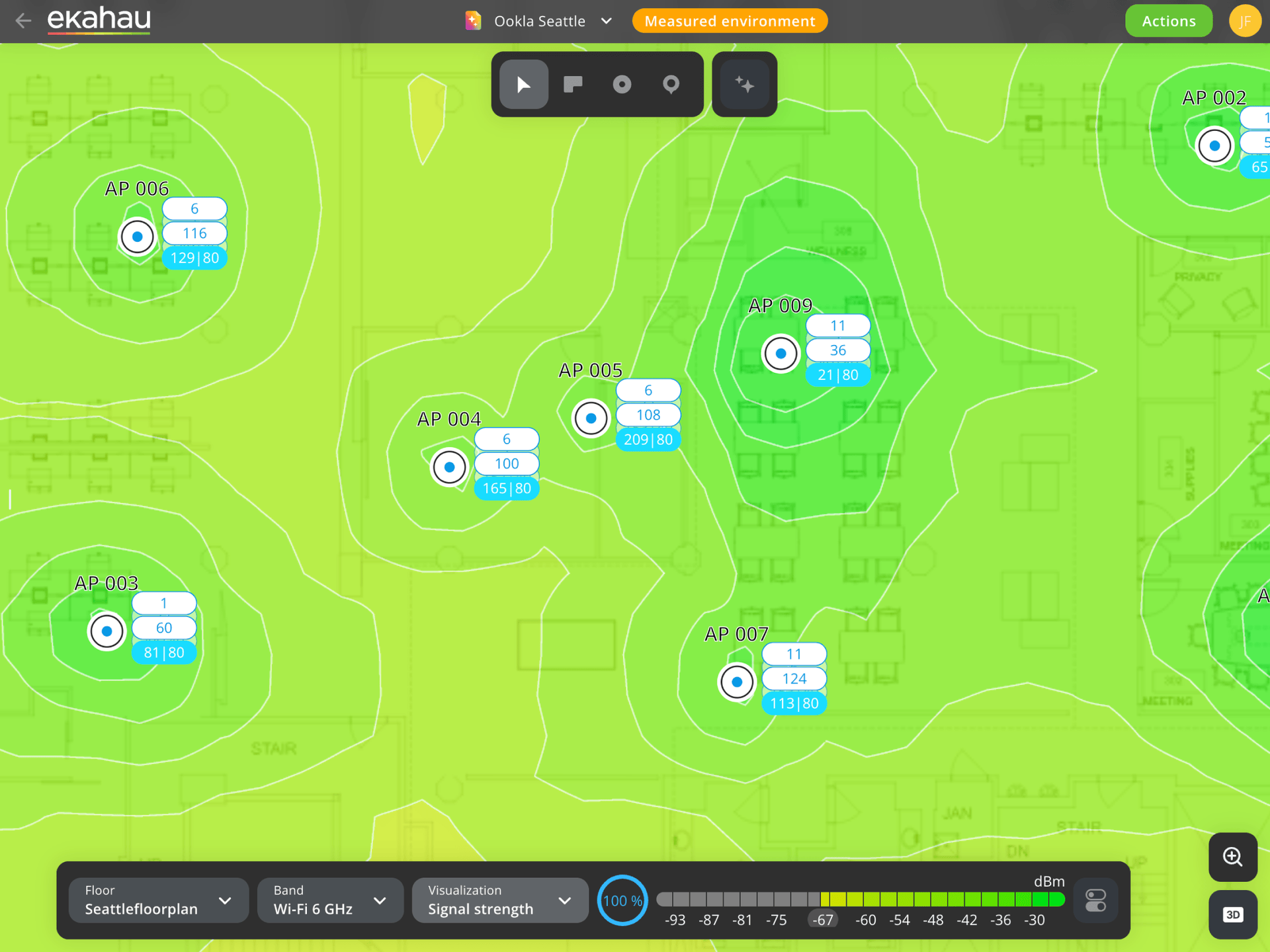
An Inland Empire wireless site survey from WiFi Hotshots starts with Ekahau predictive modeling and closes with post-install validation heatmaps — every engagement a fixed-fee SOW, not hourly billing.
We cover the full IE from Valencia dispatch on an approximate 60-minute drive to Ontario and Rancho Cucamonga: tilt-up distribution centers across Ontario, Fontana, Jurupa Valley, Moreno Valley, and Perris, clinical floors at Loma Linda University Medical Center, Kaiser Fontana, Kaiser Riverside, and Riverside Community Hospital, the 1,900-acre UC Riverside R1 research campus, Cal State San Bernardino and California Baptist University in Riverside, and K-12 districts including Corona-Norco Unified’s 53,000-plus students. See the enterprise wireless services overview, the full enterprise network services portfolio, our engineering credentials and certifications, or send us your floor plans to start a scope call.
Why Inland Empire Wireless Survey Projects Fail Without an RF Baseline
Inland Empire building stock is not generic. The IE logistics corridor along I-10, I-15, CA-60, and I-215 carries roughly 583 million sq ft of warehouse inventory — Amazon ONT9 in Ontario alone occupies approximately 4.1–4.5 million sq ft as the largest Amazon fulfillment footprint in the country, and Amazon ONT8 and ONT2 add further million-plus-sq-ft nodes along the same I-15 spine. The dominant wall assembly is tilt-up concrete, poured on-site and lifted into place with embedded lift-insert hardware.
Tilt-up concrete panels typically measure 6–9 inches thick with embedded #5 or #6 rebar grids for seismic performance and edge-welded steel plates at panel joints. The attenuation profile at 5 GHz is substantially higher per panel than modern predictive RF models tuned to drywall-and-stud stock assume.
Interior steel racking at 40-plus-foot heights in Amazon, Target, Walmart, Prologis, and Goodman facilities creates aisle shadow zones that no flat-floor predictive model can resolve — the racking metal, product SKU mix (bottled liquids versus dry goods versus dense-packed electronics), and pallet loading change the aisle RF environment dynamically as inventory turns. Clinical campuses like Loma Linda University Medical Center (approximately 1,000 beds, Level 1 trauma) mix steel-framed acute-care towers with older medical-office wings where as-built drawings are decades out of date.
Deploying APs without a measured RF baseline means your channel plan is built on assumptions, not data. When a Zebra TC-series scanner drops association mid-aisle in a 1.4 million sq ft Fontana distribution center or a Spectralink handset holds to a ‑82 dBm AP three rooms deep inside a Loma Linda clinical floor, the root cause is always the same: the pre-deployment work was skipped or compressed.
An enterprise Inland Empire wireless site survey is not optional for complex environments — it is the engineering step that separates a network that works from one that generates tickets. The design target for a general enterprise data environment is a minimum ‑67 dBm RSSI at cell edge with at least 25 dB SNR. For voice-grade networks — Vocera Smartbadge, Spectralink, Ascom — those targets hold, and you add a 15–20% cell overlap requirement at the ‑67 dBm boundary to support fast BSS transition under 802.11r.
For Zebra scanner deployments in distribution centers, the accepted weaker-AP scan trigger is ‑65 dBm per Cisco/Zebra voice-deployment best practice, which pulls the design target a few dB tighter across warehouse aisles. None of those thresholds can be confirmed by looking at a floor plan. They require measurement.
Ekahau Predictive Survey Methodology: Floor Plan Ingestion to AP Placement Map
Every WFHS Inland Empire wireless site survey engagement begins in Ekahau AI Pro, the design and analysis module within the Ekahau Connect platform. The workflow starts with floor plan import at measured scale — either CAD-exported PDF or a photographed as-built drawing re-scaled to a known distance. Wall types are assigned material attenuation values: glass, drywall, CMU, poured concrete, concrete with rebar, and tilt-up concrete each carry different dB-per-meter loss figures.
For the tilt-up concrete panels that dominate IE distribution-center construction from Ontario through Perris, the model requires a tilt-up concrete attenuation assignment, not a generic concrete value, because the embedded rebar grid and edge-welded steel plates at panel joints add measurable additional loss at 5 GHz and above — per NISTIR 6055 (NIST, 1997), reinforced concrete exhibits approximately 30 dB attenuation at 2.4 GHz and higher attenuation at 5 GHz across the 0.5–8.0 GHz range tested. For steel racking at 40-plus-foot heights, aisle-by-aisle attenuation is captured during the AP-on-a-Stick validation pass and fed back into the predictive model as measured ground truth.
Once the floor plan is calibrated, the predictive engine runs AP placement simulations against the design requirement profile — coverage at ‑67 dBm RSSI (or ‑65 dBm for Zebra scanner aisles), channel plan, and secondary-AP overlap for 802.11k neighbor list population. The output is an AP count per floor with placement coordinates and a draft bill of materials.
For Inland Empire deployments, predictive design typically covers 1,200–2,000 sq ft per AP on 5 GHz and 6 GHz radios in open-plan office environments, and 4,000–8,000 sq ft per AP in high-bay distribution-center aisles with directional antennas. High-density spaces — UCR lecture halls seating 200-plus, Loma Linda clinical patient floors, Corona-Norco and San Bernardino City classrooms at 1 AP per room — require tighter placement intervals driven by client count and MOS score targets rather than coverage radius alone.
Predictive survey is accurate for standard construction. On atypical IE materials — tilt-up concrete with embedded rebar, steel racking at 40-plus-foot heights, pre-engineered metal building (PEMB) shells, cold-storage insulated panel walls, lead-lined imaging suites at Loma Linda and Kaiser Fontana — the predictive model flags uncertainty zones that require an AP-on-a-Stick validation pass before hardware procurement.
- AP count per floor with X/Y placement coordinates exportable to AutoCAD or PDF overlay
- Channel plan: 2.4 GHz channels 1/6/11 for coverage; 5 GHz 20/40/80 MHz assignments per zone with UNII-1 (36–48) + UNII-3 (149–165) prioritized near March ARB to avoid TDWR-proximate DFS sub-bands; 6 GHz LPI channel selection for Wi-Fi 6E and Wi-Fi 7 APs (indoor LPI class, no AFC required per FCC Part 15 Subpart E)
- Per-band heatmap exports showing RSSI, SNR, secondary coverage (802.11k), and co-channel interference overlay
AP-on-a-Stick Validation for Inland Empire Venues: Logistics, Healthcare, and Higher Ed
AP-on-a-Stick (APoS) methodology mounts a production-model AP on a telescopic pole at the intended deployment height — typically 12–18 ft for ceiling-tile office environments, 25–45 ft for high-bay distribution-center rack-top or truss-mount conditions. The Ekahau Sidekick 2 attaches to the survey laptop via USB-C and runs four tri-band radios scanning 2.4, 5, and 6 GHz simultaneously at up to 50 sweeps per second across the full 2,400–7,125 MHz range.
The surveyor walks the floor while the Sidekick 2’s nine custom 3D antennas record passive RF measurements at every point — RSSI, SNR, noise floor, and co-channel interference — across every visible AP. That measurement data overwrites the predictive model where they differ, producing a hybrid design that combines simulation efficiency with field accuracy.
Inland Empire venues that mandate APoS rather than predictive-only include any facility where drawings do not reflect reality. Tilt-up distribution centers in Ontario, Fontana, Jurupa Valley, Moreno Valley, and Perris have 40-plus-ft ceilings with steel racking that creates shadow zones invisible to a flat-floor predictive model — Amazon ONT9 at approximately 4.1–4.5 million sq ft and Target, Walmart, Prologis, and Goodman facilities in the same size class require aisle-by-aisle passive capture because pallet loading and SKU mix change the aisle RF environment over the operating week.
Clinical campuses at Loma Linda University Medical Center, Kaiser Fontana, Kaiser Riverside, and Riverside Community Hospital carry infection-control constraints on above-ceiling access that require cable routing to be confirmed before the first AP is mounted; lead-lined imaging suites boundary as RF-opaque zones on the heat map.
UC Riverside’s 1,900-acre R1 research campus and Cal State San Bernardino combine 200-plus-seat lecture halls with 1980s–2000s academic stock where stack zones, atrium-courtyard buildings, and laboratory equipment mixes need seat-by-seat density confirmation that a flat-floor predictive model cannot resolve.
K-12 districts across Riverside, San Bernardino City, Corona-Norco, Fontana, and Chino Valley use CMU-block exterior walls and central-corridor layouts that require room-by-room passive validation to confirm that a hallway-only AP plan holds signal at the back of a 30-seat classroom — it rarely does. Across every one of those archetypes, the Inland Empire wireless site survey deliverable is built from measured data, not assumed-material attenuation. These institutions are referenced as venue archetypes, not as claimed engagements.
- High-bay logistics: aisle-by-aisle attenuation capture through steel racking; directional antenna modeling for above-rack coverage zones in Ontario, Fontana, and Perris tilt-up distribution facilities; Zebra scanner ‑65 dBm roaming trigger validated in active testing
- Healthcare: infection-control ceiling-plenum constraints confirmed before cable pathways are routed; lead-lined imaging suite boundaries flagged as RF-opaque zones requiring AP relocation; VoWLAN handset roaming exercised on Spectralink, Vocera, and Ascom form factors with 802.11r fast BSS transition targeting sub-50 ms handoff
- Higher ed and K-12: seat-by-seat density modeling in lecture halls; 1:1 Chromebook density planning per classroom; roaming validation across wing transitions and portable-classroom clusters where hallway APs alone are insufficient at the back of a 30-seat room
Floor plans and device counts are all we need to scope the work — most Inland Empire engagements are quoted on a fixed-fee SOW within three business days of a 30–60 minute scoping call.
Passive and Active Validation: Throughput, Roaming, and Voice MOS Testing
A passive survey records every RF signal in the environment without associating to any SSID. The Ekahau Sidekick 2 listens — it measures what the air contains, not what a connected session reports. Passive surveys are used for pre-deployment environment assessment (neighbor AP inventory, noise floor, DFS radar event detection) and for post-install coverage confirmation. DFS event rates in the IE are not generic.
March Air Reserve Base (KRIV), sited between Riverside, Moreno Valley, and Perris, operates Terminal Doppler Weather Radar (TDWR) in the 5.600–5.650 GHz sub-band inside UNII-2C. Devices enabling channels in that TDWR-proximate sub-band must observe a 10-minute channel availability check (CAC), vacate within 10 seconds of a detected radar event, and a 30-minute non-occupancy period before re-entry, per FCC 15.407.
Near March ARB and the Ontario International (ONT) cargo hub, we prefer UNII-1 (36–48) and UNII-3 (149–165) for primary coverage and validate DFS exposure with field measurement before enabling DFS channels in production. Every Inland Empire site survey near March ARB captures a spectrum analyzer pass across 5.600–5.650 GHz before any TDWR-sub-band channel is considered.
The output is a heatmap for every band, every floor, at every survey waypoint — color-coded RSSI, SNR, and secondary coverage for 802.11k neighbor list validation.
Active validation associates to the production SSID and measures what the client actually experiences. iPerf3 bidirectional throughput runs confirm uplink and downlink capacity against the designed channel width. Roaming tests exercise 802.11r fast BSS transition — the protocol is designed to shorten roaming interruptions, and 50 ms or less is the accepted voice-grade handoff target that 802.11r was built to support. Active testing with a roaming test client confirms whether the deployed controller configuration actually achieves it or whether a misconfigured minimum RSSI threshold is stalling the handoff.
For voice-over-Wi-Fi migration engagements — Cisco Webex Calling, CUCM, or Teams Phone — the active test also captures a MOS (Mean Opinion Score) trace across the full walking route.
A voice-grade network targeting MOS 4.0+ requires the ‑67 dBm RSSI and 25 dB SNR thresholds to hold at cell edge without exception, with noise floor at or below ‑92 dBm per the Cisco Enterprise Mobility 4.1 VoWLAN Design Guide. Any area that drops below those targets appears as a gap in the post-install validation report, with a remediation recommendation tied to a specific AP or configuration change. The independent post-install validation report is the deliverable your operations team, auditor, or next engineer can pick up without context.
Inland Empire Market Constraints: Tilt-Up Warehouse RF, Desert Thermal, and I-10/I-15 Corridor Density
Tilt-Up Distribution-Center RF: Ontario, Fontana, Jurupa Valley, and Perris Logistics Corridor
The Inland Empire is the largest industrial warehouse market on the West Coast, with approximately 583 million sq ft of inventory across the I-10, I-15, CA-60, and I-215 freeway spine. Tilt-up concrete is the dominant wall construction: 6–9 inch panels poured on-site, lifted into place with embedded inserts, and welded at panel joints with steel plates. Inside the building, steel racking rising 40–45 ft from the slab creates aisle shadow zones that change dynamically with SKU mix — bottled liquids and dense-packed electronics attenuate differently than corrugated boxes of apparel — and predictive-only designs routinely underestimate edge-of-aisle coverage.
For Amazon ONT9 in Ontario (approximately 4.1–4.5 million sq ft, the largest Amazon fulfillment footprint in the country), along with Amazon ONT8 and ONT2 in Moreno Valley and Eastvale, Target and Walmart regional distribution centers in Fontana and Moreno Valley, and Prologis and Goodman tilt-up facilities across the I-15 corridor from Corona to Rancho Cucamonga, the survey methodology includes aisle-by-aisle passive capture through racking with production-height APoS, Zebra scanner ‑65 dBm roaming trigger validation in active testing, and channel reuse planning that accounts for dock-door-to-dock-door co-channel interference in back-to-back buildings on the same parcel.
Pre-engineered metal building (PEMB) shells at smaller regional DCs add a further shielding layer that has to be measured rather than simulated. Cold-storage facilities in Mira Loma and Rialto layer insulated panel construction over a steel-frame shell, and the insulation sandwich changes the 5 GHz attenuation profile independently of the exterior panel material. Downstream automation on AGV/AMR robot fleets operating under mezzanine mesh adds a further attenuation layer that the Inland Empire wireless site survey deliverable captures aisle by aisle through the production-height APoS pass.
Desert Thermal Loading and Outdoor AP Selection Across the Coachella Valley and High Desert
The eastern Riverside County market — Palm Springs, Palm Desert, Rancho Mirage, Indian Wells, Indio, Coachella, and Thermal in the Coachella Valley, plus Blythe in the Palo Verde Valley near the Arizona border — runs summer ambient temperatures that routinely exceed 110°F and has recorded 124°F (July 5, 2024) as the Palm Springs all-time high per the NWS San Diego station. Thermal, California recorded 118°F during the August 2019 heat event and holds a 126°F all-time record from July 28, 1995.
The San Bernardino County High Desert sub-region — Victorville, Hesperia, Apple Valley, Adelanto, and Barstow along CA-138 and CA-18 — delivers similar summer extremes with added solar loading on outdoor enclosures. Solar loading typically adds one-third to two-thirds of the thermal burden on an outdoor AP enclosure on top of ambient air temperature, per industry thermal-management guidance. Outdoor AP selection has to account for datasheet Tmax and derating under solar loading.
The Cisco Meraki MR86 outdoor Wi-Fi 6 AP is rated ‑40°C to 55°C (131°F) per the Meraki datasheet — a datasheet Tmax that can be marginal for direct-sun Coachella Valley summer mounting without shade engineering. The Cisco Catalyst CW9163E with built-in GNSS for AFC is rated ‑40°C to 65°C (149°F). The Cisco Catalyst IW9167E Heavy Duty is rated ‑40°C to 70°C (158°F) without solar loading, with cold-start capability at ‑40°C.
The Juniper Mist AP64 is rated ‑40°C to 70°C and IP67. Indoor AP mounting inside data-center or server-room environments is bounded by the ASHRAE TC 9.9 Class A2 allowable envelope of 10°C to 35°C (95°F) — when the survey identifies ambient at or near 35°C in an IE server closet, the deliverable flags it as a thermal risk for the AP itself, not just for the switches.
Santa Ana Wind Events, Clinical Wireless Coexistence, and Casino PCI DSS Segmentation
Santa Ana wind events through the Cajon Pass, San Gorgonio Pass, and Banning Pass regularly push sustained winds above 50 mph with gusts higher during autumn and winter. Outdoor AP antenna alignment on campus perimeter pole mounts and directional sector antennas at tilt-up DC yards has to be mechanically overspec’d and re-validated after significant wind events — a sector antenna that has rotated two degrees off boresight after a Santa Ana can drop the far edge of a parking-lot coverage zone below ‑67 dBm without any change to the WLAN controller.
Clinical wireless coexistence at Loma Linda University Medical Center (approximately 1,000 beds, Level 1 trauma, the #1 hospital in the Riverside–San Bernardino metro per US News), Kaiser Fontana, Kaiser Riverside, and Riverside Community Hospital is governed at the facility level by AAMI TIR18:2010, Guidance on Electromagnetic Compatibility of Medical Devices in Healthcare Facilities, supplemented by AAMI TIR69 (risk management of radio-frequency wireless coexistence) and ANSI C63.27 (wireless coexistence evaluation). WFHS is an RF survey and design practice, not a biomedical engineering firm — we flag coexistence-risk zones and route the finding to the health system’s clinical-engineering or biomed group for device-level clearance.
The IE casino archetype — Pechanga Resort Casino in Temecula, Morongo Casino in Cabazon, San Manuel Casino in Highland, and Agua Caliente properties in Rancho Mirage and Cathedral City — layers a PCI DSS segmentation requirement on top of high-density guest Wi-Fi and back-of-house operational WLAN. Cardholder data environment (CDE) traffic has to live on isolated VLANs with documented segmentation boundaries, and the survey deliverable includes SSID-to-VLAN mapping recommendations for the CDE, back-of-house, guest, and gaming-floor networks. Where the survey identifies below-ceiling pathway gaps or insufficient 802.3bt Type 4 PoE capacity at the switch port, cabling infrastructure review is scoped as a parallel workstream in the same fixed-fee SOW.
Scope an Inland Empire Site Survey.
Send floor plans to sales@wifihotshots.com or call (844) 946-8746 — we return a fixed-fee SOW, not a multi-week proposal cycle.
Survey Deliverables: Heat Maps, BOM, Install Runbook, and Validation Report
At the close of every Inland Empire wireless site survey engagement, the client receives a complete document set — not a summary slide deck. The Ekahau project file (.esx) is included in every handoff so a future engineer can reopen the exact survey, adjust wall materials, or re-run the coverage model without starting from scratch. The platform mix — Cisco Catalyst 9800, Cisco Meraki MR, HPE Aruba Central (AOS-10), Juniper Mist, RUCKUS One, ExtremeCloud IQ — does not change the deliverable set.
Every engagement ships with the same documentation regardless of vendor, because the documentation belongs to the client, not the vendor. Guest and BYOD onboarding — NAC and zero trust policy or cloud-native captive portal, certificate-based authentication — is scoped as a separate design workstream when the survey reveals that the existing SSID architecture does not segment guest traffic. AP refresh and controller migration planning for Cisco Catalyst 9800 (IOS-XE 17.15+ for Wi-Fi 7), Meraki MR, HPE Aruba Central, Juniper Mist, RUCKUS One, and ExtremeCloud IQ is scoped separately where the survey identifies a controller version or capacity constraint.
- Ekahau project file (.esx) plus annotated heatmap exports per band (2.4, 5, 6 GHz) per floor: RSSI, SNR, secondary coverage (802.11k), and co-channel interference overlay
- Vendor-agnostic AP bill of materials with AP model, mount type, antenna selection, PoE class requirement, and cabling length per drop
- Installation runbook: AP placement drawing, cable pathway map, switch port assignment, and VLAN/SSID configuration notes for the contractor
- Post-install validation report: passive heatmap confirmation, iPerf3 throughput results, 802.11r roaming handoff timing, and MOS trace data for voice-grade engagements
- Design warranty: WFHS stands behind the AP count and placement — if coverage gaps appear at post-install validation that were not present in the design, we remediate the design at no additional cost
Inland Empire Wireless Site Survey Coverage and Service Map
WiFi Hotshots dispatches from Valencia (Santa Clarita Valley) to the full Inland Empire on an approximate 60-minute drive time to Ontario and Rancho Cucamonga. The IE service area spans approximately 27,000 sq mi across Riverside County (7,208 sq mi) and San Bernardino County (20,105 sq mi — the largest county by area in the contiguous United States). Coverage runs the western IE logistics spine along I-10 and I-15: Ontario, Rancho Cucamonga, Upland, Montclair, Chino, Chino Hills, Eastvale, Fontana, Rialto, Colton, Bloomington, and Mira Loma.
The central IE corridor continues east along I-10 and CA-60 through San Bernardino, Highland, Loma Linda, Redlands, Yucaipa, Banning, and Beaumont; and along I-215 through Perris, Menifee, Wildomar, Lake Elsinore, and south to Temecula and Murrieta. The Riverside core covers Riverside, Jurupa Valley, Moreno Valley, Corona, and Norco, with Pomona sitting just west across the LA County line for shared-logistics campuses. The Coachella Valley sub-region — Palm Springs, Palm Desert, Rancho Mirage, Indian Wells, La Quinta, Indio, Cathedral City, Desert Hot Springs, and Coachella — is covered on the same dispatch, with Blythe in the Palo Verde Valley treated as an eastern Riverside County outlier.
The High Desert sub-region across CA-138 and CA-18 covers Victorville, Hesperia, Apple Valley, Adelanto, and Barstow.
Greenfield and brownfield Inland Empire wireless site survey engagements include tilt-up distribution centers at Amazon ONT9 Ontario-scale (approximately 4.1–4.5 million sq ft) along with ONT8 and ONT2 across the I-15 corridor, clinical campuses at Loma Linda University Medical Center (approximately 1,000 beds, Level 1 trauma) and the Kaiser Fontana and Kaiser Riverside campuses, higher-education campuses at UC Riverside (1,900-acre R1 research campus), Cal State San Bernardino, California Baptist University, and University of Redlands, and K-12 districts including Corona-Norco Unified (53,000-plus students, largest district in Riverside County and seventh largest in California), Riverside USD, San Bernardino City USD, Fontana USD, and Chino Valley USD.
Tribal casino campuses — Pechanga in Temecula, Morongo in Cabazon, San Manuel in Highland, and Agua Caliente in Rancho Mirage and Cathedral City — are scoped with 24/7 operating-floor access coordination and PCI DSS segmentation requirements built into the survey plan. March Air Reserve Base adjacency in Moreno Valley and Perris drives the TDWR exposure planning covered earlier.
Multi-site Inland Empire engagements are coordinated from a single SOW and a single point of contact. For enterprise clients with facilities across multiple Southern California regions, we dispatch into adjacent service areas without a separate mobilization charge. The geo-family below shows the regional pages where market-specific survey details — LA metro density, SFV media corridor, Antelope Valley aerospace, Orange County coastal constraints, San Diego biotech, Palm Desert desert environment, Bakersfield oil and ag — are documented for each sub-market. National multi-site rollouts operate out of the same fixed-fee delivery model; the IE dispatch is simply one node in a rollout that can include multiple regions on a single program.
Representative Engagement Profiles — Inland Empire Region
Tilt-up distribution-center wireless refresh
The IE logistics archetype maps to a 1–4.5 million sq ft tilt-up distribution center in Ontario, Fontana, Jurupa Valley, Moreno Valley, or Perris with 40-plus-ft ceilings, steel racking at 40–45 ft, and Zebra TC-series or similar handheld scanners driving pick and replenishment workflows across aisles — the scale familiar to anyone who knows Amazon ONT9, ONT8, and ONT2 along the I-15 corridor, Target regional distribution, Walmart regional distribution, Prologis, or Goodman facilities.
Typical scope covers aisle-by-aisle AP-on-a-Stick validation through production racking, Zebra ‑65 dBm roaming trigger confirmation in active testing, channel reuse planning for back-to-back dock doors on the same parcel, directional antenna modeling for above-rack coverage, 802.3bt Type 4 PoE sufficiency at the switch port for Wi-Fi 6E and Wi-Fi 7 radios, and cold-start thermal validation for outdoor yard APs operating in Coachella Valley-adjacent ambient conditions.
Vendor platform is typically Cisco Catalyst 9800 with Wave 2 or Wi-Fi 6 APs refreshed to Wi-Fi 6E or Wi-Fi 7 during the same change window, or HPE Aruba Central (AOS-10) and Juniper Mist deployments where the client’s operations standard drives the vendor. The deliverable set is formatted for review by distribution-center IT and the parent retailer’s corporate network governance. Amazon, Target, Walmart, Prologis, and Goodman are referenced here as venue archetypes, not as claimed engagements.
Regional-hospital clinical-wireless network migration
The IE regional-hospital archetype maps to a 250- to 1,000-licensed-bed acute-care facility with med-surg floors, ED bays, OR suites, ICU, and imaging — the scale familiar to anyone who knows Loma Linda University Medical Center, Kaiser Fontana, Kaiser Riverside, Riverside Community Hospital, or Arrowhead Regional Medical Center in Colton.
Typical scope covers a phased wireless migration with ‑65 dBm cell edges at clinical depth (designing tighter than the Cisco VoWLAN 4.1 ‑67 dBm minimum for clinical handset margin), SNR at or above 25 dB with noise floor at or below ‑92 dBm, VoWLAN-grade roaming for Spectralink, Vocera, and Ascom handsets with 802.11r fast BSS transition targeting sub-50 ms handoff, EHR bedside workflow coverage, RTLS overlay for patient location services on a parallel RF scheme (active-RFID or BLE), and ERRCS ceiling-plenum conflict identification.
AAMI TIR18 EMC guidance with TIR69 and ANSI C63.27 wireless-coexistence considerations apply at the facility level; WFHS flags coexistence-risk zones and routes device-level clearance to the health system’s clinical-engineering group. WPA3-Enterprise or WPA2-Enterprise encryption with HIPAA-aligned network segmentation is a design input, not a compliance claim. Loma Linda, Kaiser, Riverside Community, and Arrowhead are referenced here as venue archetypes, not as claimed engagements.
Higher-education dense-wireless refresh across the IE
The IE higher-education archetype maps to a large public research university on a 1,000-plus-acre campus with 20,000–30,000 enrolled students and a parallel private religious university with 10,000–12,000 students — the scale familiar to anyone who knows UC Riverside (1,900-acre R1 research campus), Cal State San Bernardino, California Baptist University in Riverside, University of Redlands, and Loma Linda University. Typical scope covers lecture halls seating 200-plus, research laboratory buildings with specialized equipment RF profiles, residence halls operating at 1:1 to 1:3 device density (laptop + phone + tablet + gaming console), and outdoor quad and pathway coverage that requires outdoor-rated APs on 6 GHz standard power with AFC coordination.
High-density lecture halls use 20 MHz channels for client-count capacity rather than wider channels for throughput, typically sized to 25 concurrent clients per radio per Meraki high-density best practice. For Cal Poly Pomona in adjacent LA County (Pomona is LA County, not IE), the same methodology applies. The deliverable set is formatted for review by campus IT governance with ADA-accessible AP mounting locations called out as a hard constraint.
Large-scale K-12 district deployment across Riverside and San Bernardino counties
The IE K-12 archetype maps to a large urban or suburban public district with 30,000–55,000 students across 30–70 schools — the scale familiar to anyone who knows Corona-Norco Unified (53,000-plus students, largest in Riverside County and seventh largest in California), Riverside USD, San Bernardino City USD, Moreno Valley USD, Fontana USD, or Chino Valley USD.
Typical scope covers 1 AP per classroom design across CMU-block construction, 1:1 Chromebook density with 25-concurrent-clients-per-radio capacity planning, voice-quality targets for district-standardized Wi-Fi calling, and E-rate FY2026–2030 Category 2 documentation requirements. 2.4 GHz residential saturation from surrounding neighborhoods requires spectrum capture before channel planning; the Ekahau Sidekick 2 spectrum analyzer at 2,400–7,125 MHz resolves neighbor-network interference in a way that a simple site survey scanner cannot. The K-12 campus wireless design methodology covers the full survey and E-rate documentation workflow. Corona-Norco, Riverside, San Bernardino City, Moreno Valley, Fontana, and Chino Valley districts are referenced here as venue archetypes, not as claimed engagements.
Inland Empire Wireless Site Survey FAQs
How long does an Inland Empire enterprise wireless site survey take?
Timeline depends on scope. A single-floor commercial space or small clinical wing with complete as-built drawings can be predictively modeled and quoted within three business days of the scoping call. An AP-on-a-Stick field validation for that same floor takes one to two days on-site.
Multi-building campus engagements — UC Riverside- or Cal State San Bernardino-scale higher ed, Loma Linda- or Kaiser-scale clinical campuses, 1.4 million sq ft Fontana or 4.5 million sq ft Ontario tilt-up distribution centers, or Corona-Norco-scale multi-school rollouts — typically run two to four weeks from floor plan receipt to final deliverable.
Every engagement is scoped and quoted as a fixed-fee SOW before work begins.
The approximate 60-minute Valencia-to-Ontario dispatch means mobilization is predictable, and the timeline, scope, and deliverables are defined in writing.
We do not bill hourly against an open-ended estimate.
On an Inland Empire site survey, are warehouse and distribution-center surveys different from office surveys in the IE?
Fundamentally different. A tilt-up concrete distribution center with 40-plus-ft ceilings and 40–45 ft steel racking is closer to a near-Faraday environment than an office; aisle shadow zones, SKU-mix attenuation variability, and crane-bridge obstruction change the RF environment dynamically as inventory turns.
Zebra scanner fleets drive a tighter ‑65 dBm weaker-AP roaming trigger per Cisco/Zebra voice-deployment best practice rather than the ‑67 dBm general-enterprise minimum, and the survey methodology requires aisle-by-aisle AP-on-a-Stick passive capture through production racking rather than a perimeter walk.
For Amazon ONT9-scale, Target, Walmart, Prologis, and Goodman facilities across Ontario, Fontana, Jurupa Valley, and Perris, predictive-only design is insufficient.
We produce aisle-granular heat maps, directional antenna placement plans, and channel reuse strategies that account for dock-door-to-dock-door co-channel interference across back-to-back buildings on the same parcel.
On an Inland Empire site survey, how do you design clinical wireless for Loma Linda, Kaiser IE, and Riverside Community Hospital?
Clinical wireless in the IE uses the same RF engineering targets as any voice-grade healthcare environment, with an added design margin for clinical handset reliability.
We design to ‑65 dBm cell edge at clinical depth (tighter than the Cisco Enterprise Mobility 4.1 VoWLAN DG minimum of ‑67 dBm) with SNR at or above 25 dB and noise floor at or below ‑92 dBm. 802.11r fast BSS transition is configured on Cisco Catalyst 9800, HPE Aruba, Juniper Mist, or whichever controller the health system operates, targeting sub-50 ms handoff for Spectralink, Vocera, and Ascom handsets.
Cell overlap is 15–20% at 5 GHz and approximately 20% at 2.4 GHz per the Cisco DG.
AAMI TIR18:2010 EMC guidance applies at the facility level, supplemented by AAMI TIR69 (wireless coexistence risk management) and ANSI C63.27 (wireless coexistence evaluation) for current-generation biomedical devices.
Loma Linda, Kaiser Fontana, Kaiser Riverside, Riverside Community Hospital, and Arrowhead Regional Medical Center in Colton are referenced here as venue archetypes, not as claimed engagements.
Which APs survive Coachella Valley and High Desert summer heat?
Outdoor AP selection in the eastern IE has to account for datasheet Tmax and derating under solar loading — Palm Springs recorded 124°F on July 5, 2024, Thermal recorded 118°F in August 2019 and 126°F all-time in July 1995, and Victorville/Barstow High Desert ambient commonly exceeds 105°F in summer.
The Cisco Meraki MR86 outdoor Wi-Fi 6 AP is rated ‑40°C to 55°C (131°F) per the Meraki datasheet, which can be marginal for direct-sun Coachella Valley summer mounting without shade engineering.
The Cisco Catalyst CW9163E with built-in GNSS for AFC is rated ‑40°C to 65°C (149°F).
The Cisco Catalyst IW9167E Heavy Duty is rated ‑40°C to 70°C (158°F) without solar loading, with cold-start capability at ‑40°C.
The Juniper Mist AP64 is rated ‑40°C to 70°C and IP67.
Solar loading typically adds one-third to two-thirds of the thermal burden on top of ambient.
Indoor mounting in server closets is bounded by ASHRAE TC 9.9 Class A2 at 10°C to 35°C (95°F); if ambient is at or near 35°C in an IE server closet, the AP deployment is a thermal risk that the survey deliverable calls out.
Do you do predictive-only surveys, or is AP-on-a-Stick always required?
Predictive-only is appropriate for a single-floor Class A office with complete, accurate as-built drawings and standard drywall-and-stud construction. For the IE, that describes a minority of environments. Tilt-up distribution centers, pre-engineered metal building shells, cold-storage insulated-panel construction, casino floors with metal-frame ceiling structures, clinical campuses with lead-lined imaging suites, and higher-education laboratory buildings all require an AP-on-a-Stick validation pass before the BOM is finalized.
A predictive survey uses Ekahau AI Pro to model RF propagation through a calibrated floor plan.
An AP-on-a-Stick survey mounts a production-model AP on a telescopic pole at the intended deployment height, and the Ekahau Sidekick 2 captures real measurements (actual RSSI, SNR, and noise floor) as the surveyor walks the floor.
Most WFHS IE engagements include both: predictive for initial design and AP count, AP-on-a-Stick for validation before the BOM is finalized.
How do you handle DFS and March ARB TDWR interference in the IE?
March Air Reserve Base (KRIV) is sited between Riverside, Moreno Valley, and Perris, and operates Terminal Doppler Weather Radar in the 5.600–5.650 GHz sub-band inside UNII-2C. Devices enabling channels in that TDWR-proximate sub-band must observe a 10-minute channel availability check, vacate within 10 seconds of a detected radar event, and a 30-minute non-occupancy period before re-entry, per FCC 15.407.
Standard DFS (UNII-2A channels 52–64 and UNII-2C channels 100–144 outside the TDWR sub-band) requires a 60-second CAC, 10-second vacate, and 30-minute non-occupancy.
Near March ARB, the Ontario International (ONT) cargo hub, and Riverside Municipal Airport, we prefer UNII-1 (channels 36–48) and UNII-3 (channels 149–165) for primary coverage, and validate DFS exposure with field measurement using the Sidekick 2 spectrum analyzer before enabling DFS channels in production.
FCC Enforcement Bureau has taken action against devices that interfere with TDWR, and the consequences of mis-enabling a TDWR-sub-band channel in an IE deployment are both operational (service disruption) and regulatory.
What does an Inland Empire wireless site survey cost?
Every engagement is priced as a fixed-fee SOW — we do not bill hourly and do not publish rack-rate pricing. Scope variables that drive cost: building square footage, number of floors, number of buildings, construction type (standard drywall vs. tilt-up concrete vs. PEMB vs. cold-storage insulated panel vs. casino metal-frame ceiling vs. clinical lead-lined imaging), required survey type (predictive only, AP-on-a-Stick, or combined predictive-plus-validation), aisle count for high-bay distribution centers, and whether post-install validation and a formal validation report are in scope.
We return a written SOW quote within three business days of the scoping call of receiving floor plans and a scope description.
Send floor plans to sales@wifihotshots.com or call (844) 946-8746.
No engagement begins without the client signing off on the fixed-fee price first.
What deliverables do we receive after a WFHS Inland Empire site survey?
Every engagement produces: the Ekahau project file (.esx) for future re-use; annotated heatmap exports per frequency band (2.4, 5, 6 GHz) per floor showing RSSI, SNR, secondary coverage (802.11k), and co-channel interference; a vendor-agnostic AP bill of materials with mount type, antenna, PoE class, and cabling callouts; an installation runbook for the contractor;
channel and power plan accounting for DFS exposure near March ARB and ONT; spectrum analyzer findings from the Sidekick 2 scan across 2,400–7,125 MHz; a remediation list ranked by RF impact; and a post-install validation report with passive heatmap confirmation, iPerf3 throughput results, 802.11r handoff timing, and MOS trace data for voice-grade engagements.
Ekahau AI Pro exports to Word and PDF formats.
The deliverable set is the same regardless of the AP vendor — Cisco, Meraki, HPE Aruba, Juniper Mist, RUCKUS, or Extreme.
The documentation belongs to the client and is formatted for a 10-year shelf life.
Do you cover all of the Inland Empire, or just Riverside and San Bernardino?
All 34 incorporated cities across Riverside and San Bernardino counties, plus unincorporated communities. Riverside County: Riverside, Moreno Valley, Corona, Temecula, Murrieta, Jurupa Valley, Perris, Menifee, Lake Elsinore, Norco, Eastvale, Hemet, Banning, Beaumont. San Bernardino County: San Bernardino, Fontana, Rancho Cucamonga, Ontario, Chino, Chino Hills, Upland, Redlands, Loma Linda, Rialto, Colton, Grand Terrace, Highland, Yucaipa, Montclair. High Desert: Victorville, Apple Valley, Hesperia. Coachella Valley (Riverside County): Palm Desert, Palm Springs.
Unincorporated: Mead Valley, Temescal Valley, Woodcrest, Muscoy, Bloomington, Mentone.
Dispatch from Valencia is 75–90 minutes via I-210 / I-15. We also dispatch into adjacent service areas — LA metro, Santa Clarita, Orange County, San Diego — under the same fixed-fee SOW structure. ONT (Ontario International) and high-desert airport engagements are quoted with airport-access credentialing factored in. Additional IE communities served: Hemet and Grand Terrace.
Does a rooftop AP mast on our Ontario distribution center require FAA notification?
Potentially yes. Any construction or alteration exceeding 200 ft AGL, or penetrating Part 77 imaginary surfaces around Ontario International (KONT), triggers an FAA Form 7460-1 notice under 14 CFR 77.9. Antenna structures 20 ft AGL or less, shielded in congested areas, are exempt.
Our Inland Empire site survey scope includes running the FAA Notice Criteria Tool for any Ontario, Rialto, Fontana, or Rancho Cucamonga rooftop mast over 20 ft AGL, with tool output attached to the deliverable.
That prevents post-install FAA enforcement surprises on Class C / Part 77-adjacent facilities and keeps the obstruction evaluation record clean against AC 70/7460-1M marking and lighting requirements.
Why does WFHS avoid U-NII-2C channels near March Air Reserve Base?
FCC 47 CFR 15.407 DFS rules govern 5.47-5.725 GHz radar detection, and March ARB (KRIV) uses TDWR approaches for southern California. U-NII devices must detect radar at -64 dBm (200 mW to 1 W EIRP systems), complete a 60-second Channel Availability Check before transmitting, cease transmission within 10 seconds of detection, and honor a 30-minute non-occupancy period.
For Inland Empire sites within ~35 km of March ARB (Riverside, Moreno Valley, Perris, Corona, Redlands), our channel plans exclude the TDWR-sensitive UNII-2C subset (120/124/128) by default and validate UNII-2C behavior on the AP-on-a-stick run before production turn-up.
How does WFHS model tilt-up concrete attenuation on Ontario distribution centers?
Ekahau predictive surveys use calibrated floor plans with per-material attenuation values. For Inland Empire tilt-up (typical 6-9 inch reinforced concrete panels on Ontario/Fontana DCs), the predictive model references the NIST NISTIR 6055 concrete measurement dataset — spread-spectrum horn measurements across 0.5-2 GHz and 3-8 GHz ranges. NIST found rebar spacings of 70 mm and 140 mm did not substantially alter shielding vs plain concrete in the tested bands.
Tilt-up panel walls are modeled predictively, then confirmed with live AP-on-a-stick readings because actual attenuation varies with panel thickness, embedded conduit, and moisture.
Cold-storage insulated metal panel walls are modeled separately — their losses materially change cell count.
Does WFHS deploy Arista CloudVision CUE for IE enterprise engagements?
Yes. Arista CV-CUE is one of the cognitive Wi-Fi platforms we support as a vendor-agnostic firm. The Wi-Fi 7 lineup covers C-460/C-460E (4×4 tri-radio with BLE 5.3 IoT and GNSS, up to 11.5/5.76/1.4 Gbps across 6/5/2.4 GHz, 2x 10 Gbps 802.3bt uplinks), C-430 (2×2 tri-band with 2x 5 Gbps 802.3at uplinks), C-400 (2×2 entry with 1x 5 Gbps 802.3at), and O-435/O-435E (outdoor 2×2 802.11be).
Arista is our preferred platform when a client already runs Arista EOS campus LAN, when continuous 6 GHz rogue monitoring is required via a non-duty-cycled radio, or when an outdoor Wi-Fi 7 AP is in scope.
What is the Arista C-460 advantage in a multi-tenant IE office park?
The C-460’s quad 4×4 radios (6/5/2.4 GHz client-serving plus integrated BLE 5.3 IoT and GNSS) plus dual 10 Gbps 802.3bt ports remove the usual duty-cycle trade-off between client service and spectrum awareness. In multi-tenant Chino Hills, Eastvale, or Corona office parks, rogue APs and tenant interference from adjacent suites become continuously visible rather than sampled.
Aggregate throughput reaches 11.5/5.76/1.4 Gbps across 6/5/2.4 GHz.
PoE++ is required for full feature operation; PoE+ runs with reduced functionality. 802.11be 4K-QAM, MLO, and preamble puncturing are supported. CV-CUE surfaces neighbor rogue APs without truck-rolling a spectrum analyzer, shortening MTTR on tenant-reported issues.
Can we use 6 GHz Standard Power (36 dBm EIRP) outdoors on an Ontario DC yard?
Yes, but only at an AFC-registered location using an AFC-capable AP. AFC is mandatory for outdoor 6 GHz Standard Power in the US; indoor Low Power Indoor (LPI, capped at 30 dBm EIRP with 5 dBm/MHz PSD) does not require AFC. Standard Power EIRP ceiling is 36 dBm for both indoor and outdoor with AFC, in UNII-5 (5.925-6.425 GHz) and UNII-7 (6.525-6.875 GHz).
The AP must obtain available frequencies and per-frequency power budget from an AFC system before enabling Standard Power.
Outdoor 6 GHz yard coverage at Ontario, Fontana, Moreno Valley, and Perris DCs is viable with AFC-capable APs (Cisco IW9167E heavy-duty, Arista O-435); pre-install scope confirms which UNII-5/7 channels AFC authorizes at the GPS coordinate.
How does Wi-Fi 7 Multi-Link Operation (MLO) change warehouse AP placement?
MLO lets a single Wi-Fi 7 client use multiple bands simultaneously to the same AP for higher aggregate throughput and lower latency — but it requires WPA3 (mandatory for 11be rates) and coordinated coverage on both bands at every cell, which typically tightens AP spacing vs a Wi-Fi 6 design.
Vendors implement MLMR-STR (multi-radio simultaneous TX/RX) and EMLSR (single-radio time-slicing); MLMR-nSTR is not adopted. 320 MHz channels are available in the US 6 GHz band (three usable); 4K-QAM adds ~20% throughput over 1024-QAM at sufficient SNR.
Warehouse designs need both 5 GHz and 6 GHz coverage to -67 dBm at the cell edge to keep MLO in effect; a plan that only qualifies 5 GHz and assumes 6 GHz follows is one we correct on-site.
What dBm and SNR do Vocera badges need in a Loma Linda or Kaiser patient tower?
Per Vocera’s Infrastructure Guide, badges require -65 dBm minimum RSSI with SNR greater than 25 dB, and should never drop below -75 dBm at the serving AP. Vocera documents 802.11r Fast Transition configuration for compatible infrastructure.
Loma Linda, Kaiser Fontana, and Riverside Community Hospital patient-floor designs target -63 dBm at cell edge (2 dB margin above Vocera’s -65 dBm), SNR greater than or equal to 28 dB, and AP overlap at the -65 dBm boundary to give badges margin for orientation and body-blocking during handoff.
Survey validation walks the floor with a reference voice device and logs RSSI, SNR, and roam timing at every room threshold, feeding directly into our wireless engineering deliverable.
What is the Zebra MC9400 band-steering behavior in a Wi-Fi 6E Ontario DC?
The MC9400 is a Wi-Fi 6E handheld with the SE58 Extended Range Scan Engine rated over 100 ft (30.5 m) scan range with IntelliFocus technology.
Its band-steering behavior prefers 6 GHz where RSSI and channel-utilization conditions are met, so designers must ensure 6 GHz cell edge is equal to or stronger than 5 GHz at the same location.
IE DC scanner fleet designs keep 6 GHz cell edge at -67 dBm or better with 20% overlap, and tune 5 GHz TX power so it does not show higher RSSI than 6 GHz at the same location.
Without that tuning, MC9400s will drift to 5 GHz despite a stated 6 GHz preference, collapsing the capacity benefit of the new band.
Exact per-device RSSI thresholds are confirmed at AP-on-a-stick tuning.
What thermal rating do outdoor APs need in the Coachella Valley and High Desert?
Outdoor APs for Palm Springs, Indio, Thermal, Hesperia, and Victorville deployments need hardened thermal ratings. The Cisco Catalyst IW9167E heavy-duty AP is rated -40°C to +70°C (-40°F to +158°F) with solar loading in still air, with IP67 ingress protection, and supports 6 GHz Standard Power with AFC in UNII-5 and UNII-7.
Coachella Valley and High Desert outdoor AP selection starts at the IW9167E heavy-duty tier or an equivalent hardened SKU from Arista (O-435 outdoor class) or other primary vendors.
Non-hardened indoor-rated APs installed under rooftop solar load will throttle or fail in IE summer conditions; we document enclosure temperature expectations in the deliverable and size for worst-case solar-loaded ambient, not nominal.
Does CARB Rule 2305 (warehouse indirect source) affect our wireless survey scope?
Indirectly. CARB Rule 2305 — the South Coast AQMD Warehouse Indirect Source Rule — drives ZEV adoption and related facility changes at warehouses greater than 100,000 sq ft across Los Angeles, Orange, Riverside, and San Bernardino counties. The rule uses a points-based Warehouse Actions and Investments to Reduce Emissions (WAIRE) menu including ZEV trucks, chargers, on-site solar, and filtration.
Those changes introduce new wireless requirements that should be scoped into the survey.
IE warehouse survey scope now routinely includes yard coverage for ZEV truck telematics and asset tracking, rooftop-solar RF coexistence check (inverter noise at 2.4 GHz), and management-network coverage for EV charger stations. A 2026 IE DC survey that ignores the WAIRE-driven footprint is incomplete.
How does WFHS handle NFPA 1225 / ERCS in-building radio coverage during a wireless survey?
Where the AHJ requires it, we coordinate the Wi-Fi site survey with a parallel NFPA 1225 emergency responder communications (ERCS) grid test. NFPA 1225 Chapter 18 (2022) requires 95% floor-area coverage in general areas and 99% in critical areas (fire command centers, fire pump rooms, exit stairs, elevator lobbies, standpipe cabinets), with a minimum -95 dBm signal and DAQ 3.0 audio delivery.
Each floor is divided into approximately 20 equal test areas for two-way verification.
Many IE AHJs (Riverside, San Bernardino, Ontario, Corona) tie Certificate of Occupancy to an ERCS grid-test pass, so we coordinate Wi-Fi antenna locations with DAS headend and donor-antenna siting so the two systems do not compete for roof-edge or elevator-lobby mounting points.
Does HIPAA require WPA3 for clinical wireless at Loma Linda or Kaiser?
HIPAA does not name a specific cipher. 45 CFR 164.312(e)(1) requires transmission security for ePHI, and 164.312(e)(2)(i) integrity controls plus 164.312(e)(2)(ii) encryption are addressable implementation specifications. HHS guidance expects covered entities to implement encryption to protect electronic transmissions of PHI where reasonable and appropriate.
That means WPA2-Enterprise minimum, WPA3-Enterprise preferred, for any clinical SSID — and WPA3 becomes hard-required when the clinical fleet moves to Wi-Fi 7, because 11be mandates WPA3 and Enhanced Open for MLO.
IE hospital clinical SSIDs default to WPA3-Enterprise with a parallel WPA2-transition SSID only for legacy biomed devices.
Once a hospital moves to Wi-Fi 7, the transition SSID must be retired or isolated from MLO clients.
How does WFHS validate voice roaming for a Spectralink Versity fleet?
We run an active roaming survey carrying a Spectralink-class reference handset (or the client’s own Versity device) while recording RSSI, SNR, and re-association timing at every roam boundary. IEEE 802.11r-2008 Fast BSS Transition targets sub-50 ms handoffs — Cisco’s deployment guidance states the edge network should introduce no more than ~50 ms delay into a voice call, and roams faster than ~100 ms are generally imperceptible.
Vocera documents 802.11r FT configuration for supported infrastructure.
Voice validation in IE hospitals logs handoff latency on every roam boundary with an active iPerf stream running; the deliverable includes a ≥99% handoff under 50 ms target and a handoff-latency heat map, with any transition boundary failing called out for channel or AP-position remediation.
What does an AP-on-a-Stick (APoS) survey deliver that a predictive-only survey misses?
Predictive surveys use modeled attenuation from a calibrated floor plan; APoS captures measured attenuation under real building conditions — actual rebar density, real steel racking placement, real ceiling obstructions, real door positions.
A tripod-mounted AP is raised to design-ceiling height and actively surveyed with a capture tool while the reference AP radiates, logging live RSSI, SNR, and MCS decisions at known locations.
APoS is essentially mandatory for warehouses with racking over 25 ft, hospitals with lead-lined or OR rooms, cold-storage IMP walls, multi-tenant fit-outs with unknown wall materials, and tilt-up panel variations.
Our wireless site survey deliverable publishes the delta between predictive and APoS measurements so the client sees where the model needed correction — referencing NIST NISTIR 6055 material loss data as the predictive baseline.
Can CBRS or private LTE replace Wi-Fi for an Ontario DC yard?
CBRS complements rather than replaces Wi-Fi. The FCC allocated 150 MHz at 3550-3700 MHz for shared flexible use under GN Docket 12-354 and 15-319, establishing the three-tier framework (incumbent, PAL, GAA), with the October 2018 R&O (17-258) finalizing PAL auction parameters. CBRS is strong for outdoor yard, multi-building backhaul, and autonomous-vehicle telematics; Wi-Fi remains the indoor scanner, voice, and office standard.
Ontario DC and multi-building campus designs often use CBRS private LTE for ZEV yard truck telematics, container and asset tracking, and inter-building coverage that would otherwise require outdoor Wi-Fi bridges.
Wi-Fi 6E/7 stays indoor for scanners, voice handsets, and office clients — scoping addresses both in the same survey.
How do California Title 24 PoE lighting controls interact with AP PoE budgets?
Title 24 Part 6 networked lighting control requirements — administered by the California Energy Commission and overseen by the Building Standards Commission — frequently route PoE-powered luminaires onto the same switches that power APs. That creates a shared PoE-budget problem.
Wi-Fi 7 demand is steep: the Arista C-460 requires PoE++ (802.3bt) for full feature operation and runs with reduced functionality on PoE+; HPE Aruba AP-755 accepts 48 Vdc nominal with 802.3af/at/bt class 3 or higher.
IE office surveys include a switch PoE budget analysis when lighting drivers share infrastructure with APs.
Typical Ontario, Chino Hills, and Eastvale TI jobs need 802.3bt-capable switches on any uplink carrying a Wi-Fi 7 AP, with headroom sized for simultaneous AP and lighting-driver load at the chassis level.
What ASHRAE thermal class applies to Wi-Fi controllers in an IE IDF closet without HVAC?
Enterprise switches and WLCs in IDF closets typically fall under ASHRAE TC 9.9 Class A2 allowable: 10-35°C (50-95°F) dry-bulb, with 80% RH ceiling and ESD mitigation at the lower humidity bound. The recommended envelope across A-classes is 18-27°C (64.4-80.6°F) at server inlet for long-term reliability. IE IDFs without split HVAC routinely reach 100°F (38°C) in summer, above the Class A2 allowable 35°C ceiling.
We document IDF ambient temperature at production conditions during the survey and recommend either mini-split install or controller relocation to an MDF before cutover.
Applies equally to Cisco C9800-CL/L/M, HPE Aruba 9200/9240 gateways, and Arista CV-CUE VM hosts — any of which will throttle or fail out of spec.
Do I need a new survey after a tenant improvement in my Ontario warehouse?
Yes, whenever the tenant improvement changes wall layout, rack configuration, ceiling height, cold-storage footprint, or HVAC layout. Predictive models are only as accurate as the floor plan fed into them; any of those changes invalidates the prior RF model and makes prior AP placement assumptions suspect. NIST NISTIR 6055 documents how construction materials attenuate RF across 0.5-2 GHz and 3-8 GHz — wall swaps materially change the propagation model.
Racking geometry also drives aisle-shadow behavior: selective vs narrow-aisle vs drive-in rack layouts create different signal voids even at the same AP locations.
We offer a scoped TI re-survey for pre-existing IE warehouse clients: delta-only floor plan input, updated rack measurements, re-run predictive model, and spot APoS validation in the modified zones.
How does 802.11ax OFDMA improve warehouse scanner performance vs 802.11ac?
OFDMA lets the AP allocate small Resource Units (RUs) to many scanners simultaneously in a single transmission instead of round-robin channel access per client. Per IEEE 802.11-2020 and Wi-Fi Alliance Wi-Fi 6 specifications, multiple-user access via RU allocation within a single transmit opportunity materially improves efficiency for small-packet, frequent-poll scanner traffic patterns typical in IE distribution centers. Wi-Fi 7 / 802.11be carries OFDMA forward alongside multi-link operation and upgraded MU-MIMO.
IE DC scanner fleet designs (Zebra MC9400, Honeywell CK65, Datalogic Skorpio X5, and equivalents) benefit from Wi-Fi 6 and 6E OFDMA on small-frame scan traffic.
Validation uses an active iPerf stream plus passive capture at peak-shift load to confirm per-scanner latency targets are met in the production traffic pattern, not just a quiet-floor test.
WiFi Hotshots is a minority-owned, engineer-led wireless services firm with 25 years of enterprise networking leadership. Our Inland Empire wireless site survey practice runs on Ekahau Connect with Ekahau ECSE certified survey engineers and a multi-CCIE bench — every engagement a fixed-fee SOW, vendor-agnostic, and documented to a standard your operations team can reference for the life of the infrastructure. For warehouse and distribution center survey work across the IE logistics corridor or clinical wireless environments at Loma Linda, Kaiser, and Riverside Community scale, the methodology and deliverable set are identical: measure first, design to data, validate before the invoice closes.
Inland Empire Site Survey — Further Reading
Adjacent disciplines that intersect with an Inland Empire wireless site survey in any modern enterprise build — warehouse and 3PL hyperscale across Amazon, FedEx, UPS, Maersk, Skechers, and Niagara facilities along the I-15 logistics spine through Rancho Cucamonga and Fontana; Riverside healthcare campuses (Loma Linda University Medical Center, Riverside University Health, Kaiser Fontana, Kaiser Riverside); the UCR and Cal State San Bernardino higher-education footprint; San Bernardino-County tribal-gaming compact properties (Yaamava’ Resort & Casino / San Manuel, Morongo Casino Resort & Spa); and Riverside / San Bernardino City / Corona-Norco / Fontana / Chino Valley K-12 districts. Each link below describes how the destination service line interacts specifically with the Inland Empire wireless survey workflow — the high-bay 40-50 ft AP mounting and narrow-aisle 802.11r forklift fast-roaming work, the distribution-center voice-pick (Honeywell Vocollect) deployments, NIGC MICS + GLI-26 v2.0 tribal-gaming compact compliance, HIPAA-aligned clinical voice for Loma Linda-scale and Riverside-University-scale environments, and the PCI Wireless Guideline backhaul that the K-12 1:1 estate rides on — not the destination service line in the abstract.
- Enterprise wireless engineering — the discipline practice the IE site survey deliverable feeds into: high-bay 40-50 ft AP mounting at Amazon ONT9, FedEx, UPS, Maersk, Skechers, and Niagara tilt-up distribution centers along the I-15 logistics spine, narrow-aisle 802.11r fast BSS transition per IEEE 802.11-2024 (incorporating 802.11r-2008) so Honeywell Vocollect voice-pick headsets and Zebra forklift-mount scanner roams stay under 50 ms across racking transitions, and the per-AP IEEE 802.3bt Type 4 (90 W) PoE budget per IEEE 802.3bt-2018 sized for tri-radio Wi-Fi 7 over the Sidekick-2-validated above-rack truss-mount profile.
- Campus LAN refresh — the wired access fabric that powers and trunks the IE survey’s AP plan: Catalyst 9300X-48HX / HPE Aruba CX 6300M / Juniper EX4400-48MP / Arista 720XP downlinks delivering IEEE 802.3bt Type 4 PoE budget under sustained warehouse-and-clinical-and-campus-Wi-Fi load, multigig 2.5 / 5 / 10GBASE-T per IEEE 802.3-2022 sized for tri-radio Wi-Fi 7 backhaul, IEEE 802.11k/v neighbor-list and BSS-transition assistance per IEEE 802.11k-2008 and IEEE 802.11v-2011 propagated from the campus-LAN distribution layer through to the AP edge, and dynamic VLAN assignment from ISE / ClearPass / Mist landing on the AP-trunk port post-authentication for clinical-staff vs guest vs back-of-house segmentation at Loma Linda, Riverside University, UCR, and CSUSB.
- Data center fabric design — the spine-leaf core that anchors the regional IE controller and management-plane stack: on-prem Catalyst 9800 / HPE Aruba 9240 + MCR / RUCKUS SmartZone 144 / Juniper Mist Edge controller-pair anchoring on the EVPN-VXLAN overlay per IETF RFC 7348 and IETF RFC 7432 that NIGC MICS per 25 CFR § 543.20 and GLI-26 v2.0 tribal-gaming compact posture favors at Yaamava’ / San Manuel and Morongo over cloud-only management, plus the cluster placement for AAA / RADIUS / NAC services that authenticate IE survey deliverable APs and the hosting plane for Loma Linda / Riverside University on-prem CUCM / Webex Calling Local Gateway clusters whose voice traffic the IE wireless survey validates against MOS targets.
- SD-WAN fabric design and migration — the multi-site IE transport that connects the I-15 logistics-corridor distribution-center fleet (Rancho Cucamonga, Fontana, Ontario, Jurupa Valley, Moreno Valley, Perris) and the Riverside / San Bernardino healthcare and higher-education footprint to corporate hub and SASE PoP: per-app SLA-class probing for the Wi-Fi-edge voice (Webex Calling, Vocera, Spectralink, Honeywell Vocollect), DSCP-marking preservation across MPLS-replacement internet underlays per IETF RFC 4594, IPsec / IKEv2 underlay integrity per IETF RFC 7296 for tribal-gaming compact-tracked sites whose NIGC MICS audit favors validated underlay encryption, and BFD-tuned dual-carrier transport per IETF RFC 5880 across the I-10 / I-15 / CA-60 / I-215 freeway spine.
- Network security architecture — the policy fabric that consumes the IE survey’s SSID / VLAN plan: WPA3-Enterprise per Wi-Fi Alliance WPA3 specification with EAP-TLS supplicant certificates per IETF RFC 5216, NAC posture and dynamic VLAN landing per ISE / ClearPass / Mist Access Assurance for Loma Linda HIPAA-segmented clinical traffic, NIGC MICS + GLI-26 v2.0 tribal-gaming compact segmentation for Yaamava’ / San Manuel and Morongo gaming-floor SSIDs versus back-of-house and guest, and PCI DSS 4.0.1 Requirement 11.2.1 quarterly rogue-AP detection across distribution-center back-of-house IT estate and tribal-gaming retail concession SSIDs per PCI SSC document library.
- Structured cabling — the Cat 6A horizontal cable plant the IE survey’s AP placements terminate on: per ANSI/TIA-568.2-E Cat 6A category certification at the 100 m channel length running through warehouse-truss and high-bay industrial pathways, per ANSI/TIA-1005-A industrial-premises wiring practice for the manufacturing-and-warehouse environment that distinguishes Cucamonga-corridor distribution-center cabling from commercial-office cabling, per ANSI/TIA TSB-184-A bundled-cable thermal de-rating that protects 802.3bt Type 4 PoE budgets in dense AP-and-camera-and-IoT bundles common across Loma Linda Health and tribal-gaming campuses, and per ANSI/TIA-606-D labeling and administration so every IE survey-deliverable AP placement maps cleanly to a named station outlet in the closeout package.
- Unified communications migrations — the voice and video traffic the IE wireless survey validates: voice-grade RSSI at −65 dBm cell edge with 25 dB SNR for Spectralink, Vocera, Ascom, and Honeywell Vocollect handsets at Loma Linda University Medical Center / Riverside University Health / Kaiser clinical floors and across distribution-center voice-pick deployments, sub-50 ms 802.11r fast BSS transition handoff for Webex Calling / CUCM / Teams Phone clients across UCR / CSUSB lecture-and-dorm transitions, MOS budget per ITU-T G.107 E-model with one-way latency under ITU-T G.114 150 ms across the regional SD-WAN fabric, and E911 dispatchable-location compliance for tribal-gaming-floor and clinical-campus address-precision requirements.
- Independent validation testing — post-deployment verification of the IE wireless site survey’s design against the as-installed reality: NetAlly AirCheck G3 Pro per-AP RSSI / SNR / data-rate confirmation across 2.4, 5, and 6 GHz at every survey waypoint, IEEE 802.11k/v / 802.11r roaming-handoff timing measured against the sub-50 ms voice-grade target, MOS / R-factor capture per ITU-T P.800.1, FCC 6 GHz LPI / Standard Power channel-availability behavior verified against AFC authorization at the GPS coordinate per FCC OET DA-24-166A1, and PCI DSS 4.0.1 Requirement 11.2.1 quarterly rogue-AP scan validation at every CDE location across distribution-center back-of-house IT and tribal-gaming retail concessions — deliverable is a vendor-neutral acceptance report rather than a screenshot of a controller dashboard or a distribution-center barcode-scanner uptime metric.
Inland Empire Site Survey Engineering References
Technical claims on this page are cited against the following primary sources. Coverage targets (‑67 dBm RSSI, 25 dB SNR, noise floor at or below ‑92 dBm) are per the Cisco Enterprise Mobility 4.1 VoWLAN Design Guide, Cisco Meraki Site Survey Guidance, and Meraki RF Design Best Practices.
Zebra scanner ‑65 dBm roaming trigger per Cisco/Zebra Voice Deployment Best Practices. 802.11r fast BSS transition per Cisco 802.11r BSS Fast Transition Deployment Guide. Ekahau Sidekick 2 hardware specifications per Ekahau Sidekick 2 product page. Wi-Fi 7 certification per Wi-Fi Alliance CERTIFIED 7 Resources; Wi-Fi 6 and 6E per Wi-Fi Alliance CERTIFIED 6 Resources. FCC 6 GHz device class definitions (LPI, Standard Power, VLP) per FCC Part 15 Subpart E and FCC DOC-407628A1. FCC AFC system operational date (February 23, 2024) per FCC OET DA-24-166A1. FCC DFS rules (CAC, vacate, non-occupancy) per FCC 15.407.
TDWR frequency allocation and enforcement per FCC U-NII and TDWR Interference Enforcement. Reinforced concrete attenuation per NISTIR 6055 (NIST, 1997). ASHRAE TC 9.9 Class A2 allowable envelope per ASHRAE TC 9.9 reference. Outdoor AP thermal specifications per Meraki MR86 Datasheet, Cisco Catalyst CW9163E Data Sheet, Cisco Catalyst IW9167E Heavy Duty Data Sheet, and Juniper AP64 Access Point Datasheet.
AAMI TIR18:2010 EMC guidance per ANSI webstore, with AAMI TIR69 and ANSI C63.27 as current wireless-coexistence supplements. ERRCS applicability thresholds and coverage percentages (99% critical / 90% remaining) per LA County fire code referencing NFPA 72 and NFPA 1221. CWNP CWNA (currently CWNA-109, released September 2023) per CWNP CWNA certification page; CWNP CWDP design methodology per CWNP CWDP certification page. NetAlly AirCheck G3 Pro for independent post-install validation across 2.4, 5, and 6 GHz.